The Life of Tyrannosaurus rex: From Tiny Hatchling to Giant Predator
Around 66 million years ago, one of the most formidable predators in Earth's history roamed western North America. Yet even Tyrannosaurus rex began life small, vulnerable, and far removed from the gigantic animal we recognize today.
DinoNavi editorial · 2026-10-24T14:17:34.631563+00:00
The Life of Tyrannosaurus rex: From Tiny Hatchling to Giant Predator
Around 66 million years ago, one of the most formidable predators in Earth's history roamed western North America. Yet even Tyrannosaurus rex began life small, vulnerable, and far removed from the gigantic animal we recognize today. With its immense skull, powerful jaws, robust teeth, and muscular hind limbs, Tyrannosaurus rex remains one of the most recognizable dinosaurs ever discovered. But an adult T. rex was not simply a larger version of its younger self. As it grew, its skull became deeper, its teeth changed shape, its body became much heavier, and its role in the ecosystem may have changed dramatically. For decades, researchers believed that T. rex underwent an extraordinary teenage growth spurt and reached skeletal maturity at roughly 20 years of age. Research published in 2026, however, suggests a potentially longer and more gradual growth history. How did a young tyrannosaur survive? What did it eat? When did it reach maturity? And how long could it live? The answers are written, imperfectly but remarkably, in fossilized bone. EDITORIAL NOTE: This article distinguishes direct fossil evidence, scientific interpretation, and imaginative reconstruction.
Zoom then drag. Part names at150%, lines and descriptions at250%.
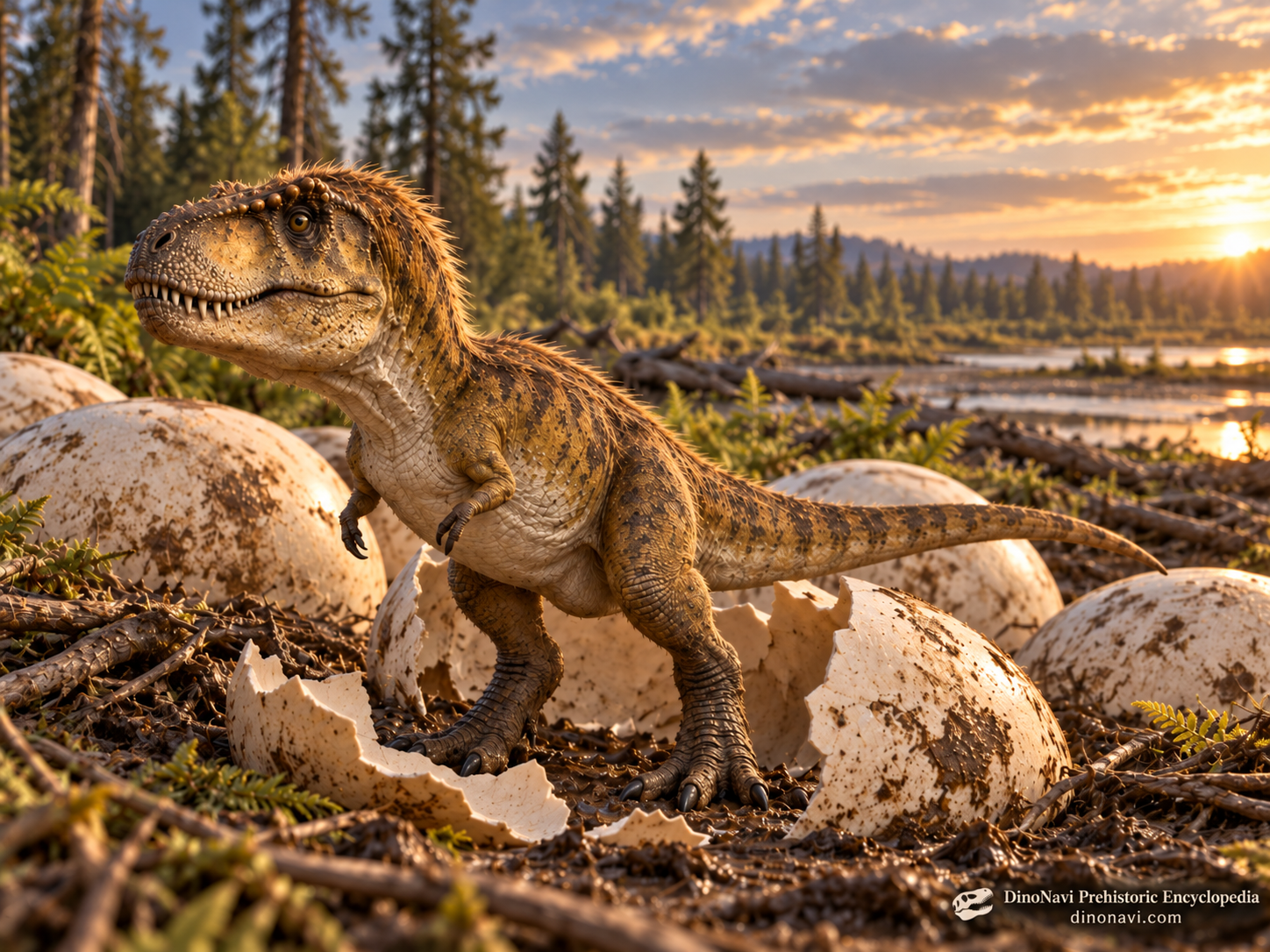
Animal beside eggshells (imagined reconstruction; proportions unverified).
DinoNavi Prehistoric Encyclopedia · dinonavi.com
Reconstruction / infographic · Sekimosoft LLC / DinoNavi · AI-generated / code-authored explanatory images
AI reconstruction. Appearance, behavior and scenes are distinct from directly established fossil evidence.
1. The Beginning of a Giant
A small life in a dangerous world
Imagine the floodplains of western North America near the end of the Cretaceous Period. Rivers wind through wooded landscapes. Hadrosaurs feed among the vegetation, smaller animals move through the undergrowth, and enormous dinosaurs dominate the surrounding terrain. Somewhere in this world, a young Tyrannosaurus begins its life. It cannot yet overpower the massive herbivores that an adult might attack. It must survive in a world of competition, environmental hazards, and uncertain access to food. This opening scene is an imaginative reconstruction, not the recorded history of a particular animal. Nevertheless, it reflects a central biological reality: giant predators must begin their lives at a much smaller size.
What do we know about T. rex eggs?
Tyrannosaurus almost certainly reproduced by laying eggs, as other dinosaurs and living birds do. However, the precise nesting behavior of T. rex remains poorly understood. We cannot confidently reconstruct the number of eggs in a clutch, the arrangement of a nest, the duration of incubation, or the extent of parental care from definitive T. rex nesting evidence. Studies of very young tyrannosaur fossils, including small bones and teeth, offer increasingly valuable clues about the beginning of life. Yet much about the earliest stages remains unknown.
Zoom then drag. Part names at150%, lines and descriptions at250%.
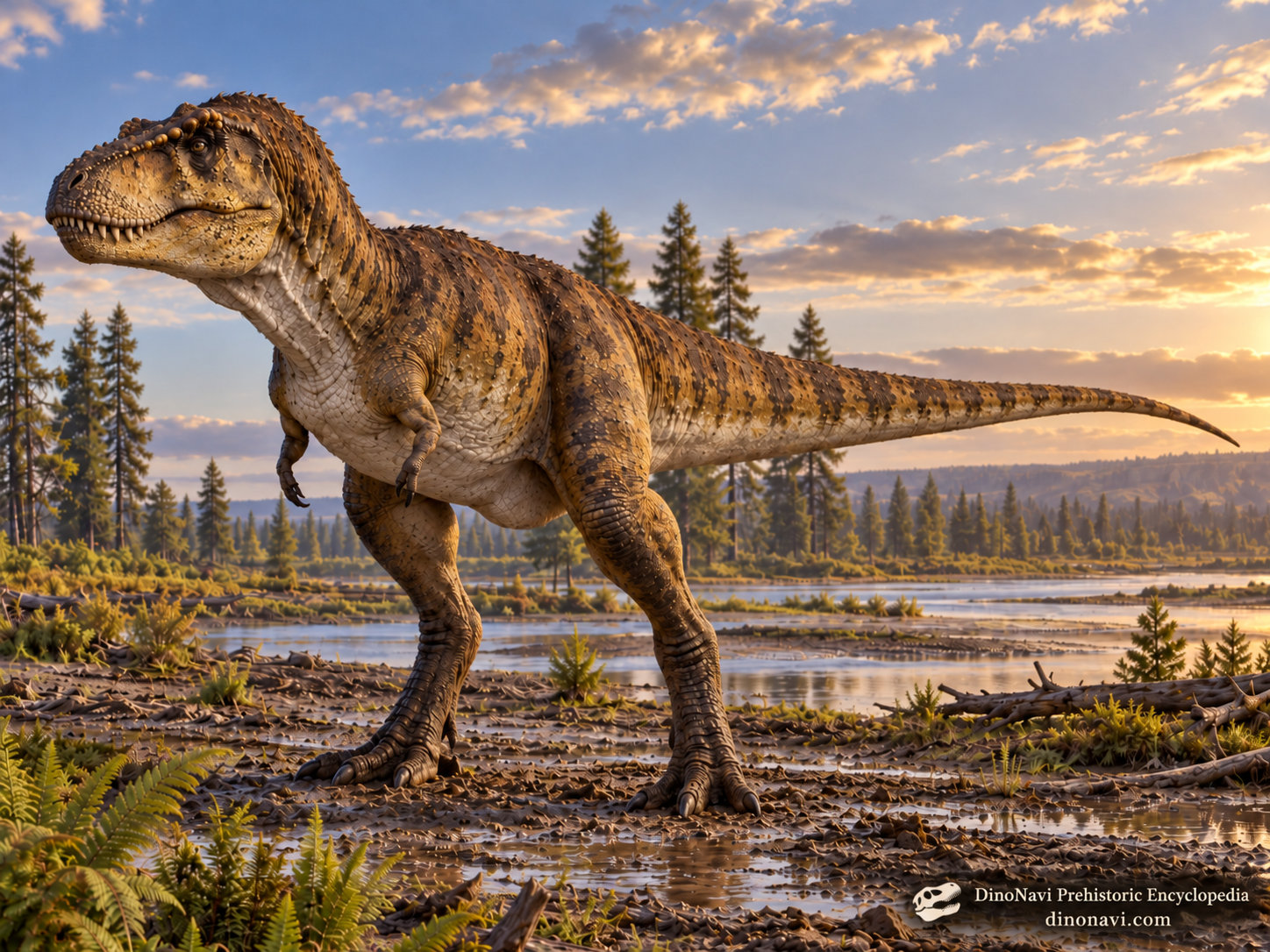
Side-view reconstruction; age unconfirmed.
DinoNavi Prehistoric Encyclopedia · dinonavi.com
Reconstruction / infographic · Sekimosoft LLC / DinoNavi · AI-generated / code-authored explanatory images
AI reconstruction. Appearance, behavior and scenes are distinct from directly established fossil evidence.
Did baby tyrannosaurs have feathers?
Some artistic reconstructions show young tyrannosaurs with a light covering of filament-like feathers. Feather-like structures are known from certain relatives of T. rex, making such reconstructions biologically plausible. However, the exact body covering of a hatchling T. rex has not been established. Bell and colleagues (2017) reported scaly skin impressions from large-bodied tyrannosaurids, including T. rex. Evidence from preserved patches does not establish the covering of the entire body or of juveniles. A partially feathered hatchling can therefore be shown as a plausible interpretation, not a confirmed appearance.
Zoom then drag. Part names at150%, lines and descriptions at250%.
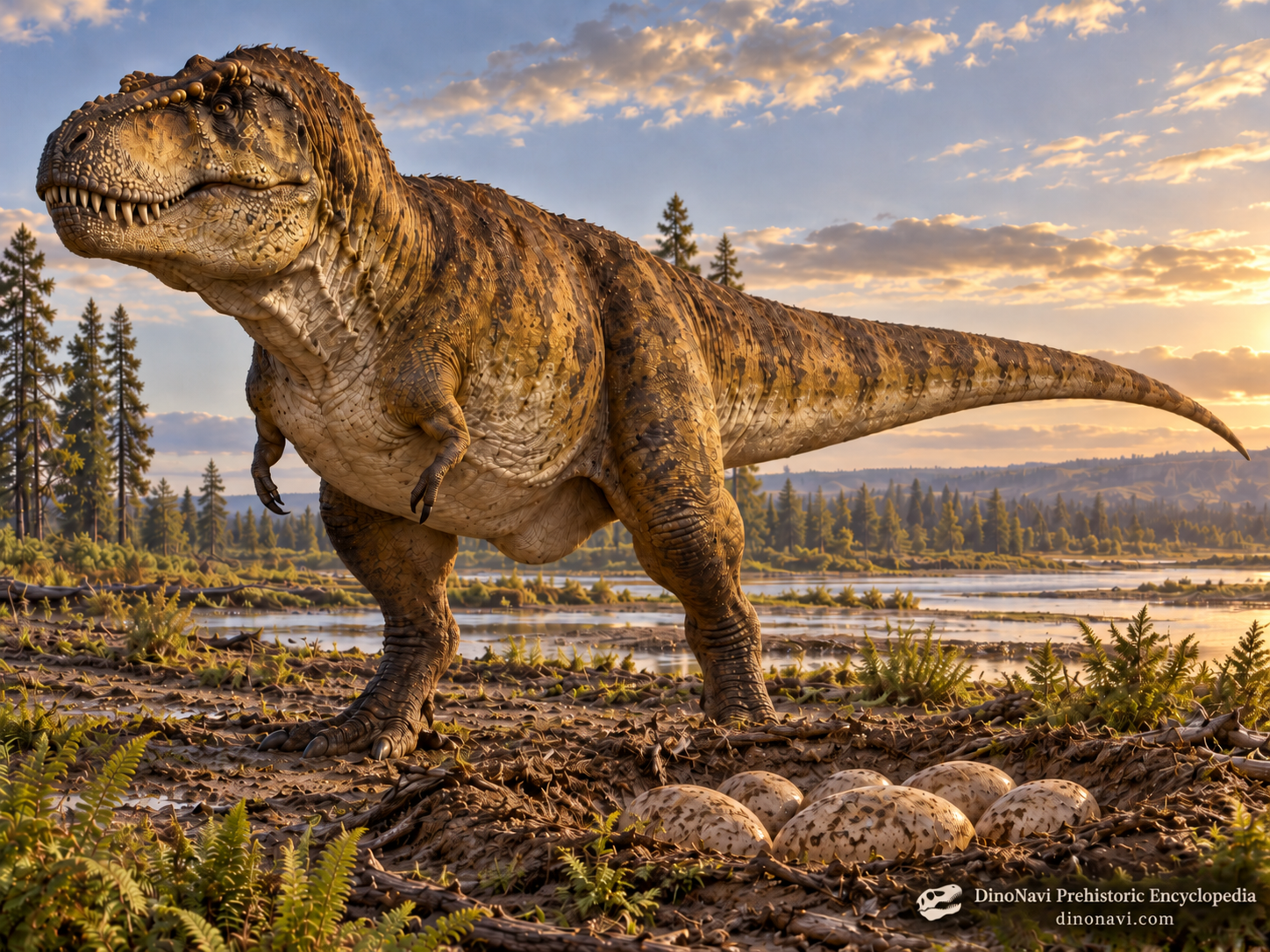
Reconstructed head and torso.
DinoNavi Prehistoric Encyclopedia · dinonavi.com
Reconstruction / infographic · Sekimosoft LLC / DinoNavi · AI-generated / code-authored explanatory images
AI reconstruction. Appearance, behavior and scenes are distinct from directly established fossil evidence.
2. Juveniles: A Different Kind of Predator
Not miniature adults
Young tyrannosaurids were relatively slender animals, with more lightly built skulls, longer-looking hind limbs, and narrower teeth than mature individuals. Adult T. rex, in contrast, developed a remarkably deep and robust skull suited to powerful biting. These differences were not simply matters of scale. Growth transformed the animal's proportions, functional anatomy, and probably its ecological role.
Zoom then drag. Part names at150%, lines and descriptions at250%.
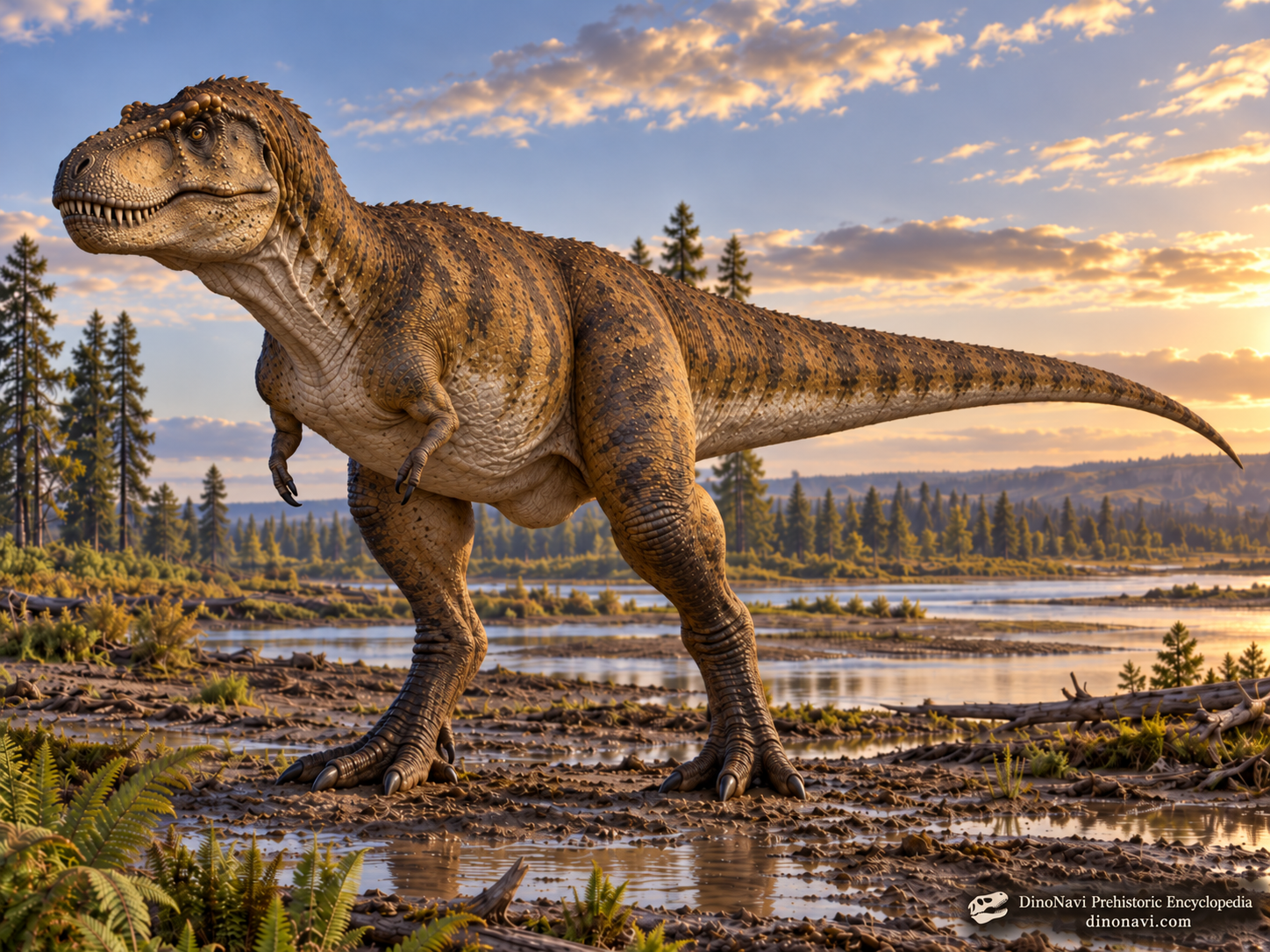
Waterside reconstruction; age unconfirmed.
DinoNavi Prehistoric Encyclopedia · dinonavi.com
Reconstruction / infographic · Sekimosoft LLC / DinoNavi · AI-generated / code-authored explanatory images
AI reconstruction. Appearance, behavior and scenes are distinct from directly established fossil evidence.
Different prey at different ages
An adult tyrannosaur possessed the equipment needed to attack large herbivorous dinosaurs. A young individual, with its narrower skull and blade-like teeth, was probably better suited to smaller prey. Important evidence comes from a juvenile Gorgosaurus, another member of Tyrannosauridae. Fossilized stomach contents show that this young predator had consumed juvenile dinosaurs. Although this is not direct evidence from T. rex, it supports the hypothesis that young and adult tyrannosaurids occupied different feeding niches.
Speed versus power
The slender hind limbs of young tyrannosaurs have inspired reconstructions of agile hunters pursuing smaller animals. Meanwhile, mature T. rex possessed enormous mass and a skull capable of powerful bites. Scientists cannot directly measure the running speeds of extinct dinosaurs, and absolute speed estimates remain model-dependent. What can be said is that the physical capabilities of Tyrannosaurus changed substantially during its life.
Zoom then drag. Part names at150%, lines and descriptions at250%.
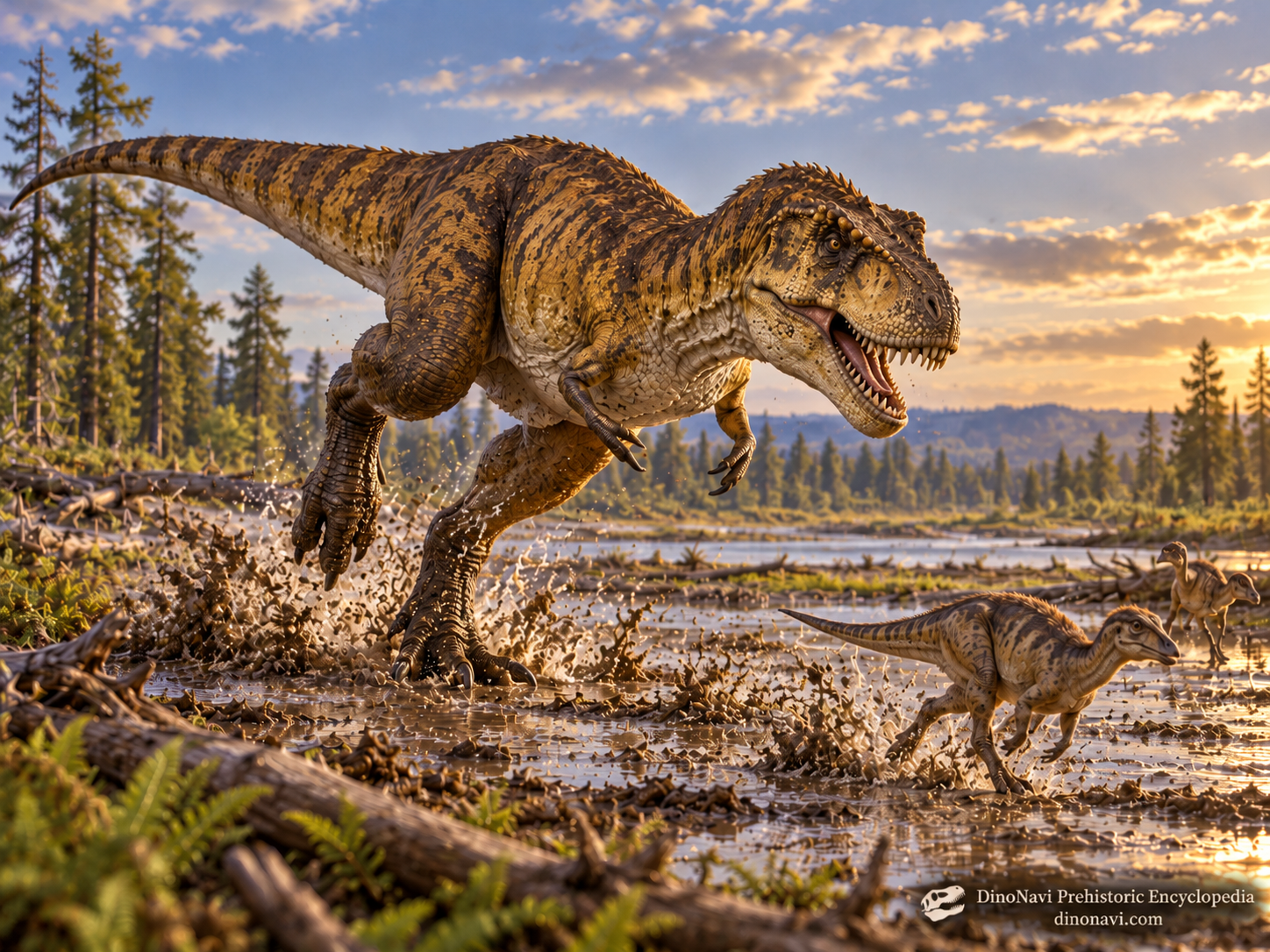
Imagined pursuit of a smaller animal.
DinoNavi Prehistoric Encyclopedia · dinonavi.com
Reconstruction / infographic · Sekimosoft LLC / DinoNavi · AI-generated / code-authored explanatory images
AI reconstruction. Appearance, behavior and scenes are distinct from directly established fossil evidence.
3. The Growth Rings Inside Fossil Bones
How scientists estimate a dinosaur's age
Fossil bones sometimes preserve microscopic growth marks. By preparing thin sections and examining their internal structure, paleontologists can estimate how much an animal grew and how old it may have been when it died. Some growth marks function much like annual rings in trees. The method is powerful but imperfect. Internal bone remodeling can erase older marks, and some subtle structures are difficult to identify. Age estimates therefore depend on both the fossils and the methods used to interpret them.
The classic rapid-growth model
A major study published in Nature in 2004 suggested that T. rex experienced exceptionally rapid growth. Its estimated peak growth rate reached approximately 2.1 kilograms per day, and skeletal maturity was modeled at roughly two decades. This did not mean every individual gained exactly that amount of weight each day. The figure represented a modeled maximum rate derived from fossil specimens of different ages and sizes. For many years, the study shaped the familiar image of Tyrannosaurus as a dinosaur that grew extraordinarily fast during adolescence.
The 2026 reassessment
In 2026, researchers published an expanded bone histology study involving femora and tibiae from 17 individuals assigned to a Tyrannosaurus rex species complex. They examined additional growth marks and compared alternative statistical models. Their best-supported model suggested lower peak growth rates and a much longer period of growth than earlier interpretations. Under that model, body size approached its asymptotic maximum at approximately 35–40 years. This is not proof that every T. rex lived for 40 years, nor does it establish when sexual maturity occurred. The findings depend on how growth marks are interpreted, which specimens are included, and how their taxonomic identities are assessed. Nevertheless, the study raises an important possibility: the life history of Tyrannosaurus may have been considerably longer and more complex than previously assumed.
When was a T. rex an adult?
There is no single answer unless the meaning of adulthood is defined. Sexual maturity, skeletal maturity, and the near-completion of body growth do not necessarily occur at the same age. The traditional estimate of approximately 20 years remains historically important, but newer research suggests the end of growth may have occurred later. Neither "every T. rex was fully mature at 20" nor "no T. rex could reproduce until 40" is justified by the available evidence.
Zoom then drag. Part names at150%, lines and descriptions at250%.
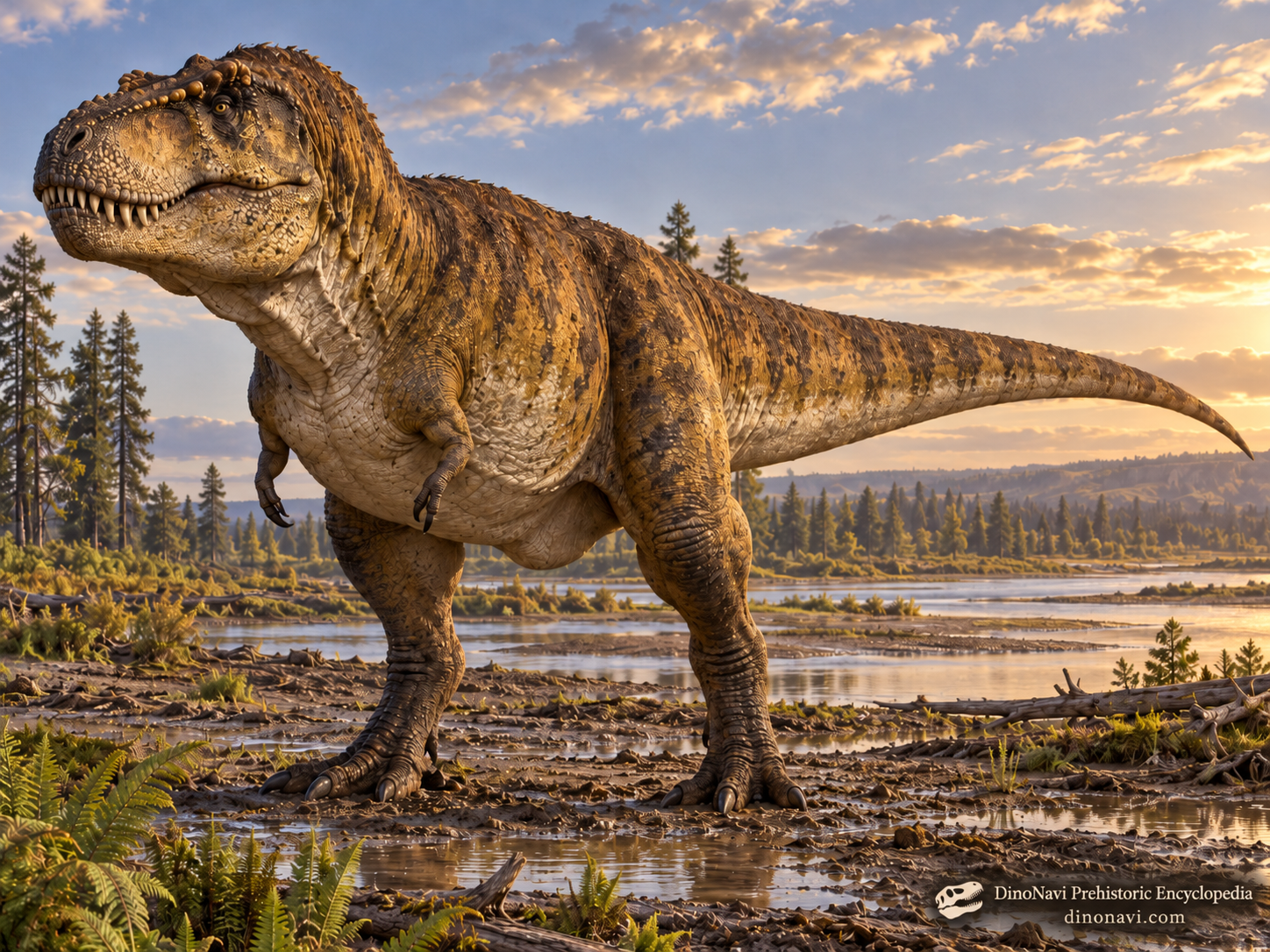
Standing reconstruction; age unconfirmed.
DinoNavi Prehistoric Encyclopedia · dinonavi.com
Reconstruction / infographic · Sekimosoft LLC / DinoNavi · AI-generated / code-authored explanatory images
AI reconstruction. Appearance, behavior and scenes are distinct from directly established fossil evidence.
4. Becoming an Apex Predator
A skull built for extraordinary force
As Tyrannosaurus grew, its skull became more massive and robust. Its teeth also changed, becoming relatively thicker and better suited to resisting powerful forces. These transformations allowed large individuals to exploit food resources that smaller juveniles probably could not handle in the same way. The shift from a relatively lightly built juvenile to a heavily built adult was one of the defining events of its life.
Zoom then drag. Part names at150%, lines and descriptions at250%.
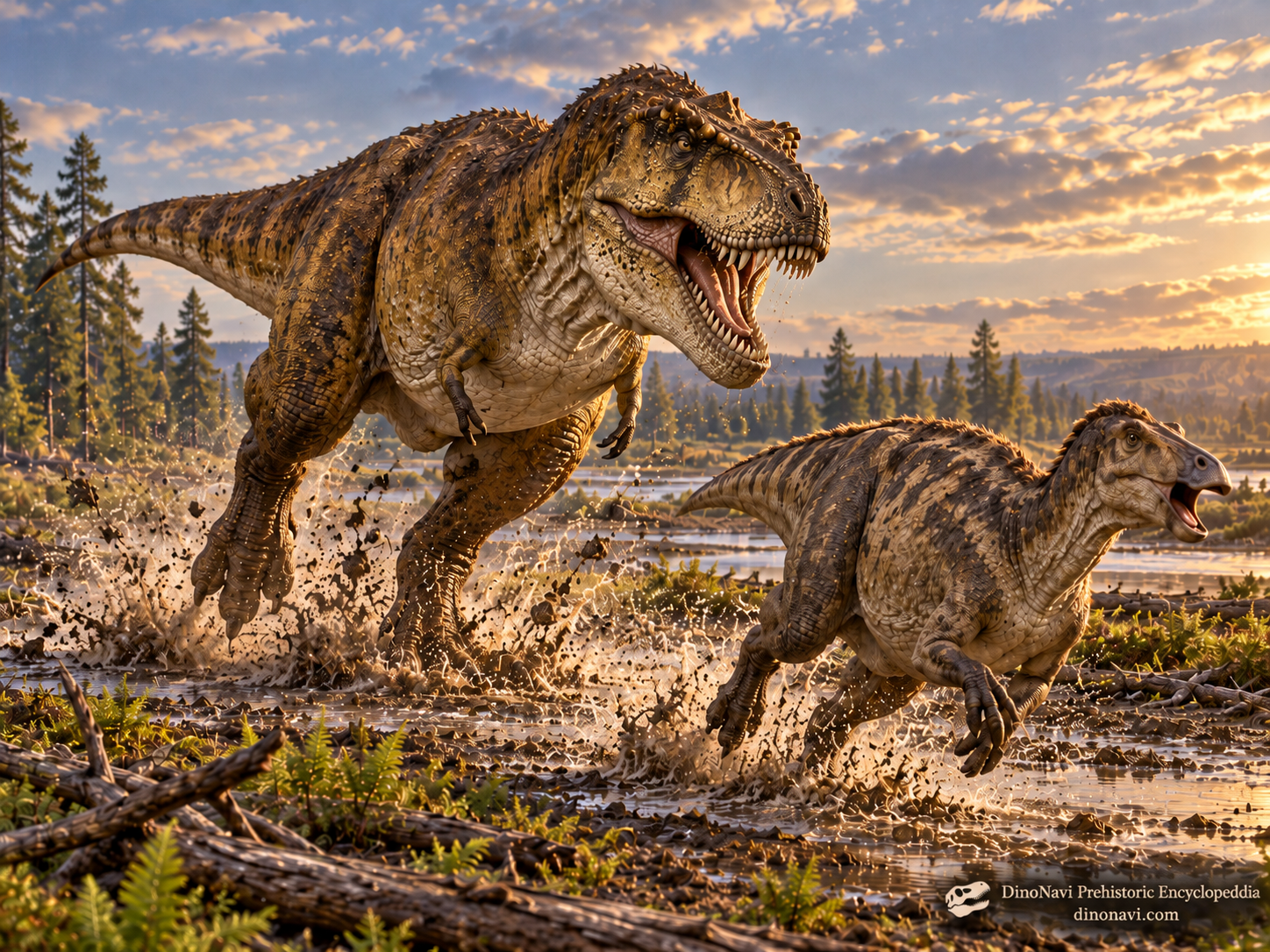
An animal in pursuit (imagined reconstruction; age unconfirmed).
DinoNavi Prehistoric Encyclopedia · dinonavi.com
Reconstruction / infographic · Sekimosoft LLC / DinoNavi · AI-generated / code-authored explanatory images
AI reconstruction. Appearance, behavior and scenes are distinct from directly established fossil evidence.
Evidence of hunting
For many years, researchers debated whether T. rex primarily hunted living animals or scavenged carcasses. A remarkable fossil provided direct evidence of predatory behavior. A hadrosaur tail vertebra contained an embedded tyrannosaur tooth surrounded by healed bone. The injury had occurred while the prey was alive, and the animal survived long enough for healing to begin. This shows that Tyrannosaurus attacked living prey. It does not mean that T. rex never scavenged. Like many large carnivores, it may have exploited both living prey and carcasses.
Encounters with Triceratops
Tyrannosaurus and Triceratops lived in the same broad environment at the end of the Cretaceous. Encounters between them were therefore possible. But the dramatic battles depicted in films and illustrations should not automatically be interpreted as typical behavior. A predator's decisions would have depended on prey size, vulnerability, available opportunities, and the risk of injury. A reconstructed confrontation between these dinosaurs is a scientifically informed scene, not a documented individual event.
Zoom then drag. Part names at150%, lines and descriptions at250%.
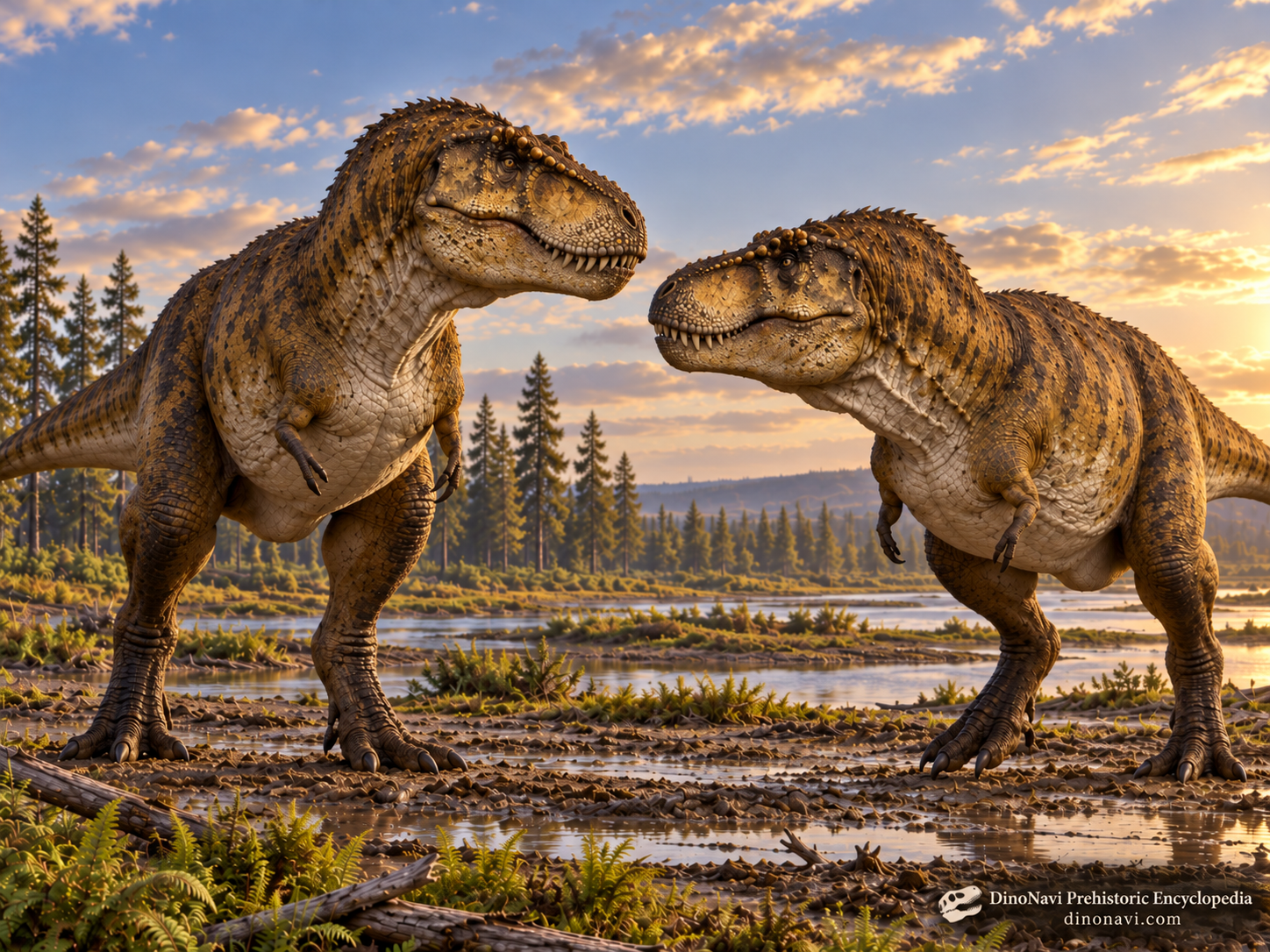
Two animals facing each other (imagined reconstruction; behavior unconfirmed).
DinoNavi Prehistoric Encyclopedia · dinonavi.com
Reconstruction / infographic · Sekimosoft LLC / DinoNavi · AI-generated / code-authored explanatory images
AI reconstruction. Appearance, behavior and scenes are distinct from directly established fossil evidence.
5. Reproduction and the Mystery of Parenting
Evidence from reproductive bone tissue
In 2005, researchers reported tissue inside a T. rex hind-limb bone that resembled medullary bone in living birds. In birds, this specialized tissue is associated with calcium storage during egg production. The discovery suggested that the dinosaur may have been a reproductively active female. It also provided an important opportunity to compare reproductive biology in non-avian dinosaurs and birds. However, the finding does not reveal the detailed nesting behavior or parental strategies of Tyrannosaurus.
Did T. rex care for its young?
An adult guarding a nest or remaining beside hatchlings is an emotionally compelling image. Some other dinosaur groups provide evidence of nesting and parental behavior. Yet those findings cannot simply be transferred to T. rex. Direct evidence for its parental care remains insufficient to confidently reconstruct whether adults guarded eggs, fed hatchlings, or maintained long-term family groups. Such scenes can be depicted as speculative reconstructions, with appropriate labeling.
Zoom then drag. Part names at150%, lines and descriptions at250%.
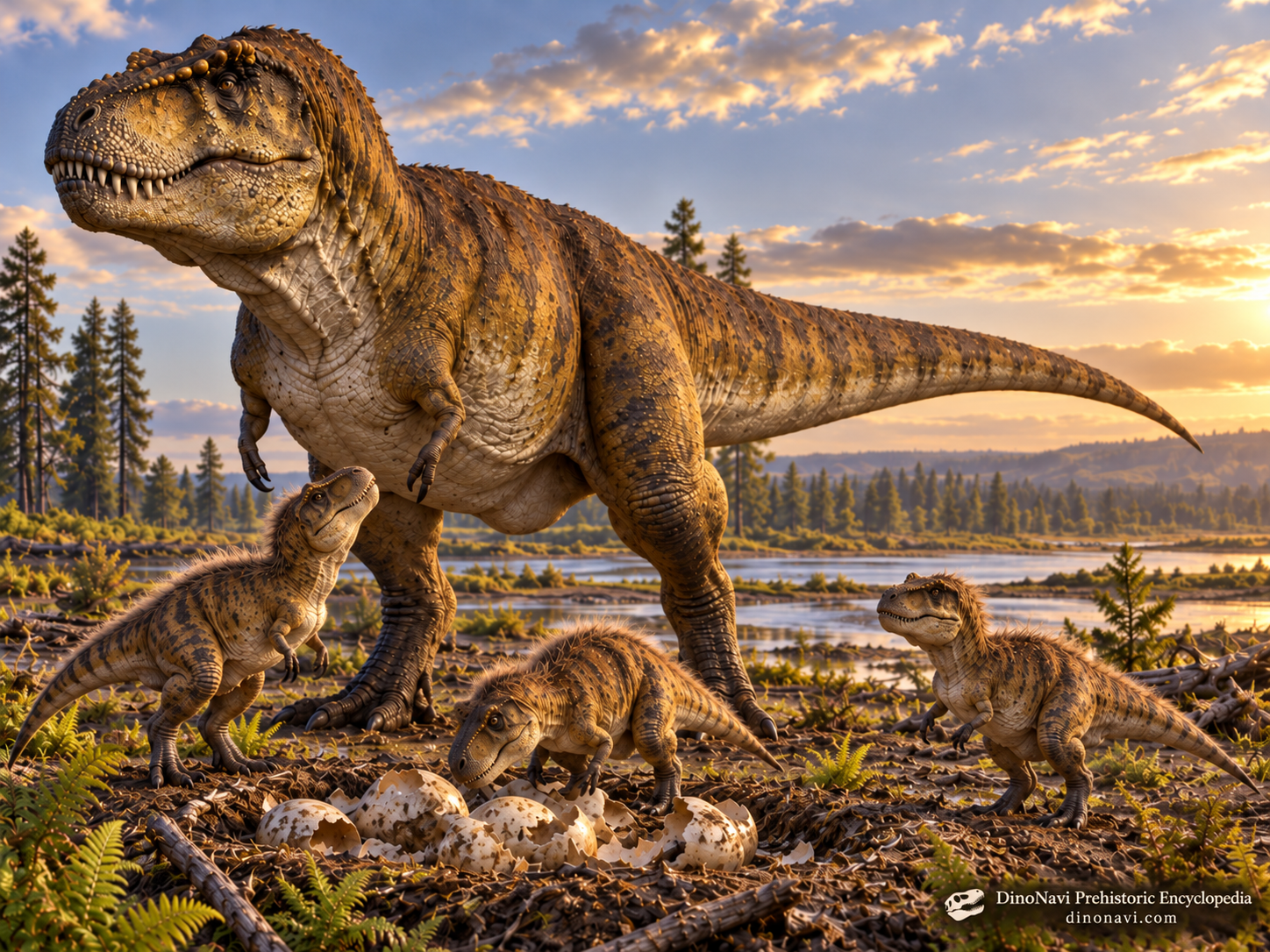
An imagined group of different sizes; kinship unconfirmed.
DinoNavi Prehistoric Encyclopedia · dinonavi.com
Reconstruction / infographic · Sekimosoft LLC / DinoNavi · AI-generated / code-authored explanatory images
AI reconstruction. Appearance, behavior and scenes are distinct from directly established fossil evidence.
6. Injury, Aging, and Death
Even giants were vulnerable
Enormous size did not make Tyrannosaurus invincible. An individual could experience injury and other difficulties during its life. The Field Museum describes abnormalities and injuries preserved in SUE’s bones. Its 2022 report describes bone repair around holes in the lower jaw, indicating that the animal survived for some time after the damage. The cause of those holes remains unresolved; infection should not be presented as an established diagnosis. The origin of the holes and SUE’s cause of death are separate questions, and these traces alone do not establish the cause of death.
What SUE tells us
SUE, the famous T. rex specimen housed at Chicago's Field Museum, was discovered in South Dakota in 1990. Its remarkable preservation has made it one of the most important specimens in Tyrannosaurus research. Traditional bone growth studies estimated SUE's age at approximately 28 years. That number should not be treated as a proven maximum lifespan for the entire species. The fossil record preserves only a fraction of the individuals that once lived, and age estimation methods continue to develop. The 2026 growth study provides another reason to distinguish an individual specimen's estimated age from a species-wide biological limit.
The end of a life
What killed a particular Tyrannosaurus? For most specimens, the answer remains unknown. The animal might have succumbed to injury, illness, environmental hazards, or other causes. After death, burial and fossilization could preserve portions of its skeleton, allowing people millions of years later to study a life that would otherwise have vanished without a trace.
7. Museums, Fossils, and Changing Scientific Ideas
Reconstructing a lost life
Paleontologists combine anatomy, microscopic bone structure, pathology, and comparisons between specimens to understand how extinct animals developed. A juvenile skeleton reveals one stage of life. A large adult reveals another. Only by studying multiple specimens can researchers begin to reconstruct a complete growth history.
SUE, Jane, and the identity question
SUE represents a famous large-bodied Tyrannosaurus. Jane, a smaller tyrannosaur specimen, has featured prominently in research and debate about juvenile anatomy and classification. The identity of smaller tyrannosaurs has been disputed for decades. Recent research supporting the validity of Nanotyrannus has challenged older assumptions that many small tyrannosaurs belonged to juvenile T. rex. Accordingly, any reconstruction of juvenile Tyrannosaurus must distinguish securely identified material from specimens whose classification remains debated.
Science is never a finished story
The history of Tyrannosaurus research is one of changing interpretations. New fossils provide additional evidence. Improved imaging reveals hidden anatomical details. Better statistical models allow researchers to revisit familiar questions. The reassessment of growth published in 2026 is a particularly striking example. Rather than weakening paleontology, scientific disagreement helps researchers refine their understanding of animals that disappeared long before humans existed.
8. A Lifetime That Changed an Ecosystem
The life of Tyrannosaurus was more than a story of increasing body size. Its skull, teeth, limb proportions, feeding abilities, and ecological relationships all changed during development. A young predator searching for small prey was not equivalent to a fully grown animal capable of threatening enormous herbivores. These differences may have reduced direct competition between age groups and allowed a single species to exploit multiple ecological niches throughout its life cycle. To understand the success of T. rex, we must therefore look beyond its most familiar adult appearance. We must also ask how its youngest members survived, what they ate, and how they developed into giants.
Conclusion: A King Was Not Born a King
Tyrannosaurus rex was one of the most formidable terrestrial predators ever to evolve. But its extraordinary abilities were acquired gradually. From a small beginning, it developed a larger body, a more powerful skull, stronger teeth, and a very different ecological role. Its bones preserve traces of growth, injury, and survival. New research continues to change how we interpret those traces. Tyrannosaurus did not begin life as the giant predator of popular imagination. It became one through an extraordinary journey of growth and transformation. EXPLORE MORE ON DINONAVI: - Tyrannosaurus rex: Species Encyclopedia - How Powerful Was the Bite of T. rex? - Triceratops: Horns, Frill, and Defense - How Giant Dinosaurs Evolved IMAGE NOTE: Illustrations may depict scientifically informed but hypothetical scenes. They are not photographs of actual prehistoric events. © Sekimosoft LLC / DinoNavi
Zoom then drag. Part names at150%, lines and descriptions at250%.
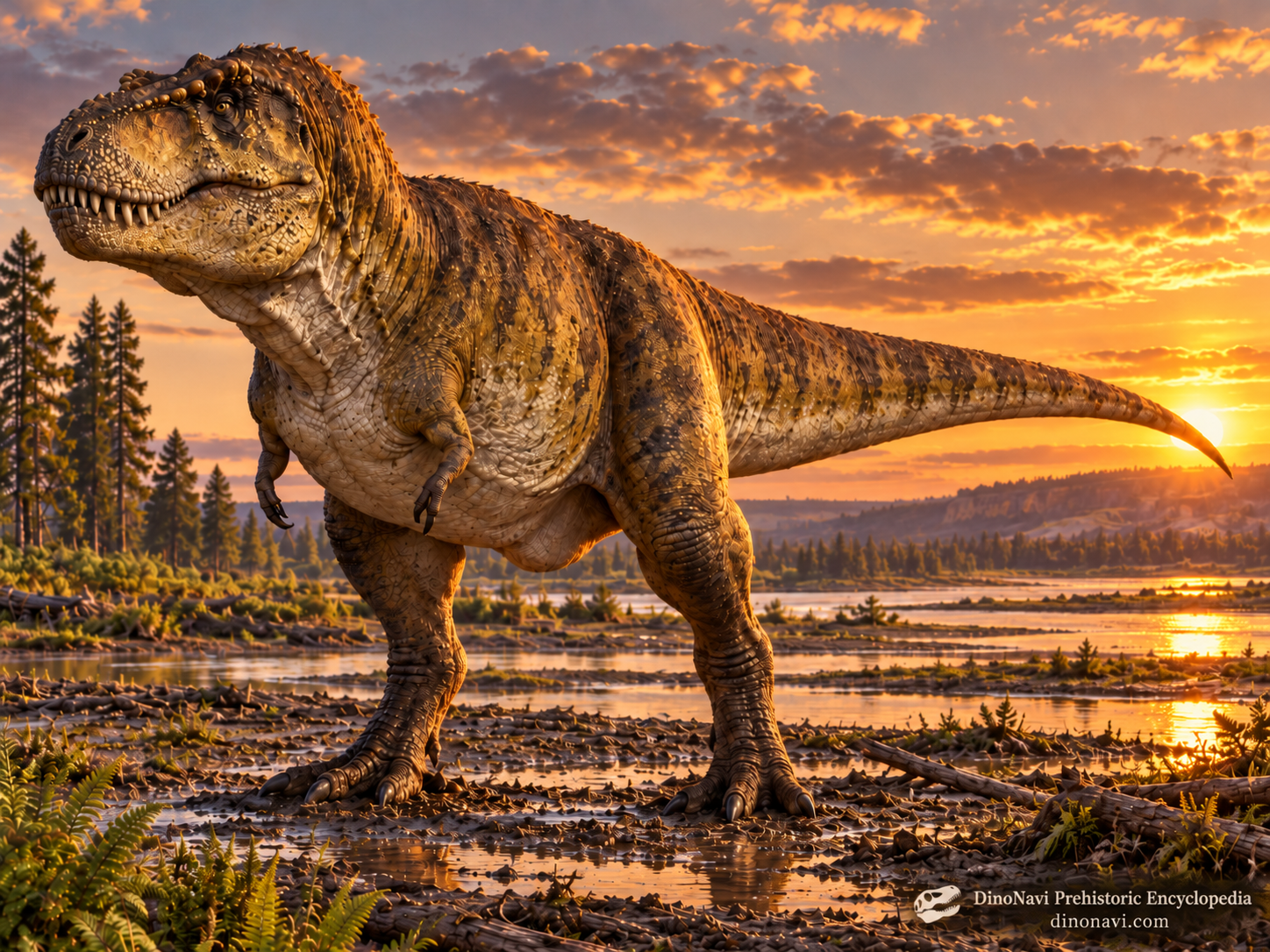
Whole-body reconstruction at sunset.
DinoNavi Prehistoric Encyclopedia · dinonavi.com
Reconstruction / infographic · Sekimosoft LLC / DinoNavi · AI-generated / code-authored explanatory images
AI reconstruction. Appearance, behavior and scenes are distinct from directly established fossil evidence.
References
- Gigantism and comparative life-history parameters of tyrannosaurid dinosaurs 163: scoped bibliography/content checked; direct URL access HOLD (challenge).
- Prolonged growth and extended subadult development in the Tyrannosaurus rex species complex revealed by expanded histological sampling and statistical modeling 163: scoped bibliography/content checked; direct URL access HOLD (challenge).
- Growing up Tyrannosaurus rex: Osteohistology refutes the pygmy "Nanotyrannus" and supports ontogenetic niche partitioning in juvenile Tyrannosaurus 163: scoped bibliography/content checked; direct URL access HOLD (challenge).
- Exceptionally preserved stomach contents of a young tyrannosaurid reveal an ontogenetic dietary shift in an iconic extinct predator 163: scoped bibliography/content checked; direct URL access HOLD (challenge).
- Gender-specific reproductive tissue in ratites and Tyrannosaurus rex 163: scoped bibliography/content checked; direct URL access HOLD (challenge).
- Physical evidence of predatory behavior in Tyrannosaurus rex 163: scoped bibliography/content checked; direct URL access HOLD (challenge).
- Resolving the “ontogeny problem” in vertebrate paleontology 163: scoped bibliography/content checked; direct URL PASS.
- Hatchlings of Tyrannosaurus rex and the Evolution of Dinosaur Reproductive Strategies 163: scoped bibliography/content checked; direct URL access HOLD (challenge).
- SUE 163: scoped bibliography/content checked; direct URL PASS.
- 【DinoNavi恐竜図鑑001】ティラノサウルスは本当に最強の恐竜だったのか? 噛む力・体格・狩りの能力を科学的に解説 163: scoped bibliography/content checked; direct URL PASS. Editorial context only.
- Tyrannosauroid integument reveals conflicting patterns of gigantism and feather evolution 164 PASS_SCOPED: author-institution record/abstract supports preserved scaly skin in large tyrannosaurids; not a complete body or juvenile covering map.
- What caused the holes in SUE the T. rex’s jaw? Probably not an infection 164 PASS_SCOPED: museum press report describes repair around jaw holes and unresolved cause; no infection/cause-of-death diagnosis.
- How well do you know SUE? 164 PASS_SCOPED: museum account of preserved bone abnormalities and historical28year estimate; older jaw-infection explanation is not adopted.
Text and figures include AI-assisted creation/editing, reconstructions and schematics. Scientific inferences are not established facts. Full-text checks of some references remain incomplete.