Triceratops: The Mystery of Its Horns and Frill
**Late Cretaceous North America, approximately 68–66 million years ago. Across river plains and woodlands walked a giant herbivore with two long brow horns, a smaller nose horn, and a spectacular bony shield-like structure behind its head.**
DinoNavi editorial · 2026-10-24T16:59:47.086Z
Triceratops: The Mystery of Its Horns and Frill
**Late Cretaceous North America, approximately 68–66 million years ago. Across river plains and woodlands walked a giant herbivore with two long brow horns, a smaller nose horn, and a spectacular bony shield-like structure behind its head.** That animal was *Triceratops*, whose name means “three-horned face.” But were those horns simply weapons against *Tyrannosaurus rex*? Was the frill a shield, an advertisement to other animals, a signal of maturity, or several things at once? Fossils reveal that horn orientation changed as Triceratops grew. The frill margin developed dramatically, too. Injuries in fossil skulls provide clues that individuals may have fought each other. Meanwhile, the distribution of skull shapes through successive rock layers raises questions about evolution across many generations. This article explores anatomy, growth, behavior, feeding and evolution, carefully distinguishing preserved evidence from scientific hypotheses and illustrated reconstructions. Illustration placeholders 01–10 indicate where explanatory artwork belongs within the text. Modern urban scenes are fictional educational comparisons, not prehistoric events.
Chapter 1 — What makes a three-horned face?
Triceratops was a large, four-legged herbivorous ceratopsian dinosaur. The Natural History Museum in London lists a representative length of around nine metres and an estimated weight of about ten tonnes. Those figures are useful approximations, not exact measurements for every individual; different specimens and reconstructions produce different estimates. Two substantial horns grew over the eyes, while a smaller third horn projected from the nose region. The skull also carried an extended frill, a beak-like front to the jaws and closely packed batteries of teeth farther back. This was no two-legged hunter with tiny arms. It was a robust quadruped with four powerful limbs, a heavy neck and one tail extending behind the body. Skulls of adult Triceratops could approach two metres in length, depending on the specimen and the measurement chosen. Such dimensions should not be casually confused with the animal’s total height or its full length from nose to tail. **FIGURE 01 — Anatomy of the skull: horns, frill, jaw and beak**
Zoom then drag. Part names at150%, lines and descriptions at250%.
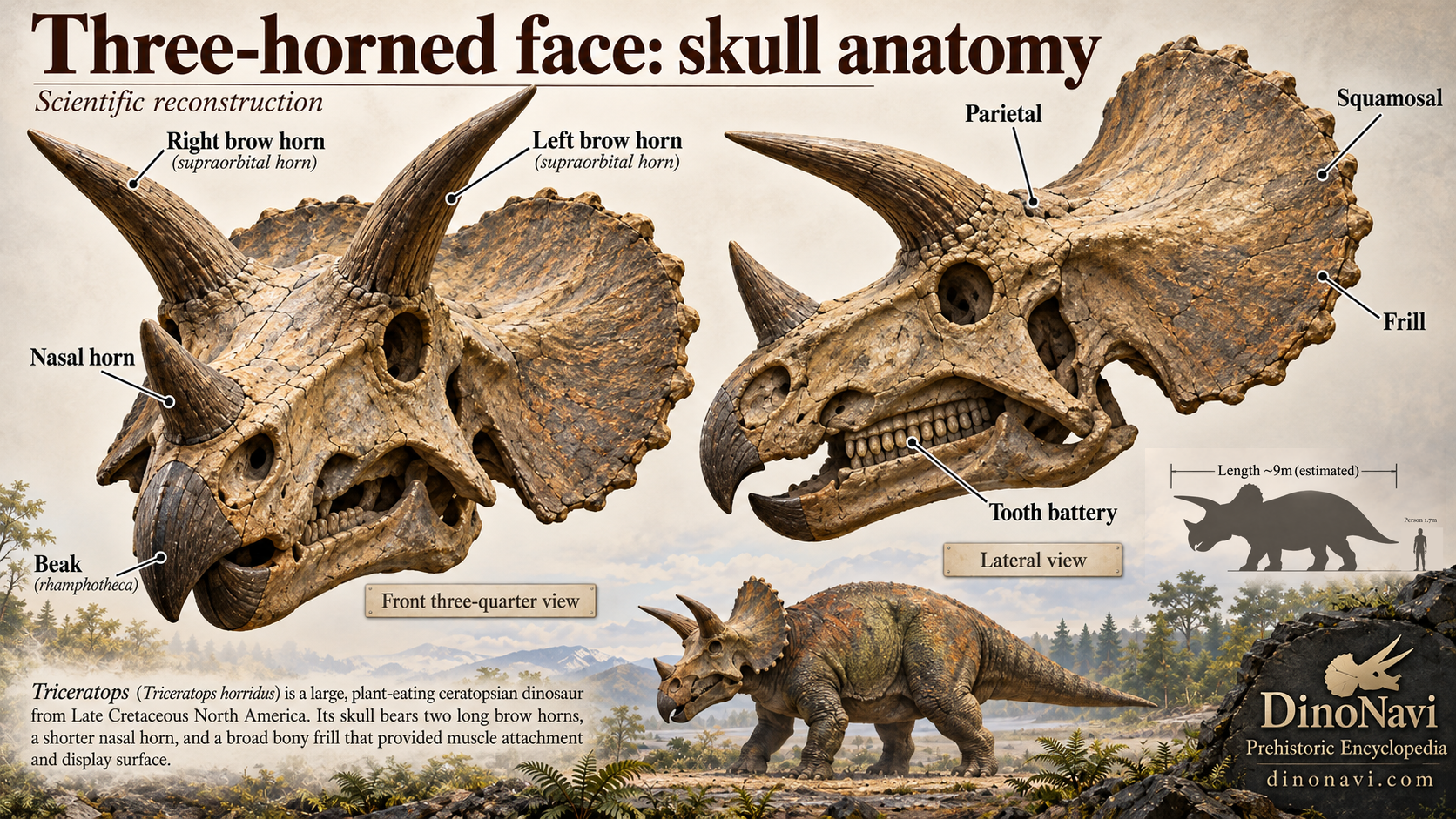
Three-horned face: skull anatomy
DinoNavi Prehistoric Encyclopedia · dinonavi.com
Reconstruction / infographic · Sekimosoft LLC / DinoNavi · AI-generated / code-authored explanatory images
AI conceptual reconstruction, not a photograph of a specimen, excavation or museum exhibit. Enlarge and zoom to read small labels. Approximately9m is a representative estimated total length; the comparison person is set to1.7m at the same diagram scale.
Chapter 2 — What was the frill made of?
The frill was not a separate solid plate mounted behind the head. It was an expansion of skull bones, especially the parietal and squamosal bones, projecting backward around the neck. Smaller ornamental bones formed part of its rim and changed shape as the animal matured. Many eventually fused into the surrounding structures. Some other ceratopsians possessed large openings in their frills. Typical adult Triceratops had a comparatively solid frill without the conspicuous paired fenestrae seen in several relatives. Yet even this description needs precision: skull sutures, damaged specimens and individual variation must not be simplified into a cartoonishly featureless shield. A frill might have helped absorb forces during conflict, contributed to visual signaling or allowed animals to recognize body size and maturity. Such functions are not mutually exclusive. Fossils show the shape of bones; they cannot reveal an animal’s intentions directly. **FIGURE 02 — Bone-based cross-section and architecture of the frill**
Zoom then drag. Part names at150%, lines and descriptions at250%.
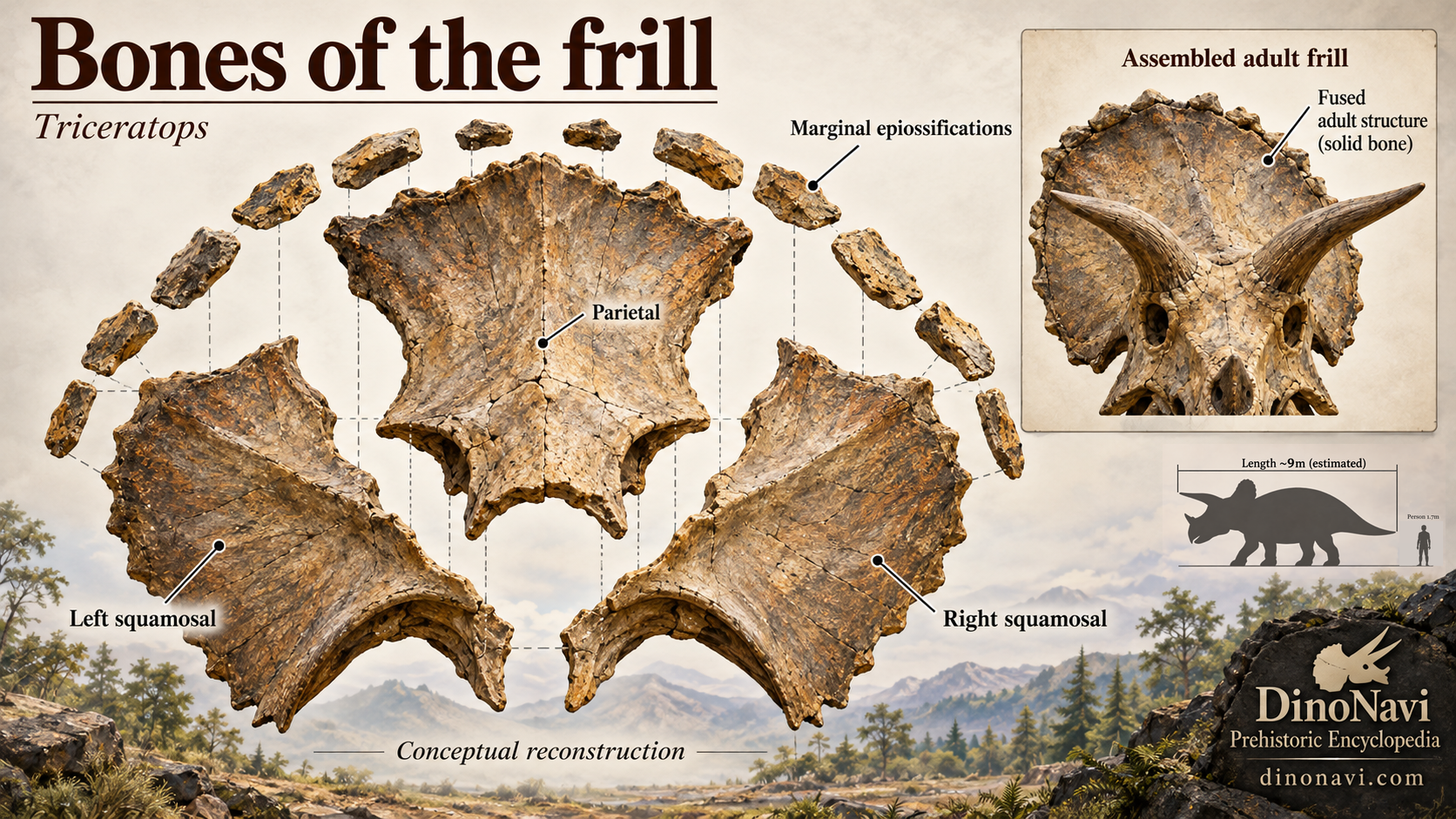
Bones of the frill
DinoNavi Prehistoric Encyclopedia · dinonavi.com
Reconstruction / infographic · Sekimosoft LLC / DinoNavi · AI-generated / code-authored explanatory images
AI conceptual reconstruction, not a photograph of a specimen, excavation or museum exhibit. Enlarge and zoom to read small labels. Approximately9m is a representative estimated total length; the comparison person is set to1.7m at the same diagram scale.
Chapter 3 — The horns of a youngster pointed differently
A juvenile Triceratops was not merely an adult scaled down. In a major 2006 study, Horner and Goodwin compared a growth series of skulls ranging from a small specimen about 38 centimetres long to adult skulls of approximately two metres. The youngest animals had short brow horns. In juveniles those horns curved backward. During later growth the horns became more upright; adults typically displayed strongly forward-oriented brow horns. Meanwhile the edge of the young frill had a scalloped appearance that gradually became smoother. The ornamental bones on its margin changed shape and increasingly fused. These findings suggest that facial ornaments could communicate something about an individual’s stage of development. Researchers have proposed visual identity or maturity-related signaling. That is a hypothesis, however, and does not establish courtship as the sole function of the horns. **FIGURE 03 — Brow-horn orientation through juvenile, subadult and adult stages**
Zoom then drag. Part names at150%, lines and descriptions at250%.
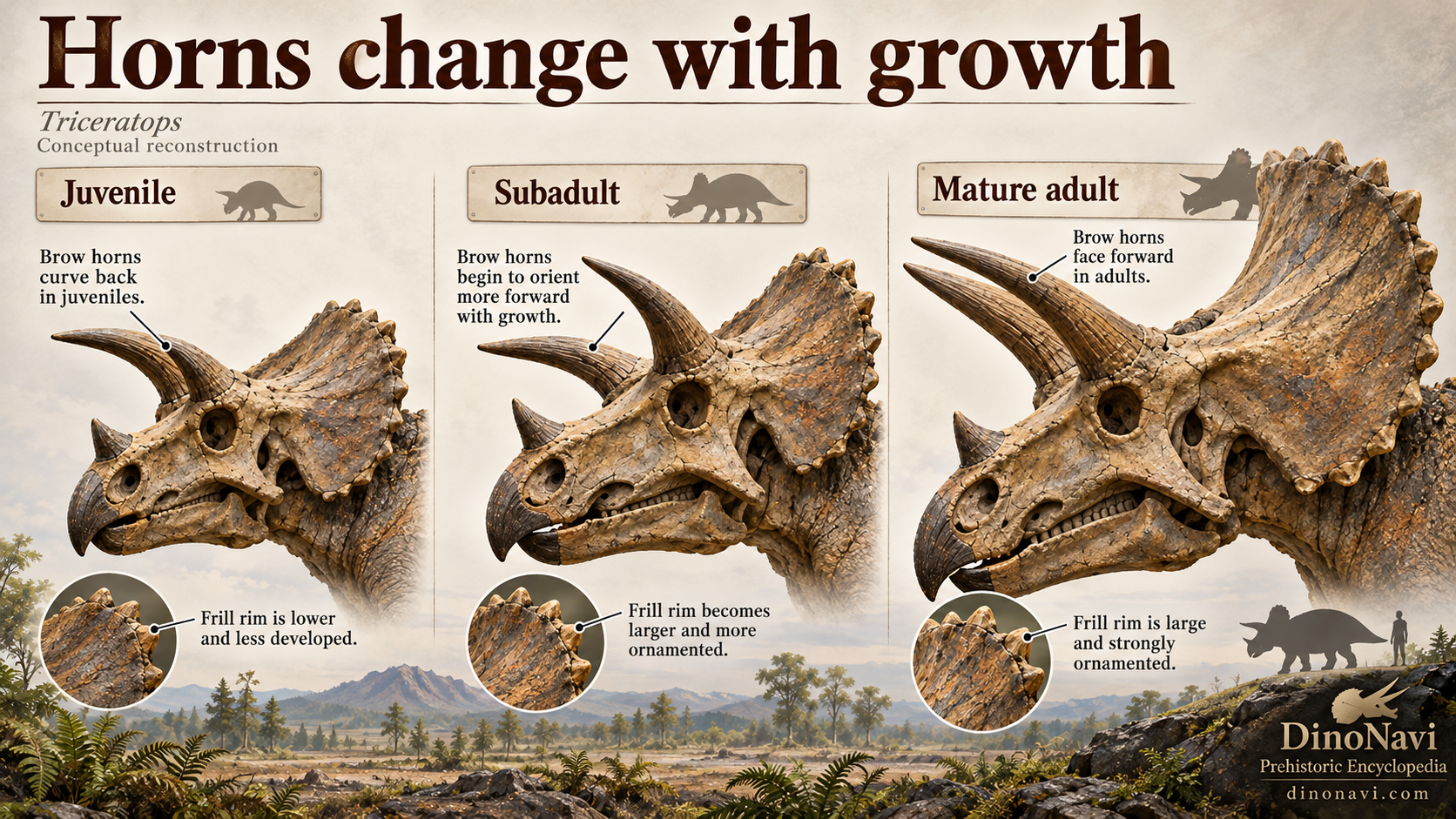
Horns change with growth
DinoNavi Prehistoric Encyclopedia · dinonavi.com
Reconstruction / infographic · Sekimosoft LLC / DinoNavi · AI-generated / code-authored explanatory images
AI conceptual reconstruction, not a photograph of a specimen, excavation or museum exhibit. Enlarge and zoom to read small labels.
Chapter 4 — Did Triceratops fight with its horns?
Picture two adult Triceratops approaching one another. Would they lock horns or shove with their heads? Bones offer unusually revealing clues. In 2009, Farke and colleagues compared patterns of cranial lesions in Triceratops and the related ceratopsian Centrosaurus. Lesions appeared at significantly different frequencies in the squamosal portion of the frill. The distribution was consistent with horn-based fighting in Triceratops and a protective role for the frill. This does not prove that every individual regularly engaged in spectacular duels, nor does it tell us the exact movements involved. Skeletal injuries may have several causes. Yet patterns across multiple specimens are more informative than an isolated dramatic-looking crack. Illustrations may depict restrained horn contact, bracing or pushing, drawing on comparisons with living horned animals. Such scenes must remain plausible reconstructions, not documentary records of an observed prehistoric event. **FIGURE 04 — Skull injury locations and competing explanations**
Zoom then drag. Part names at150%, lines and descriptions at250%.
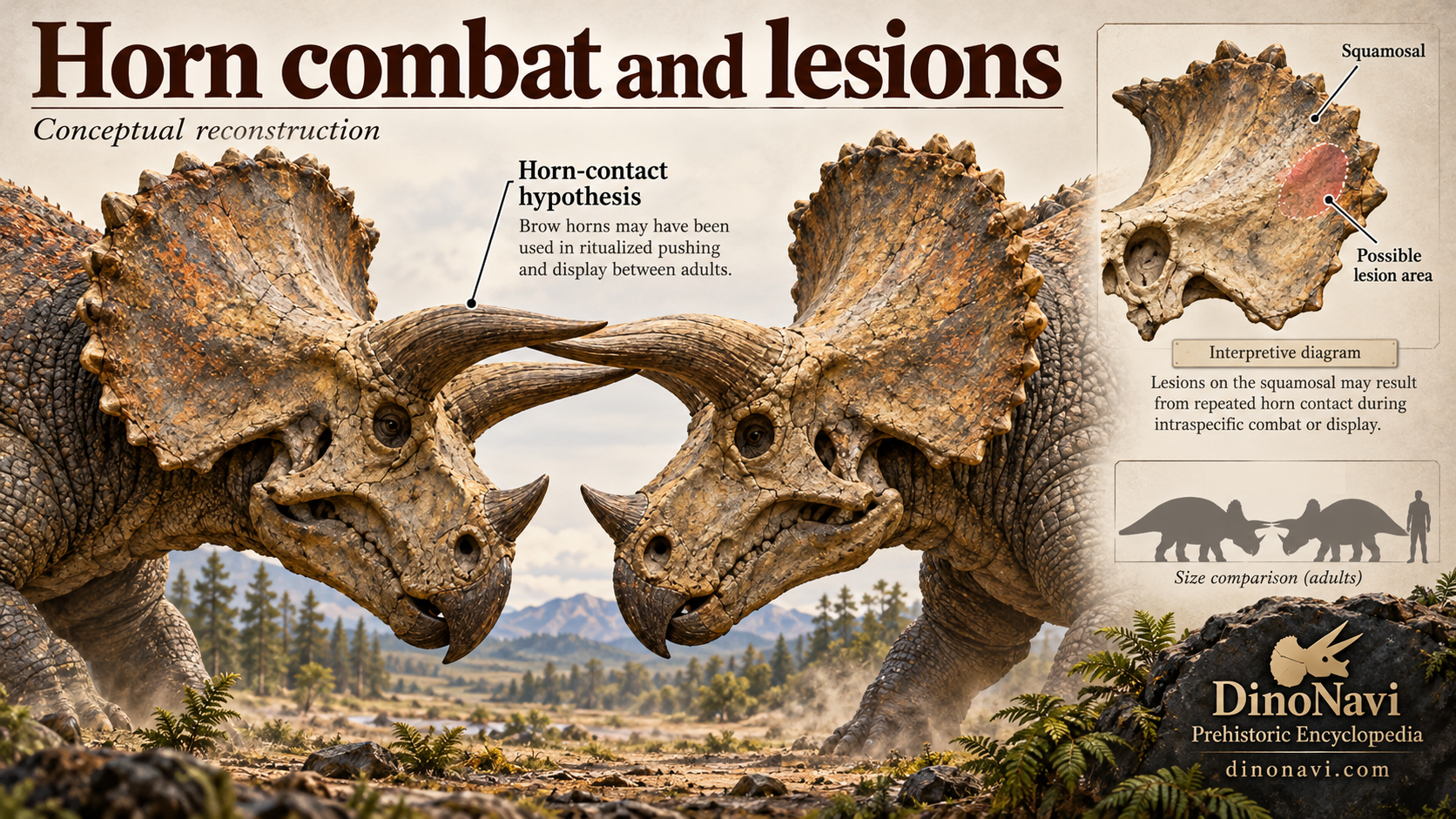
Horn combat and lesions
DinoNavi Prehistoric Encyclopedia · dinonavi.com
Reconstruction / infographic · Sekimosoft LLC / DinoNavi · AI-generated / code-authored explanatory images
AI conceptual reconstruction, not a photograph of a specimen, excavation or museum exhibit. Enlarge and zoom to read small labels. The unsupported dimension line and3m label have been removed. The silhouettes are conceptual, not a calibrated scale comparison.
Chapter 5 — Facing Tyrannosaurus
Triceratops and Tyrannosaurus inhabited the same broad ecosystems in western North America near the end of the Cretaceous. It is easy to imagine the collision between an enormous carnivore and a robust herbivore carrying long horns. Fossils have been interpreted as preserving large theropod bite traces on Triceratops remains. Some damage may reflect encounters while the herbivore was alive, but other traces may derive from feeding on a carcass. Every specimen requires its own interpretation. It would be misleading to conclude that every encounter ended in a face-to-face battle. Horns probably provided some defensive benefit, but outcomes would have depended on age, posture, terrain, health and opportunity. Our reconstruction should show animals living in a complex ecosystem, not indestructible fantasy warriors. **FIGURE 05 — Tyrannosaurus and Triceratops within the same ecosystem**
Zoom then drag. Part names at150%, lines and descriptions at250%.
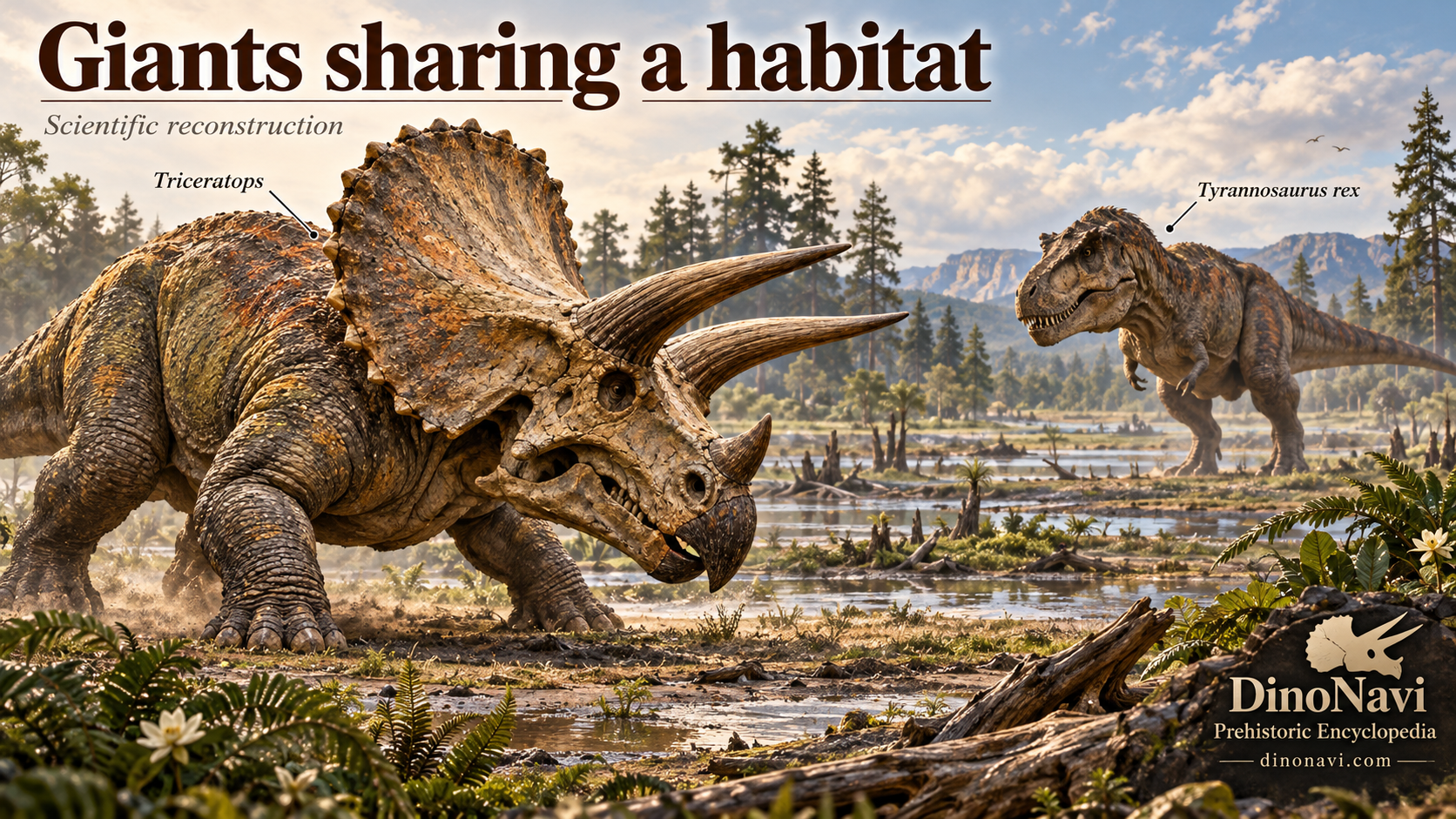
Giants sharing a habitat
DinoNavi Prehistoric Encyclopedia · dinonavi.com
Reconstruction / infographic · Sekimosoft LLC / DinoNavi · AI-generated / code-authored explanatory images
AI conceptual reconstruction, not a photograph of a specimen, excavation or museum exhibit. Enlarge and zoom to read small labels.
Chapter 6 — A beak and teeth built for plants
The horns attract attention, but Triceratops also possessed highly specialized equipment for eating. Its beak-like mouth could crop vegetation, while tightly packed teeth behind it sheared plant material. Replacement teeth helped sustain the feeding apparatus as older teeth wore down. Teeth can reveal how an animal processed food, but not an exact daily menu. We cannot confidently list the percentage of each plant species consumed by a particular Triceratops. Drawings of browsing are reconstructions informed by jaw mechanics and the flora of its environment. A sturdy quadrupedal stance supported the heavy head. The precise range of head movement and preferred feeding height remain subjects for biomechanical interpretation. **FIGURE 06 — Beak and dental battery: how vegetation was processed**
Zoom then drag. Part names at150%, lines and descriptions at250%.
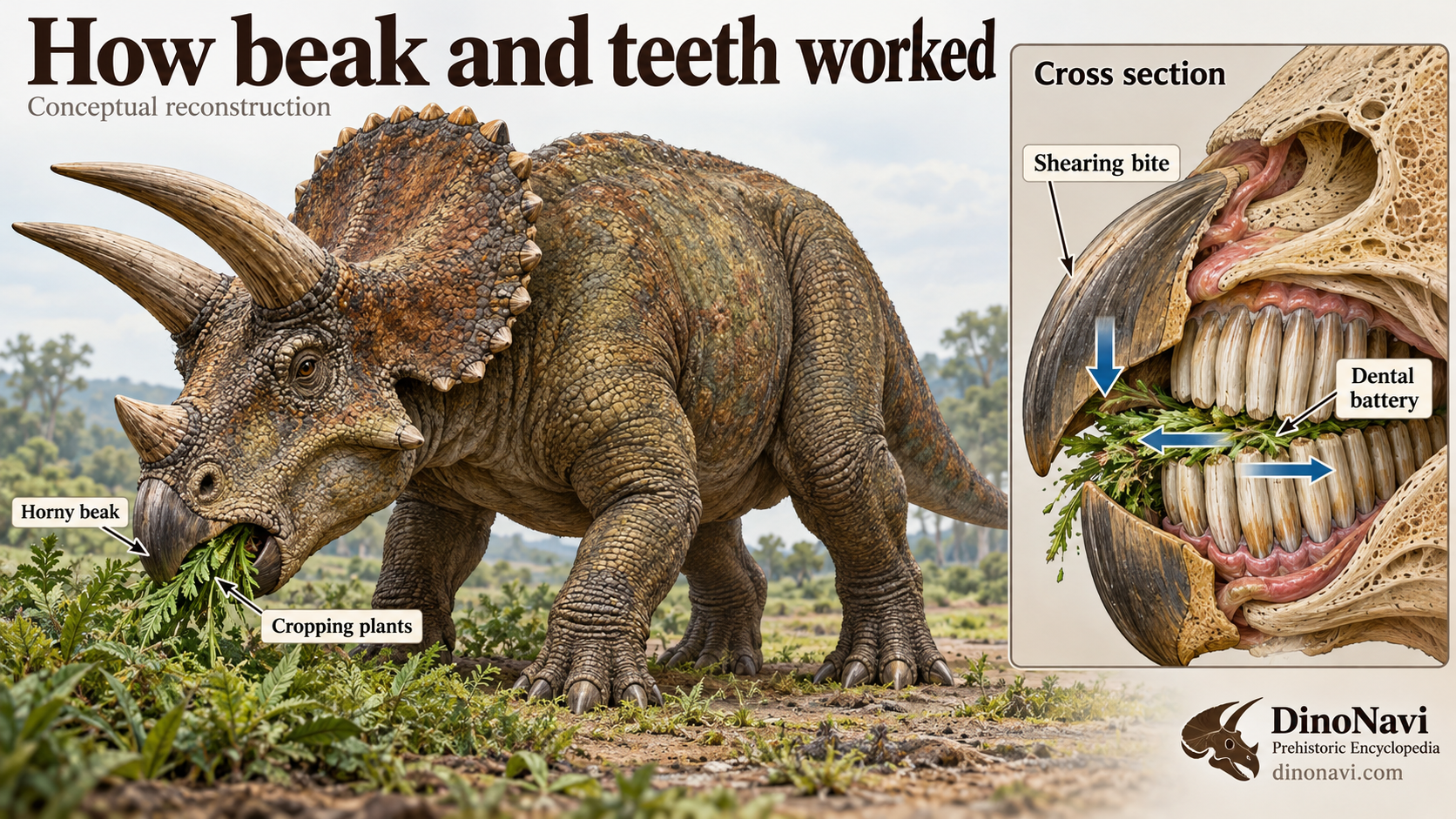
How beak and teeth worked
DinoNavi Prehistoric Encyclopedia · dinonavi.com
Reconstruction / infographic · Sekimosoft LLC / DinoNavi · AI-generated / code-authored explanatory images
AI conceptual reconstruction, not a photograph of a specimen, excavation or museum exhibit. Enlarge and zoom to read small labels.
Chapter 7 — How big would Triceratops look today?
A representative nine-metre body length becomes more intuitive when set beside familiar objects. A typical passenger car roughly four to five metres long provides one useful reference. Triceratops would be roughly as long as two such vehicles, though vehicle and dinosaur heights are quite different. To make a comparison scientifically meaningful, the animal, person and vehicle must share the same ground plane, perspective and clearly described scale. A foreground dinosaur beside a distant building can create a spectacular picture but misleading size information. Now imagine a Triceratops walking along a modern Tokyo street, with a familiar tower in the background. Such images can make an extinct animal's scale immediately memorable. They must be visibly identified as fictional visualizations, because no non-avian dinosaur actually appeared in modern cities. **FIGURE 07 — Same-scale comparison with a person and a car**
Zoom then drag. Part names at150%, lines and descriptions at250%.
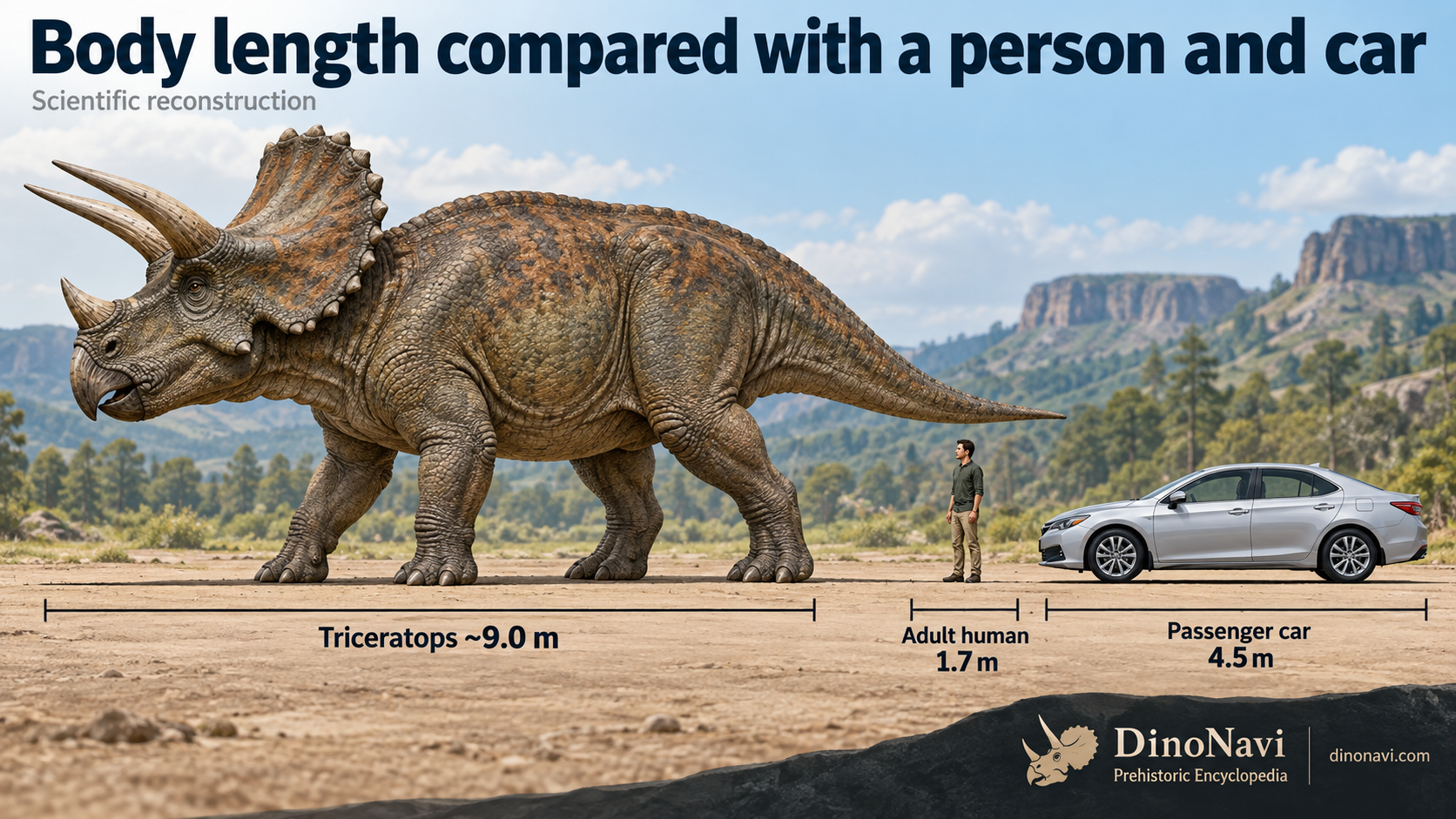
Length compared with people and cars
DinoNavi Prehistoric Encyclopedia · dinonavi.com
Reconstruction / infographic · Sekimosoft LLC / DinoNavi · AI-generated / code-authored explanatory images
AI conceptual reconstruction, not a photograph of a specimen, excavation or museum exhibit. Enlarge and zoom to read small labels. Dimensions and scale are illustrative approximations, not verified measurements.
**FIGURE 08 — Imaginary Triceratops in contemporary Tokyo**
Zoom then drag. Part names at150%, lines and descriptions at250%.
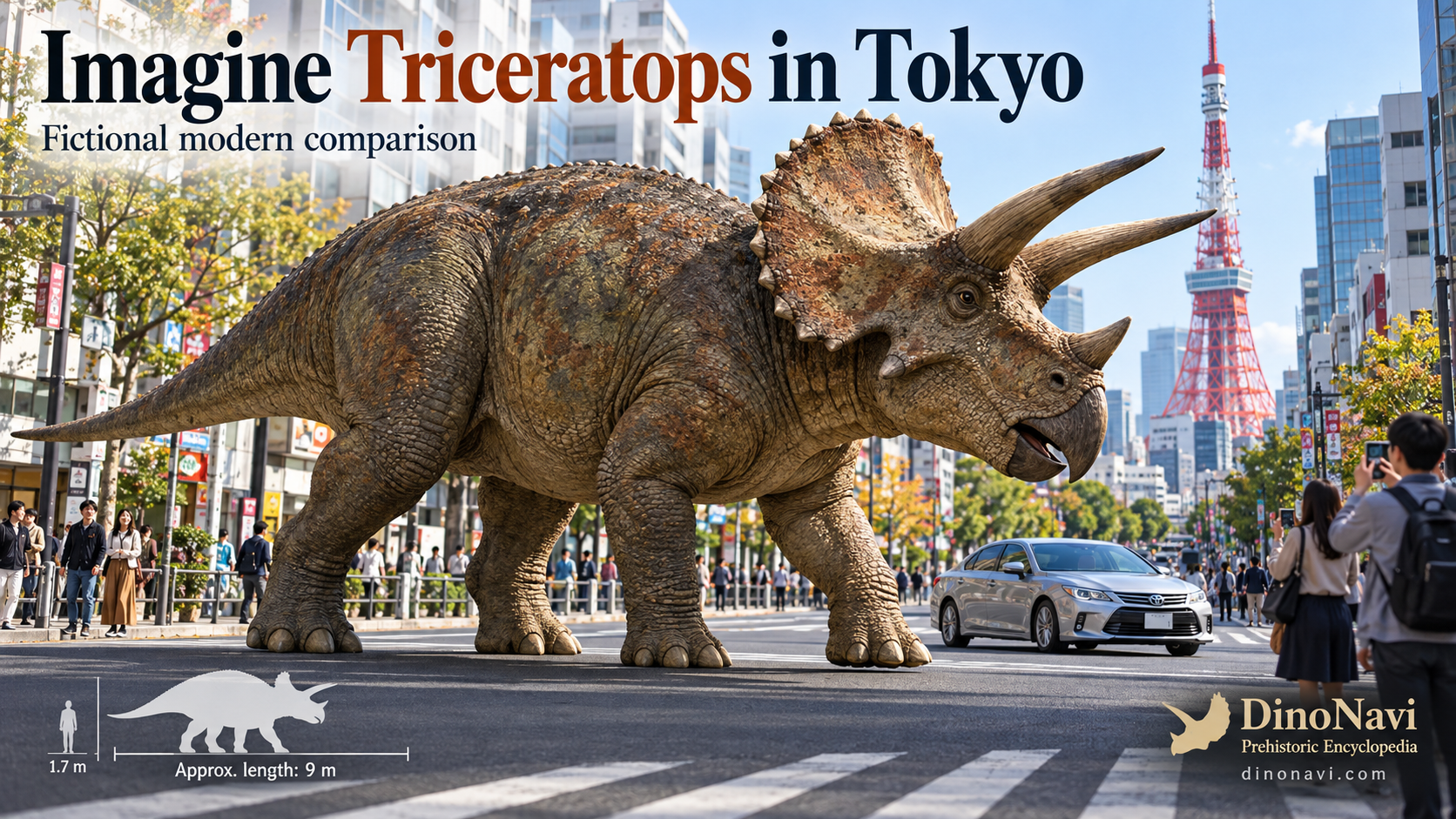
Imagine Triceratops in Tokyo
DinoNavi Prehistoric Encyclopedia · dinonavi.com
Reconstruction / infographic · Sekimosoft LLC / DinoNavi · AI-generated / code-authored explanatory images
AI conceptual reconstruction, not a photograph of a specimen, excavation or museum exhibit. Enlarge and zoom to read small labels. The modern Tokyo scene is fictional.
Chapter 8 — Two species and a changing lineage
Two named species, *Triceratops horridus* and *Triceratops prorsus*, are widely recognized. Their skulls differ in horn and snout morphology. Research published in 2014 examined more than 50 skulls from the Hell Creek Formation in Montana within a stratigraphic framework. The earlier part of that sequence contained morphology associated with T. horridus, while forms identified as T. prorsus were concentrated in younger layers. Intermediate forms occupied intervening strata. The researchers suggested gradual evolutionary transformation within a lineage over many generations. Species boundaries and exact ancestor–descendant relationships remain hypotheses open to further testing. A single animal does not grow from one species into another. Growth within one lifetime and evolutionary change across a lineage are distinct processes, even when both influence horn shape. **FIGURE 09 — Comparative skull morphology and stratigraphic sequence**
Zoom then drag. Part names at150%, lines and descriptions at250%.
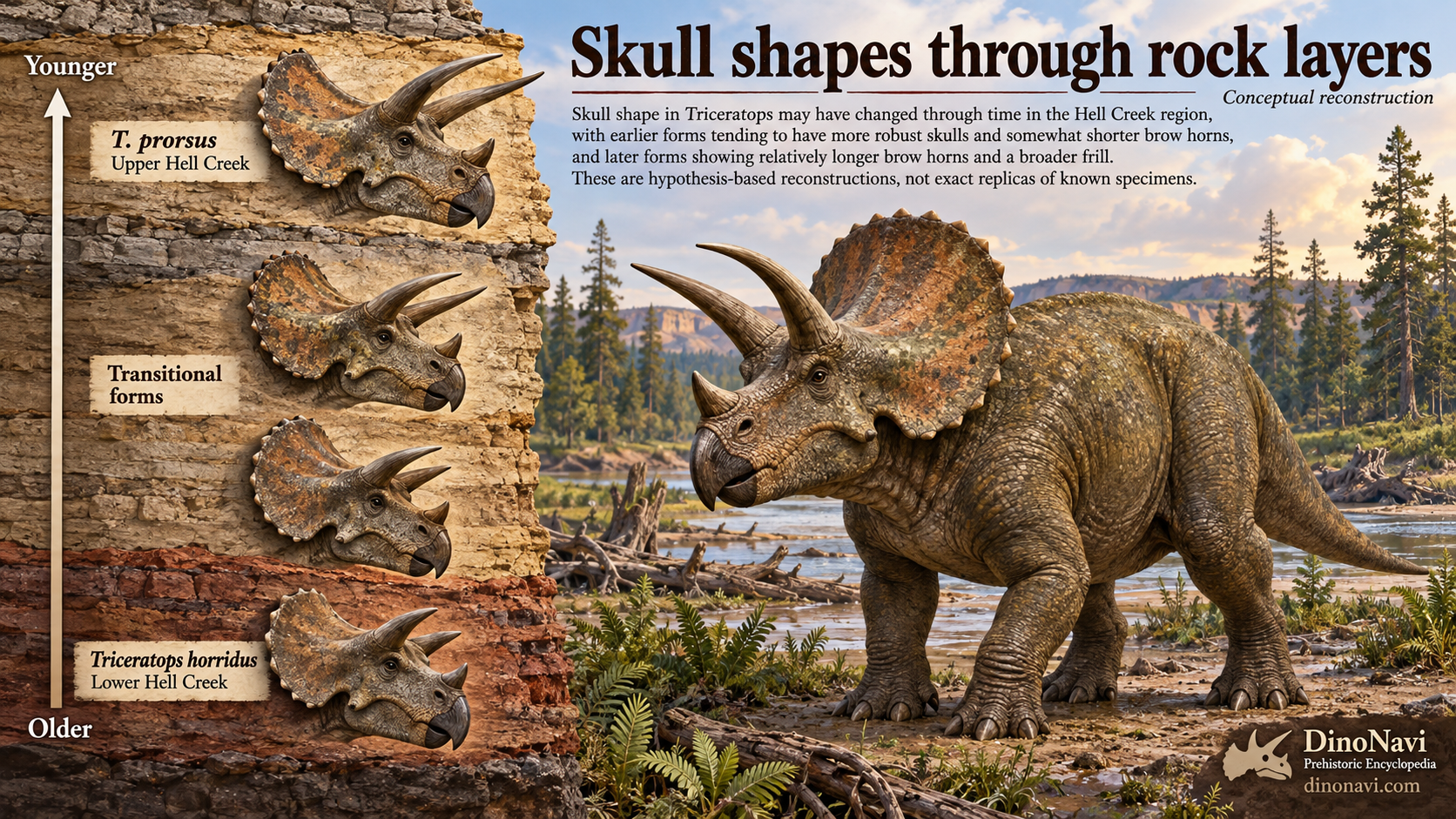
Skull shapes through rock layers
DinoNavi Prehistoric Encyclopedia · dinonavi.com
Reconstruction / infographic · Sekimosoft LLC / DinoNavi · AI-generated / code-authored explanatory images
AI conceptual reconstruction, not a photograph of a specimen, excavation or museum exhibit. Enlarge and zoom to read small labels.
Chapter 9 — What fossils and museums can reveal
A spectacular skull in a museum may look complete, yet fossils often reach us fragmented, compressed or distorted. Museum mounts may include original bone, replicas and carefully reconstructed missing sections. The visual continuity of an exhibition is not proof that every bone came from one perfectly preserved specimen. Paleontologists must document where each bone was discovered, the surrounding rock layers, its collection history and its preserved anatomy. Small juvenile skulls can be as informative as imposing adult skulls when the question concerns growth and development. Museum and excavation scenes in DinoNavi can be useful educational illustrations. Fictional galleries, reconstructed specimens and imagined fieldwork must not be represented as photographs of a specific existing exhibition. **FIGURE 10 — How scientists reconstruct a horned dinosaur skull**
Zoom then drag. Part names at150%, lines and descriptions at250%.
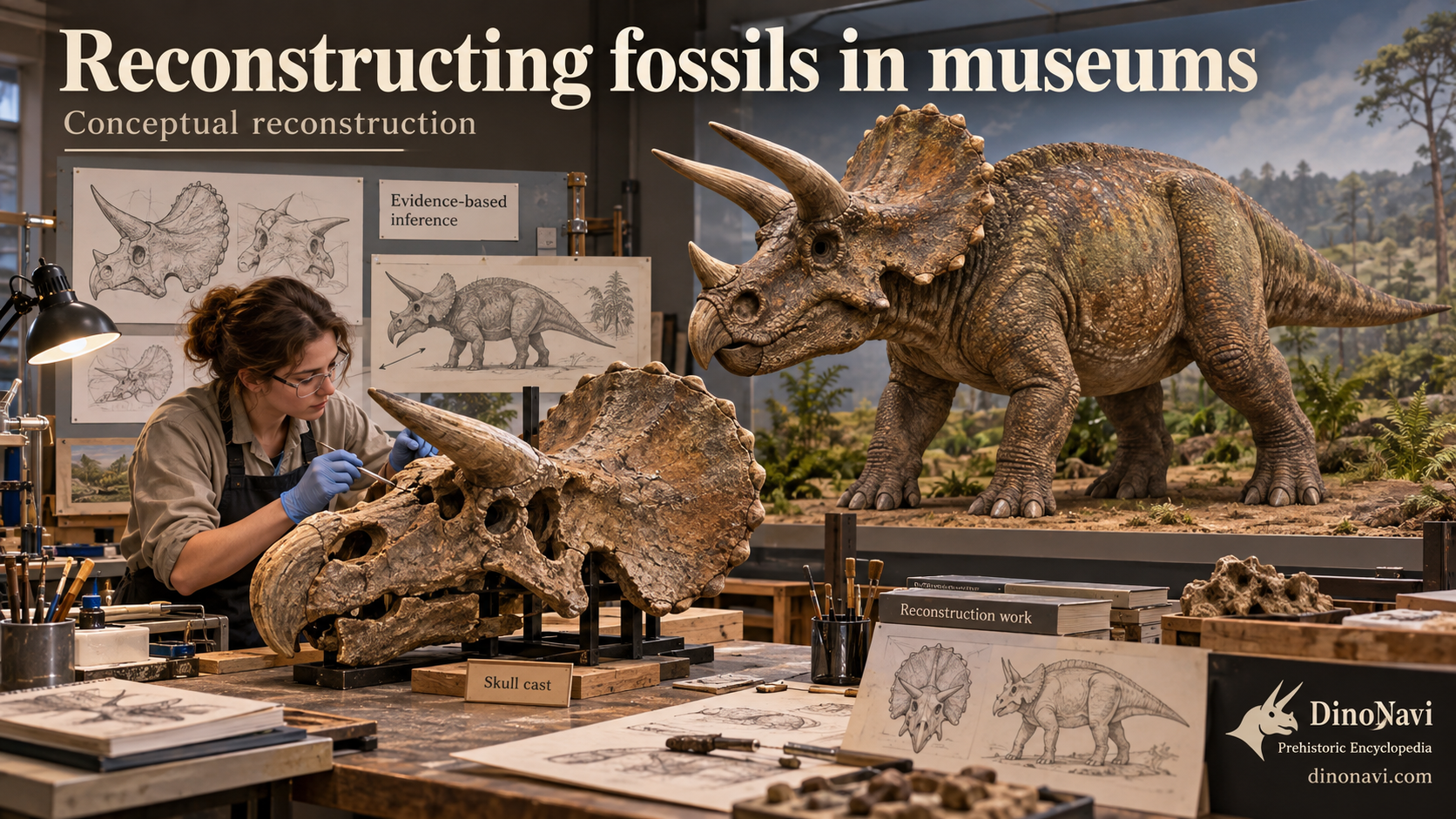
Reconstructing fossils in museums
DinoNavi Prehistoric Encyclopedia · dinonavi.com
Reconstruction / infographic · Sekimosoft LLC / DinoNavi · AI-generated / code-authored explanatory images
AI conceptual reconstruction, not a photograph of a specimen, excavation or museum exhibit. Enlarge and zoom to read small labels.
Conclusion — More than a weapon
Triceratops did not carry an unchanging set of three horns throughout life. Its brow horns shifted orientation as the animal grew, the frill transformed, and patterns of injury suggest that these structures sometimes played a role in physical conflict. Teeth, ecology and the distribution of skull forms across rock layers provide still more parts of the story. The horns may have been defensive structures, social signals and age-related visual features at different times. No single explanation necessarily accounts for every function in every situation. **The three-horned face is not merely an icon of the dinosaur age. It is a record of biology, behavior and evolution waiting to be read.** Explore more: The Life and Growth of Tyrannosaurus rex / Giant Dinosaur Size Comparisons / Triceratops Species Encyclopedia. © Sekimosoft LLC / DinoNavi — dinonavi.com
References
- Horner and Goodwin 2006 PENDING: Cranial ontogeny and horn reorientation; supplied citation/claims not independently verified
- Farke et al 2009 PENDING: Lesions and intraspecific combat; supplied citation/claims not independently verified
- Scannella et al 2014 PENDING: Stratigraphy and evolution; supplied citation/claims not independently verified
- Natural History Museum Triceratops PENDING: Size habitat diet; supplied citation/claims not independently verified
- American Museum of Natural History Dinosaur Teeth PENDING: Dental batteries; supplied citation/claims not independently verified
- Goodwin et al 2006 juvenile skull PENDING: Young skull evidence abstract; supplied citation/claims not independently verified
- Horner and Goodwin 2008 PENDING: Frill epi-ossifications; supplied citation/claims not independently verified
- Recent histology PENDING: 2025/2026 cranial ornament histology; background only; supplied citation/claims not independently verified
Text and figures include AI-assisted creation/editing, reconstructions and schematics. Scientific inferences are not established facts. Full-text checks of some references remain incomplete.
Related encyclopedia entries
Related articles
The Life of Tyrannosaurus rex: From Tiny Hatchling to Giant Predator