Spinosaurus and Life at the Water’s Edge: Did the Sail-Backed Giant Really Swim?
Around 95 million years ago, much of what is now North Africa was not the desert landscape we know today. River systems supported fish, reptiles and dinosaurs. Along a muddy channel walked an extraordinary predator: Spinosaurus aegyptiacus, with an elongated snout and a towering sail along its back.
DinoNavi editorial · 2026-10-25T07:39:54.261Z
Spinosaurus and Life at the Water’s Edge: Did the Sail-Backed Giant Really Swim?
Featured species: *Spinosaurus aegyptiacus* (distinct from *S. mirabilis*) Editorial status: draft for private review / 25 October 2026 Scientific note: Direct fossil evidence, model-based inference and imaginative scenes are distinguished. Artwork depicts reconstructions, not documentary imagery.
Introduction — A Giant at the Water’s Edge
Around 95 million years ago, much of what is now North Africa was not the desert landscape we know today. River systems supported fish, reptiles and dinosaurs. Along a muddy channel walked an extraordinary predator: Spinosaurus aegyptiacus, with an elongated snout and a towering sail along its back. Early restorations portrayed it as a conventional giant land-dwelling theropod. Later fossils suggested a much stranger anatomy: relatively short hind limbs in some reconstructions, dense bones, and a vertically expanded tail. These discoveries led to a question that still divides scientists: was Spinosaurus a powerful underwater pursuit predator or a giant hunter concentrating on shallow water and riverbanks? The evidence for a connection with fish and aquatic habitats is substantial. But whether it routinely dived and pursued prey underwater remains debated. This article separates fossil observations, model-based interpretations and imaginative reconstructions.
Zoom then drag. Part names at150%, lines and descriptions at250%.
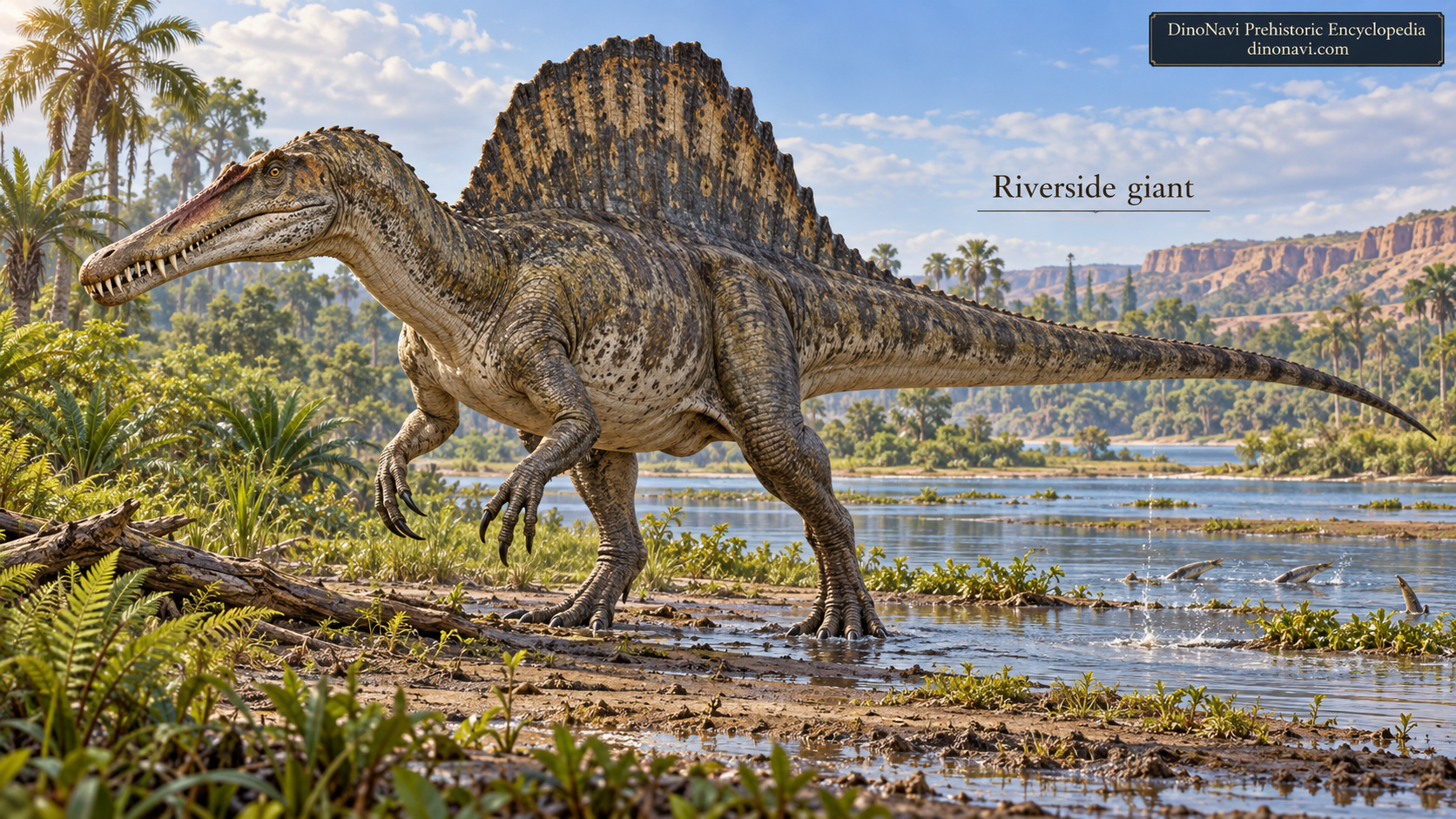
Riverside giant
DinoNavi Prehistoric Encyclopedia · dinonavi.com
Reconstruction / infographic · Sekimosoft LLC / DinoNavi · AI-generated / code-authored explanatory images
AI conceptual reconstruction, not a photograph of a specimen, excavation or actual museum exhibit. Enlarge to read small labels.
Chapter 1 — A River World Beneath the Sahara
The rocks of North Africa’s Kem Kem region preserve evidence of rich Cretaceous waterways. Fish and other aquatic organisms shared these environments with massive predators. Understanding Spinosaurus means reconstructing the habitat as well as its skeleton. A fossil site that is a desert today need not have been a desert when the animal lived. Ancient rivers, channels, mudbanks and floodplains are reasonable components of a reconstruction, although the precise vegetation and distribution of individual habitats remain uncertain. The most useful starting point for imagining Spinosaurus is therefore neither the open ocean nor an endless dry desert, but a diverse riverside landscape with varying water depths.
Chapter 2 — Long Jaws and Fish-Gripping Teeth
Spinosaurus possessed an elongated snout and comparatively conical teeth. These features have often been interpreted as useful for seizing slippery aquatic prey. They contrast with the deep, powerfully built skulls of some other giant theropods. This does not prove that every meal consisted of fish, nor that the animal behaved exactly like a crocodile. Anatomy provides evidence about possible functions, not a complete record of feeding behavior. Our anatomical plates highlight the long snout, tooth shape, jaw alignment and nostril placement. Where a feature is reconstructed from incomplete or multiple specimens, its inferential status should remain visible.
Zoom then drag. Part names at150%, lines and descriptions at250%.
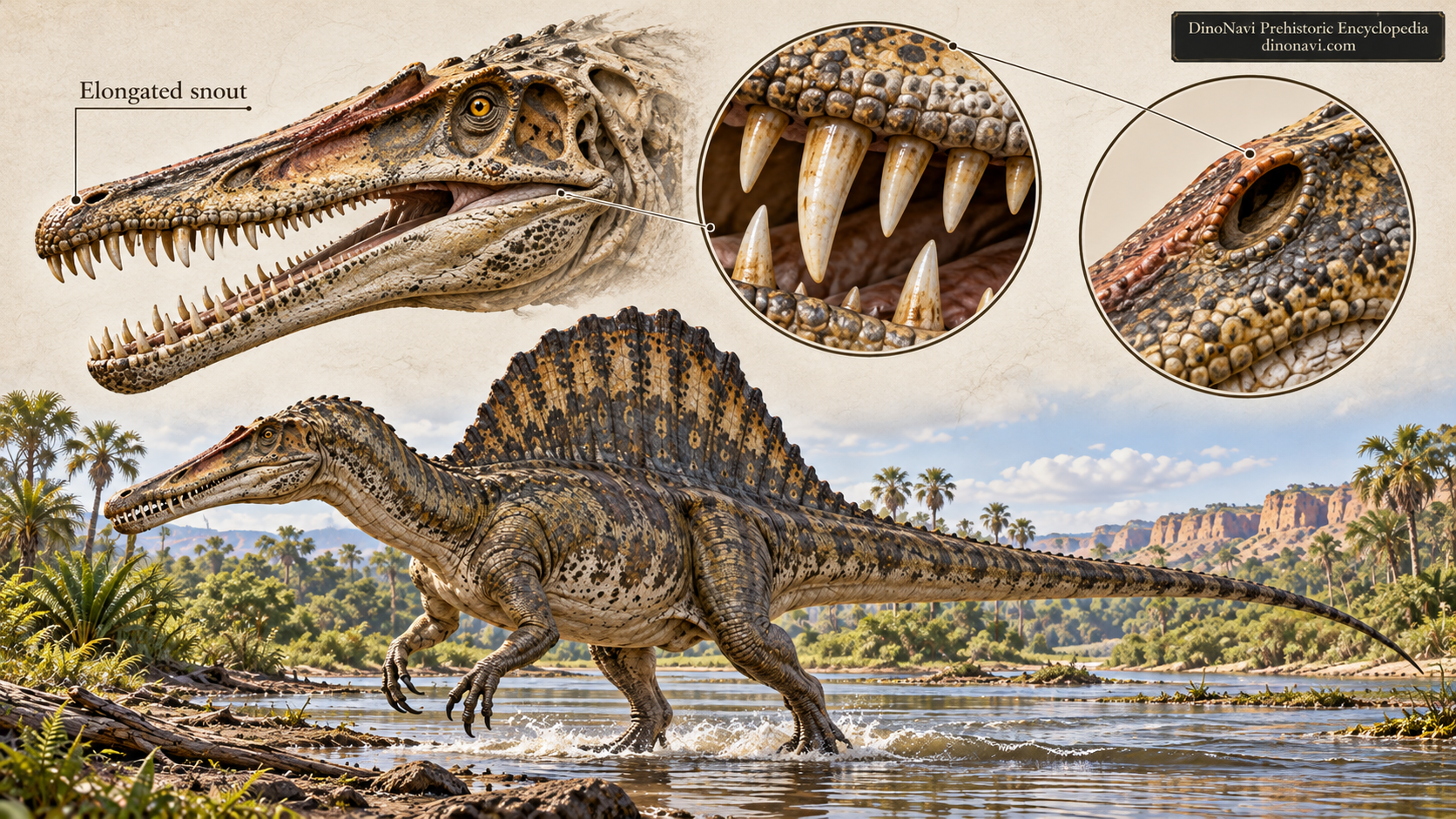
Elongated snout
DinoNavi Prehistoric Encyclopedia · dinonavi.com
Reconstruction / infographic · Sekimosoft LLC / DinoNavi · AI-generated / code-authored explanatory images
AI conceptual reconstruction, not a photograph of a specimen, excavation or actual museum exhibit. Enlarge to read small labels.
Chapter 3 — What Was the Tall Sail For?
The familiar dorsal sail was supported by remarkably elongated neural spines rising from the vertebral column. Fossils establish the existence of these bony structures. They do not preserve every detail of the skin, soft tissue or color of the living sail. Researchers have discussed display, individual recognition, thermal functions and other possibilities. The 2014 semiaquatic study considered a skin-covered display structure, but no fossil records how Spinosaurus actually used its sail in courtship or confrontation. An effective diagram must distinguish real vertebral spines from a hypothetical outer contour. The sail was not a nautical device driven by wind.
Zoom then drag. Part names at150%, lines and descriptions at250%.
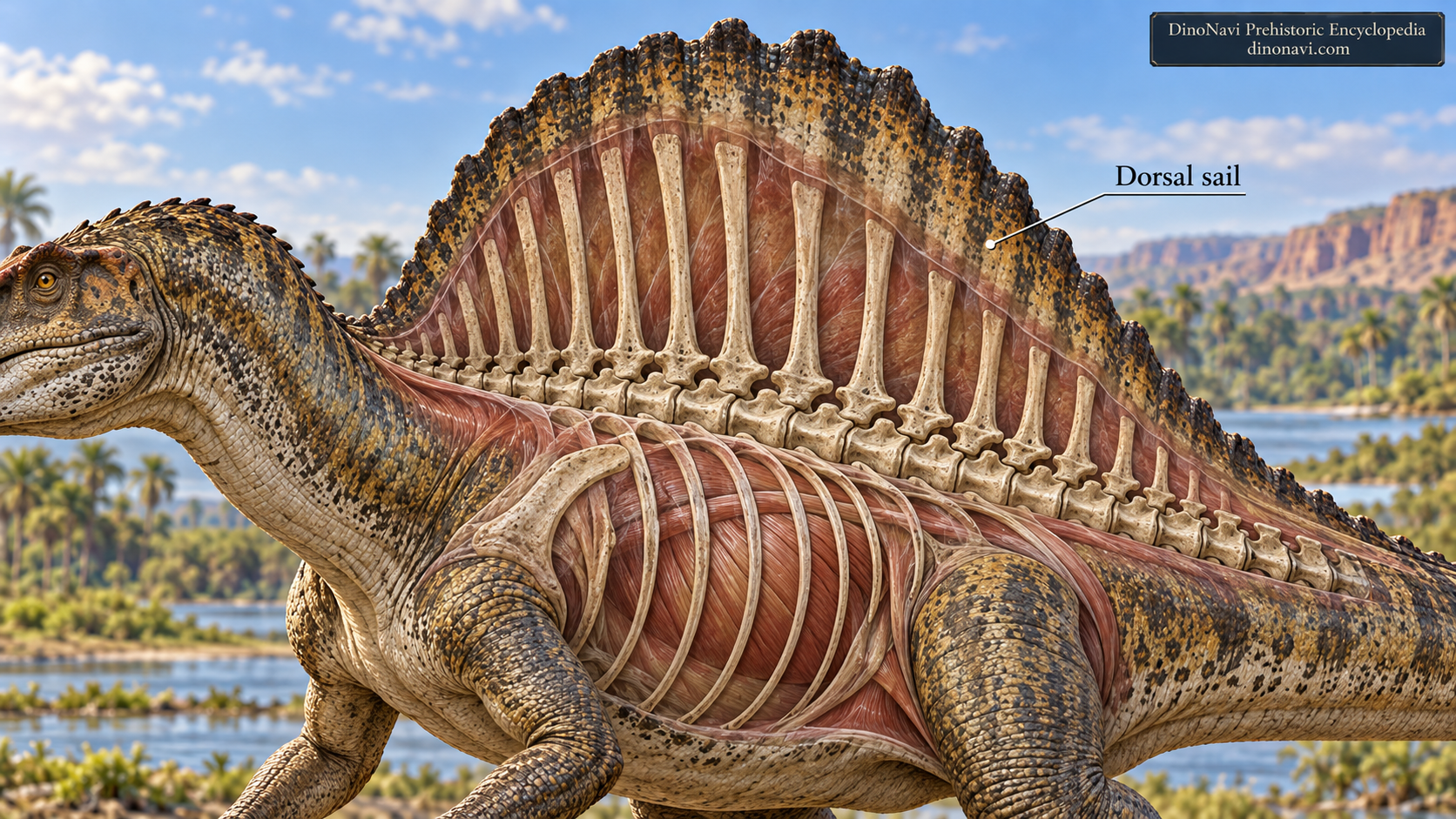
Dorsal sail
DinoNavi Prehistoric Encyclopedia · dinonavi.com
Reconstruction / infographic · Sekimosoft LLC / DinoNavi · AI-generated / code-authored explanatory images
AI conceptual reconstruction, not a photograph of a specimen, excavation or actual museum exhibit. Enlarge to read small labels. Bone/soft-tissue diagrams and arrows are schematic, not measured specimen data or measured movements.
Chapter 4 — The Tail That Changed Everything
In 2020, researchers described remarkable tail fossils from Morocco. Tall spines above and below the caudal vertebrae gave the tail a vertically expanded profile unlike the conventional narrow tail shown in older reconstructions. The team tested moving tail models in water and found evidence that the expanded shape could produce comparatively effective thrust. It was an important result supporting aquatic propulsion. Yet a model tail generating thrust does not establish that an entire living Spinosaurus could dive, turn, remain stable and chase prey efficiently underwater. These are separate biomechanical questions. A reconstruction must show one tail, with a vertically expanded profile, not the horizontal flukes of a whale.
Zoom then drag. Part names at150%, lines and descriptions at250%.
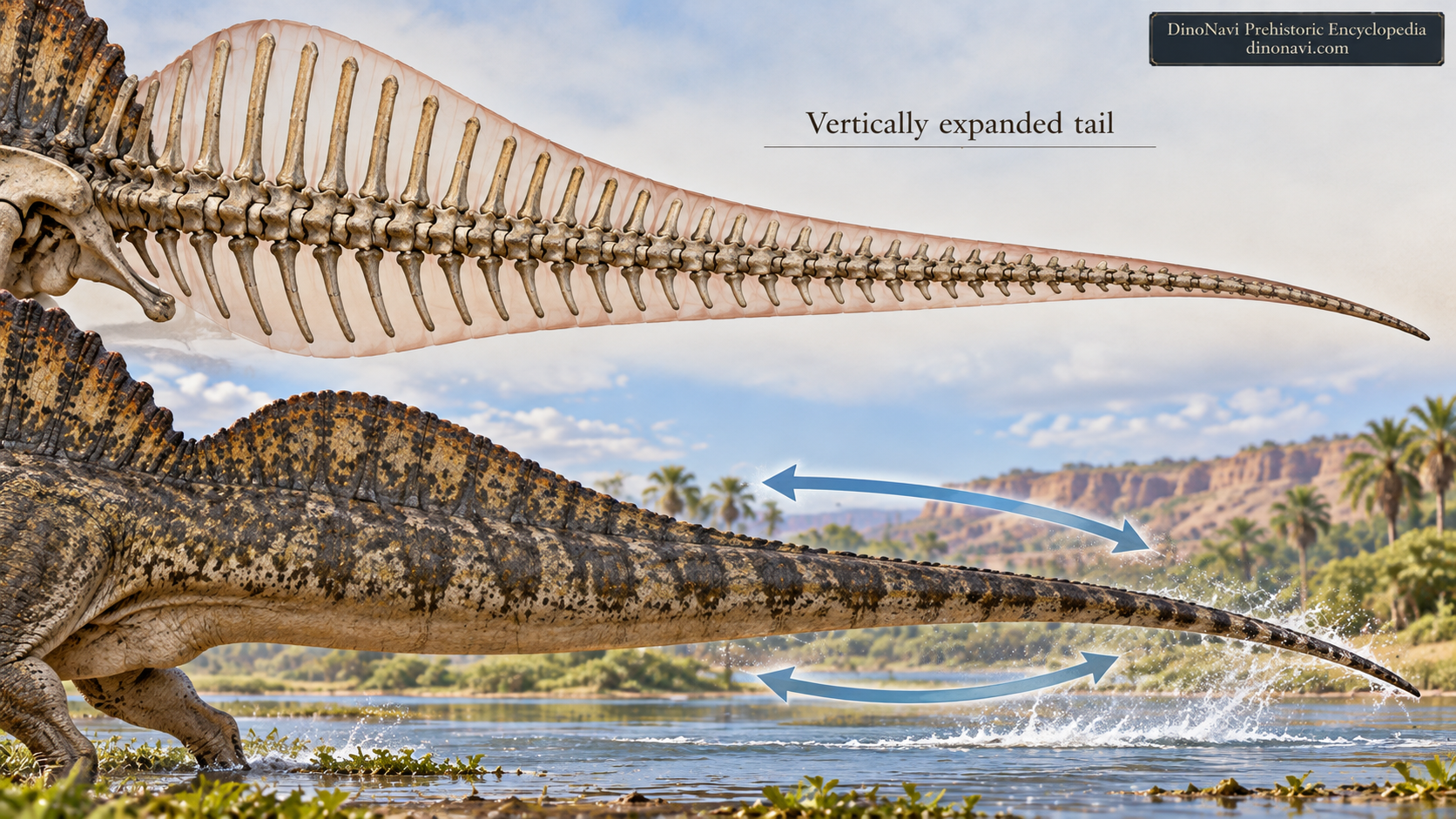
Vertically expanded tail
DinoNavi Prehistoric Encyclopedia · dinonavi.com
Reconstruction / infographic · Sekimosoft LLC / DinoNavi · AI-generated / code-authored explanatory images
AI conceptual reconstruction, not a photograph of a specimen, excavation or actual museum exhibit. Enlarge to read small labels. Bone/soft-tissue diagrams and arrows are schematic, not measured specimen data or measured movements.
Chapter 5 — What Dense Bones Can Tell Us
A 2022 Nature study compared bone compactness across many living and extinct animals. It proposed that Spinosaurus and Baryonyx showed adaptations consistent with feeding underwater, while Suchomimus differed. Dense bones can contribute to reduced buoyancy in some aquatic animals, but they cannot alone demonstrate a precise style of swimming or diving. A 2024 reassessment questioned methodological assumptions in using bone compactness and statistical classification to infer a diving lifestyle. This debate shows how scientific inference works: a measurable anatomical trait must be interpreted in light of body size, evolutionary relationships, behavior and the limitations of the data.
Zoom then drag. Part names at150%, lines and descriptions at250%.
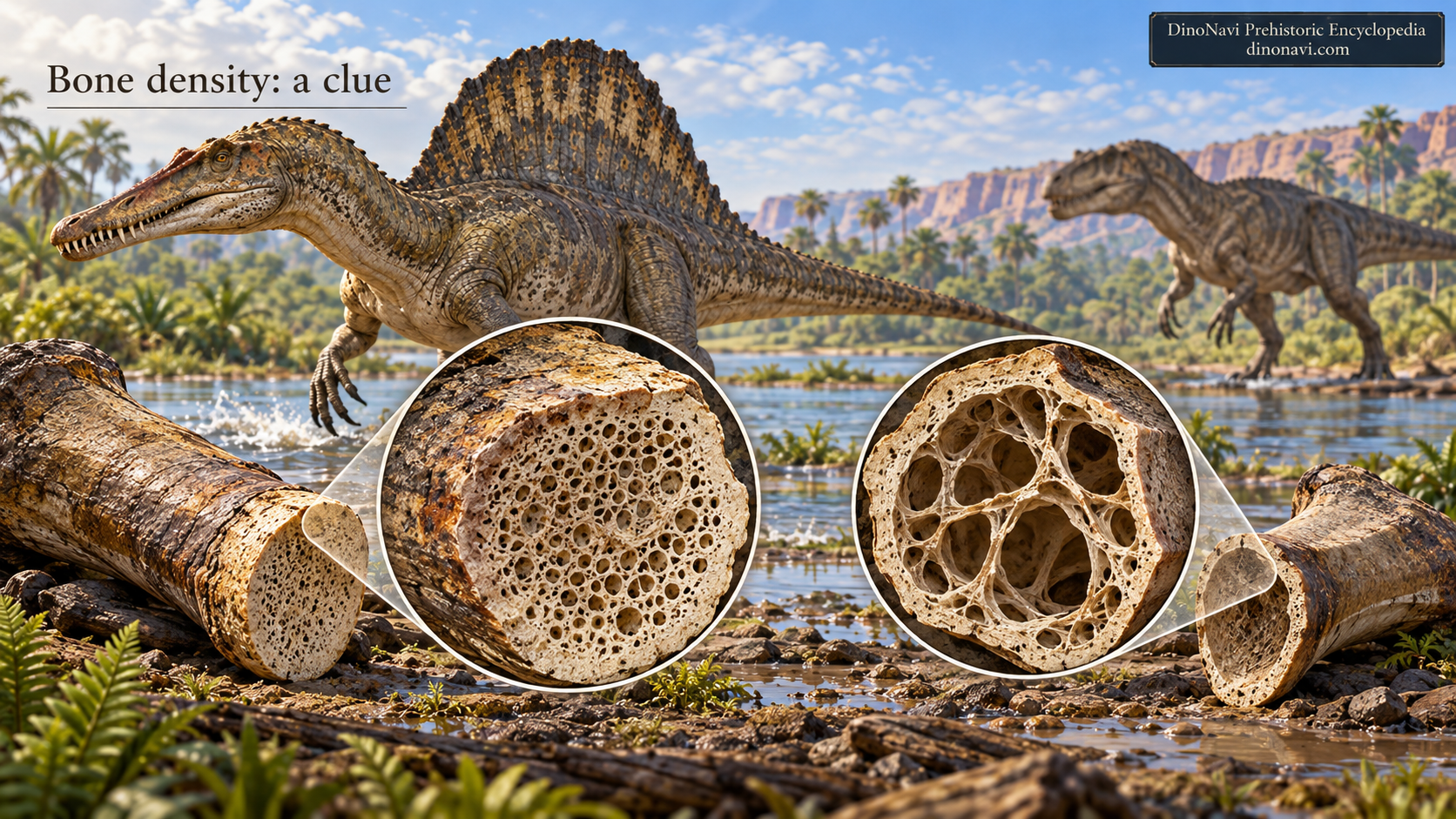
Bone density: a clue
DinoNavi Prehistoric Encyclopedia · dinonavi.com
Reconstruction / infographic · Sekimosoft LLC / DinoNavi · AI-generated / code-authored explanatory images
AI conceptual reconstruction, not a photograph of a specimen, excavation or actual museum exhibit. Enlarge to read small labels. Bone/soft-tissue diagrams and arrows are schematic, not measured specimen data or measured movements. Conceptual bone-density comparison; this drawing itself is not evidence of diving behavior.
Chapter 6 — Diver or Riverside Ambush Hunter?
One reconstruction emphasizes aquatic locomotion, particularly the expanded tail and dense skeleton. Another emphasizes stability, buoyancy and a lifestyle of catching fish at the margins of waterways. A 2022 eLife study used three-dimensional skeletal and flesh models to argue that Spinosaurus was better interpreted as a semiaquatic, bipedal ambush predator than as an efficient underwater pursuit hunter. Other researchers emphasize experiments demonstrating the propulsive capabilities of its tail. Neither position is merely a preference for an illustration. Both draw on bones and physical reasoning, yet they make different assumptions about balance, drag, muscles and movement. DinoNavi therefore treats shallow-water hunting as a conservative baseline and labels underwater pursuit as a debated reconstruction.
Zoom then drag. Part names at150%, lines and descriptions at250%.
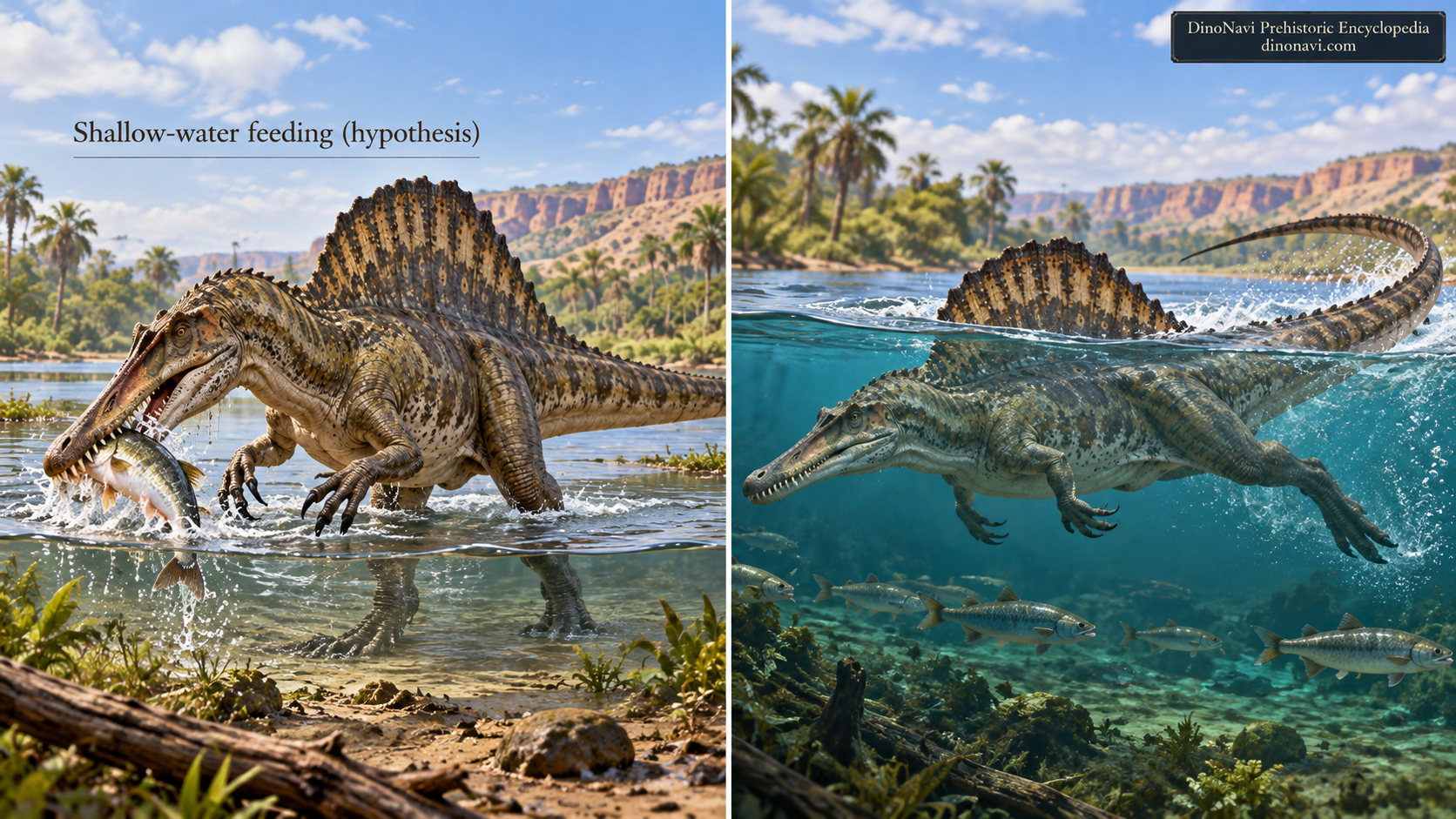
Shallow-water feeding (hypothesis)
DinoNavi Prehistoric Encyclopedia · dinonavi.com
Reconstruction / infographic · Sekimosoft LLC / DinoNavi · AI-generated / code-authored explanatory images
AI conceptual reconstruction, not a photograph of a specimen, excavation or actual museum exhibit. Enlarge to read small labels. Shallow-water feeding and underwater movement are alternative hypotheses, not observed behavior.
Chapter 7 — Walking on Land and Measuring a Giant
The skeletal reconstruction published in 2014 reignited debate over hind-limb proportions, center of mass and terrestrial posture. A later analysis supported bipedal locomotion on land. Missing skeletal elements and model choices continue to affect interpretations. Spinosaurus ranked among the largest predatory dinosaurs, but exact length and mass estimates vary by specimen and reconstruction. A single dramatic number should not be mistaken for a directly measured complete living animal. Imagine this predator beside a modern riverside road or a famous city landmark. Pedestrians, vehicles and buildings provide an engaging sense of scale—but the scene is hypothetical. Comparing length with a building’s height is not valid without explicitly stating the dimension, and perspective must be calibrated rather than invented.
Zoom then drag. Part names at150%, lines and descriptions at250%.
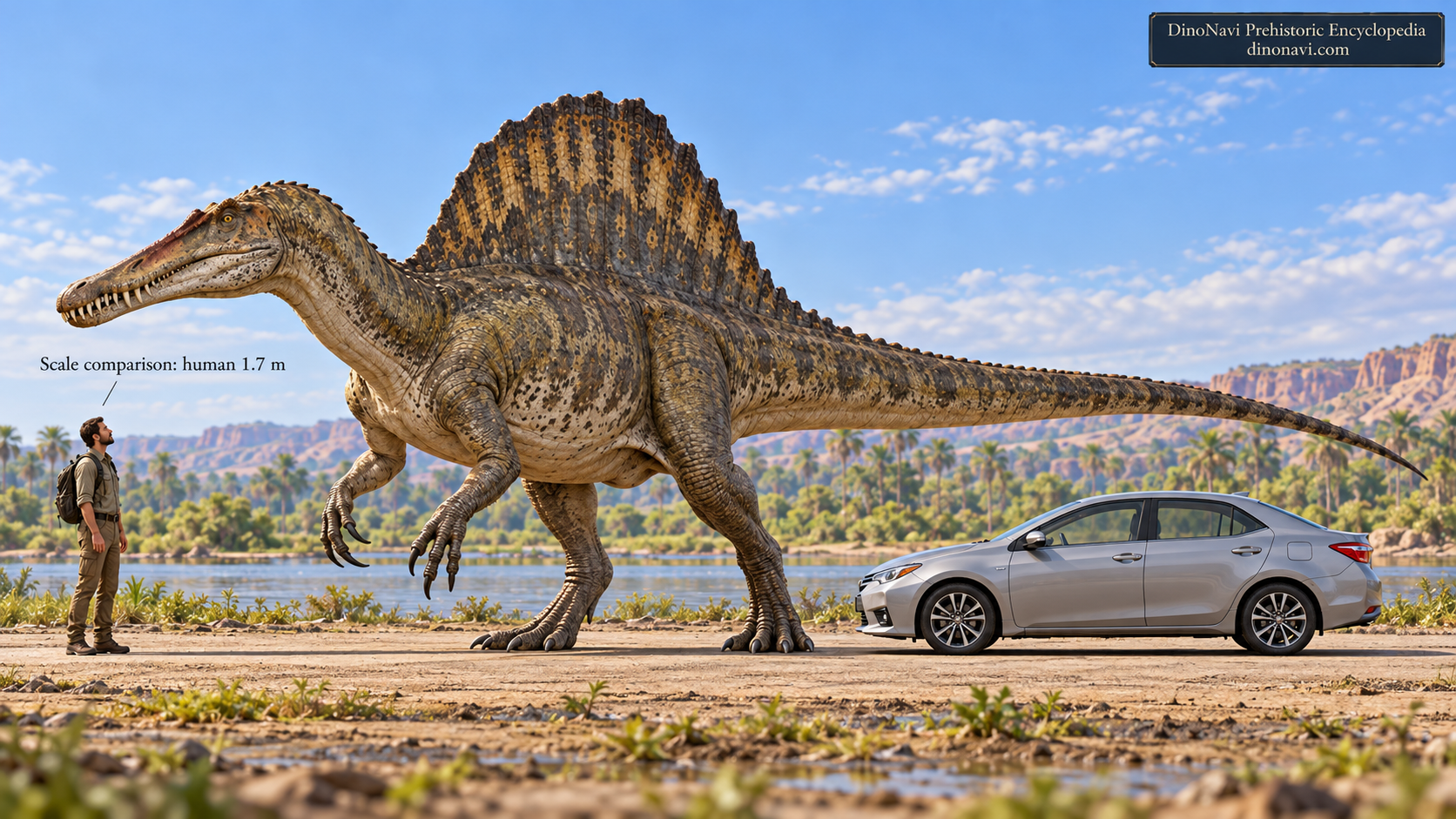
Scale comparison: human 1.7 m
DinoNavi Prehistoric Encyclopedia · dinonavi.com
Reconstruction / infographic · Sekimosoft LLC / DinoNavi · AI-generated / code-authored explanatory images
AI conceptual reconstruction, not a photograph of a specimen, excavation or actual museum exhibit. Enlarge to read small labels. The only numeric reference is the comparison person at1.7m; this is not a measured dinosaur length/height diagram.
Zoom then drag. Part names at150%, lines and descriptions at250%.
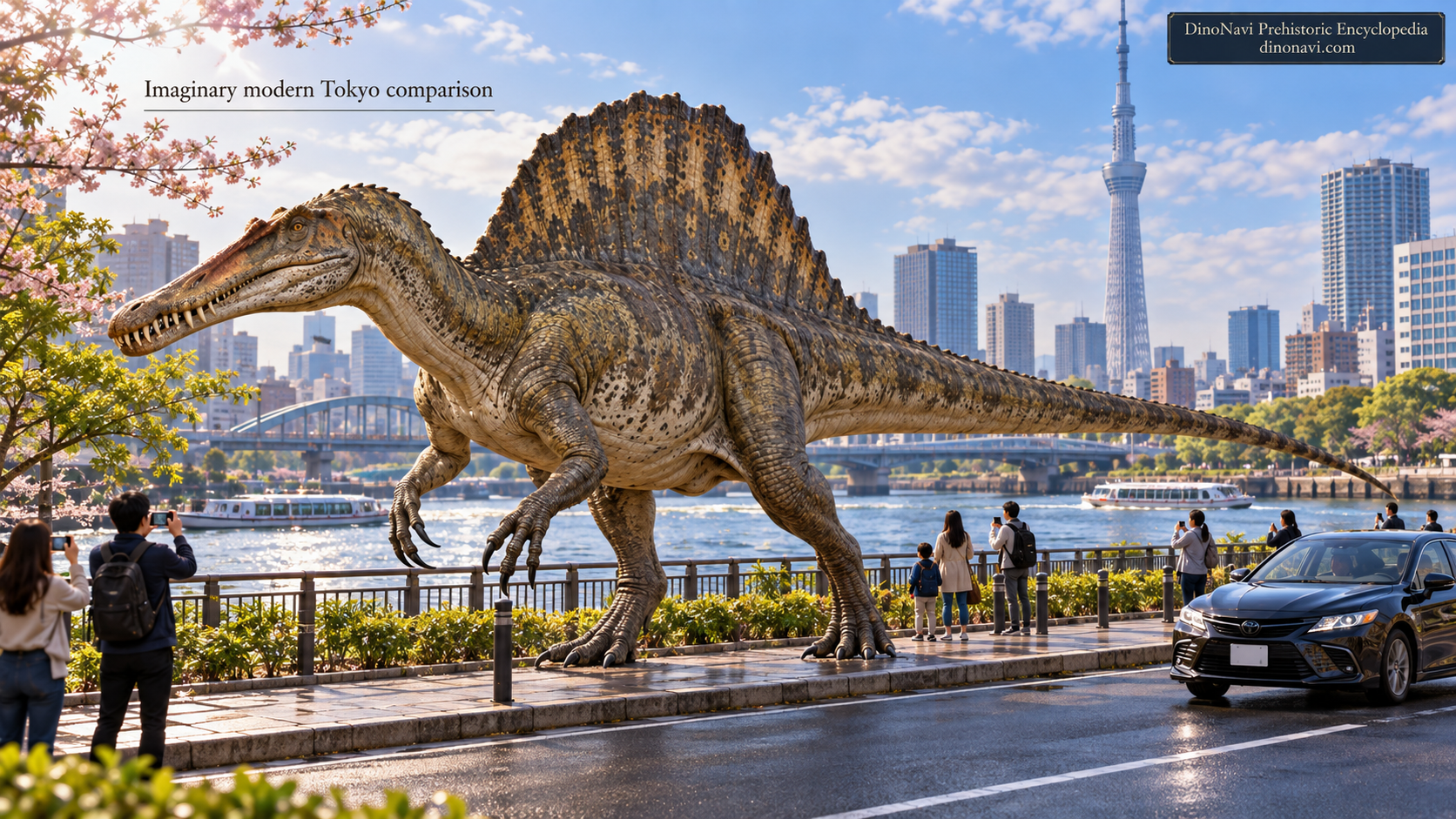
Imaginary modern Tokyo comparison
DinoNavi Prehistoric Encyclopedia · dinonavi.com
Reconstruction / infographic · Sekimosoft LLC / DinoNavi · AI-generated / code-authored explanatory images
AI conceptual reconstruction, not a photograph of a specimen, excavation or actual museum exhibit. Enlarge to read small labels. The modern Tokyo scene is fictional.
Chapter 8 — The Fossils Lost to War
Spinosaurus was originally described in the early twentieth century from Egyptian fossils. Important original material was later destroyed during the Second World War, a loss that complicated subsequent research. Reconstruction has depended on fragmentary material and new North African discoveries. Work published in 2014, 2020, 2022 and 2024 transformed discussions of its body proportions, tail and ecology. Mounted skeletons in museums are not necessarily composed entirely of original bones from a single animal. Restored or comparative elements may fill gaps. Visitors can learn to distinguish fossils, restored skeletons, inferred muscles and artistic skin reconstructions.
Zoom then drag. Part names at150%, lines and descriptions at250%.
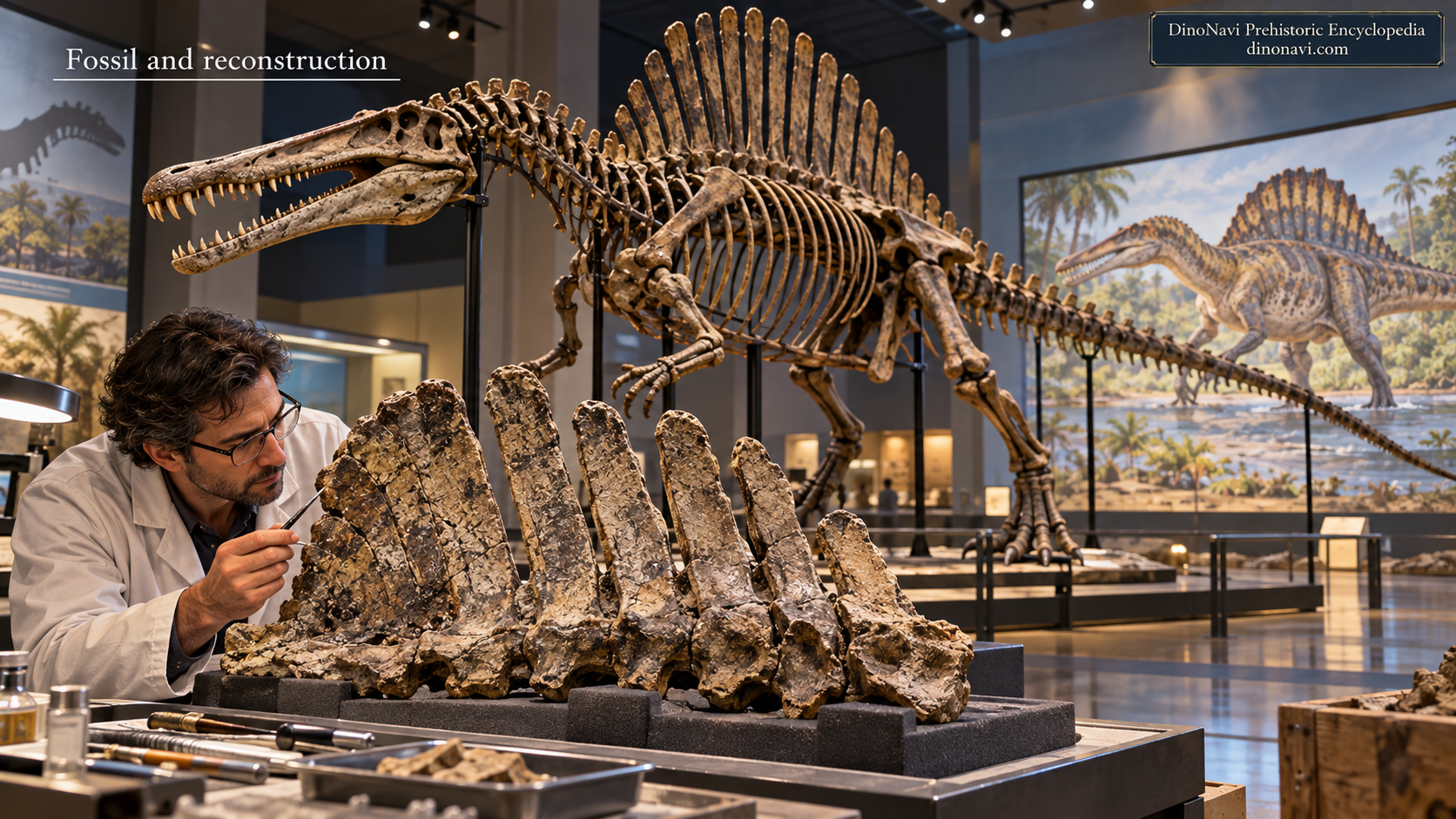
Fossil and reconstruction
DinoNavi Prehistoric Encyclopedia · dinonavi.com
Reconstruction / infographic · Sekimosoft LLC / DinoNavi · AI-generated / code-authored explanatory images
AI conceptual reconstruction, not a photograph of a specimen, excavation or actual museum exhibit. Enlarge to read small labels.
Chapter 9 — A Different Spinosaurus in 2026
In February 2026, researchers named Spinosaurus mirabilis from fossils found in Niger. Its distinctive, strongly curved cranial crest and inland discovery site added new evidence about the diversity of spinosaurs and the ecological settings they occupied. The main subject of this article is Spinosaurus aegyptiacus. The remarkable sabre-shaped crest described for S. mirabilis must not be transferred to S. aegyptiacus as a confirmed feature. The discovery is a reminder that the familiar name Spinosaurus does not represent a single unchanging appearance across every fossil, species and place.
Zoom then drag. Part names at150%, lines and descriptions at250%.
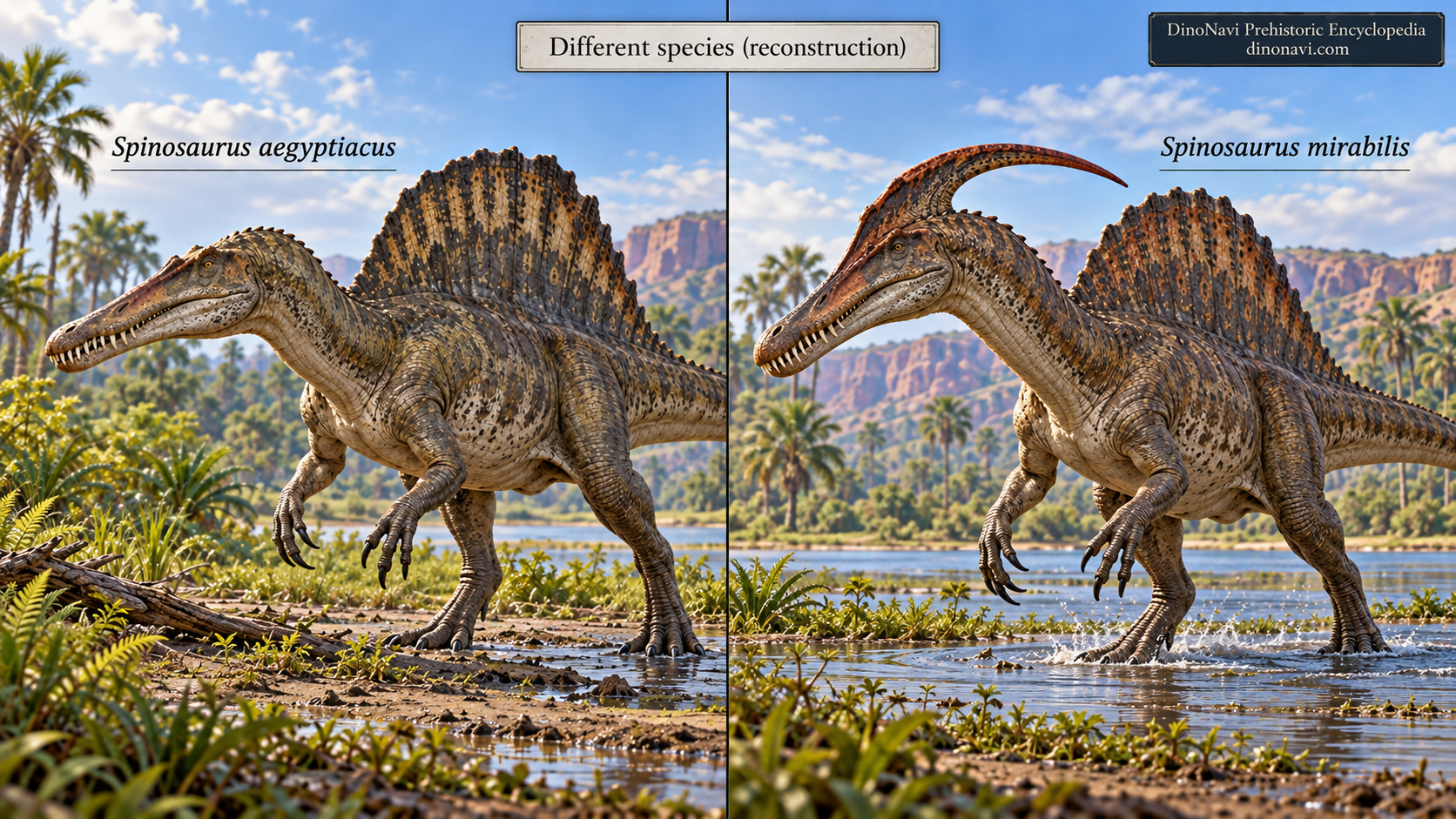
Different species (reconstruction)
DinoNavi Prehistoric Encyclopedia · dinonavi.com
Reconstruction / infographic · Sekimosoft LLC / DinoNavi · AI-generated / code-authored explanatory images
AI conceptual reconstruction, not a photograph of a specimen, excavation or actual museum exhibit. Enlarge to read small labels. Left:S. aegyptiacus; right:the distinct species S. mirabilis. The right cranial crest is not attributed to the primary species.
Chapter 10 — Learning Through Scientific Illustrations
A successful illustrated encyclopedia does more than present attractive wildlife scenes. Enlarged views of jaws and teeth, skeletal and soft-tissue overlays of the dorsal sail, reconstructions of the tail, feeding scenes and diagrams comparing competing swimming hypotheses each answer different questions. A fictional encounter between Spinosaurus and a modern landmark can be a memorable way to understand size. People and vehicles should share a consistent perspective, and any numerical comparison needs a defined anatomical dimension and a defensible reference. Numbers and arrows produced by image models require careful checking. When they are unreliable, labels should be simplified and accurate measurements supplied as structured article text rather than left as misleading marks inside an image.
Conclusion — A Giant Between Water and Land
Spinosaurus combined a towering sail, elongated jaws, unusual tail anatomy and skeletal features that strongly suggest a special relationship with aquatic environments. Fishing was likely a central part of its ecology, but the extent of routine underwater pursuit remains contested. Successive discoveries have changed scientific interpretations and will continue to do so. The excitement lies not in choosing one final picture, but in following how evidence changes the picture. When looking at a restoration, examine the teeth, tail, feet, water depth and—most importantly—the distinction between fossil evidence and the artist’s hypothesis.
Selected references
- [R01] Ibrahim et al. 2014, Semiaquatic adaptations in a giant predatory dinosaur. https://doi.org/10.1126/science.1258750 - [R02] Ibrahim et al. 2020, Tail-propelled aquatic locomotion in a theropod dinosaur. https://doi.org/10.1038/s41586-020-2190-3 - [R03] Fabbri et al. 2022, Subaqueous foraging among carnivorous dinosaurs. https://doi.org/10.1038/s41586-022-04528-0 - [R04] Sereno et al. 2022, Spinosaurus is not an aquatic dinosaur. https://doi.org/10.7554/eLife.80092 - [R05] Myhrvold et al. 2024, Diving dinosaurs? Caveats on the use of bone compactness and pFDA for inferring lifestyle. https://doi.org/10.1371/journal.pone.0298957 - [R06] Sereno et al. 2026, New scimitar-crested Spinosaurus species from the Sahara caps stepwise spinosaurid radiation. https://doi.org/10.1126/science.adx5486 - [R07] Natural History Museum 2026, New sabre-crested Spinosaurus species named from desert dinosaur fossils. https://www.nhm.ac.uk/discover/news/2026/february/new-sabre-crested-spinosaurus-species-named-from-desert-dinosaur-fossils.html - [R08] University of Chicago 2024, New analysis continues debate about how the giant Spinosaurus hunted its prey. https://bsd-divisional.prod.uchicago.edu/news/spinosaurus-aquatic-lifestyle © Sekimosoft LLC / DinoNavi · dinonavi.com
References
- Ibrahim et al. 2014 — Semiaquatic adaptations in a giant predatory dinosaur PENDING: supplied bibliography/claim correspondence not independently verified; access restrictions and mismatches not inferred
- Ibrahim et al. 2020 — Tail-propelled aquatic locomotion in a theropod dinosaur PENDING: supplied bibliography/claim correspondence not independently verified; access restrictions and mismatches not inferred
- Fabbri et al. 2022 — Subaqueous foraging among carnivorous dinosaurs PENDING: supplied bibliography/claim correspondence not independently verified; access restrictions and mismatches not inferred
- Sereno et al. 2022 — Spinosaurus is not an aquatic dinosaur PENDING: supplied bibliography/claim correspondence not independently verified; access restrictions and mismatches not inferred
- Myhrvold et al. 2024 — Diving dinosaurs? Caveats on the use of bone compactness and pFDA for inferring lifestyle PENDING: supplied bibliography/claim correspondence not independently verified; access restrictions and mismatches not inferred
- Sereno et al. 2026 — New scimitar-crested Spinosaurus species from the Sahara caps stepwise spinosaurid radiation PENDING: supplied bibliography/claim correspondence not independently verified; access restrictions and mismatches not inferred
- Natural History Museum 2026 — New sabre-crested Spinosaurus species named from desert dinosaur fossils PENDING: supplied bibliography/claim correspondence not independently verified; access restrictions and mismatches not inferred
- University of Chicago 2024 — New analysis continues debate about how the giant Spinosaurus hunted its prey PENDING: supplied bibliography/claim correspondence not independently verified; access restrictions and mismatches not inferred
Text and figures include AI-assisted creation/editing, reconstructions and schematics. Scientific inferences are not established facts. Full-text checks of some references remain incomplete.
Related encyclopedia entries
Related articles
The Life of Tyrannosaurus rex: From Tiny Hatchling to Giant Predator