Stegosaurus: The Mystery of Its Plates and Spiked Tail
Around 150 million years ago, a striking herbivorous dinosaur walked across the river plains of western North America. Two staggered rows of large plates rose from its back, while four sharp spikes armed the tip of its tail. These structures have become the visual signature of Stegosaurus. But did the plates and spikes serve the same purpose? The fossil evidence tells a more complicated story.
DinoNavi editorial · 2026-10-25T08:07:11.586505+00:00
Stegosaurus: The Mystery of Its Plates and Spiked Tail
Around 150 million years ago, a striking herbivorous dinosaur walked across the river plains of western North America. Two staggered rows of large plates rose from its back, while four sharp spikes armed the tip of its tail. These structures have become the visual signature of Stegosaurus. But did the plates and spikes serve the same purpose? The fossil evidence tells a more complicated story. Editorial note: This article distinguishes fossil evidence from scientific hypotheses and speculative reconstructions. Actual skin color, display behavior, and the details of encounters with predators remain unknown.
1. Meet Stegosaurus
Stegosaurus was a four-legged, plant-eating dinosaur belonging to Thyreophora, the group of armored dinosaurs. Its fossils are especially familiar from the Morrison Formation of western North America. London's Natural History Museum gives approximately nine meters as a representative length and places it in the Late Jurassic, roughly 152–145 million years ago. Lengths varied among individuals and reconstructions; nine meters is not an exact measurement for every animal. Its forelimbs were shorter than its hind limbs, giving its body a distinctive profile. Its head was relatively small, with a beak-like front of the mouth and small teeth suited to processing vegetation. It likely exploited relatively low-growing plants, though a complete menu cannot be read directly from fossils.
Zoom then drag. Part names at150%, lines and descriptions at250%.
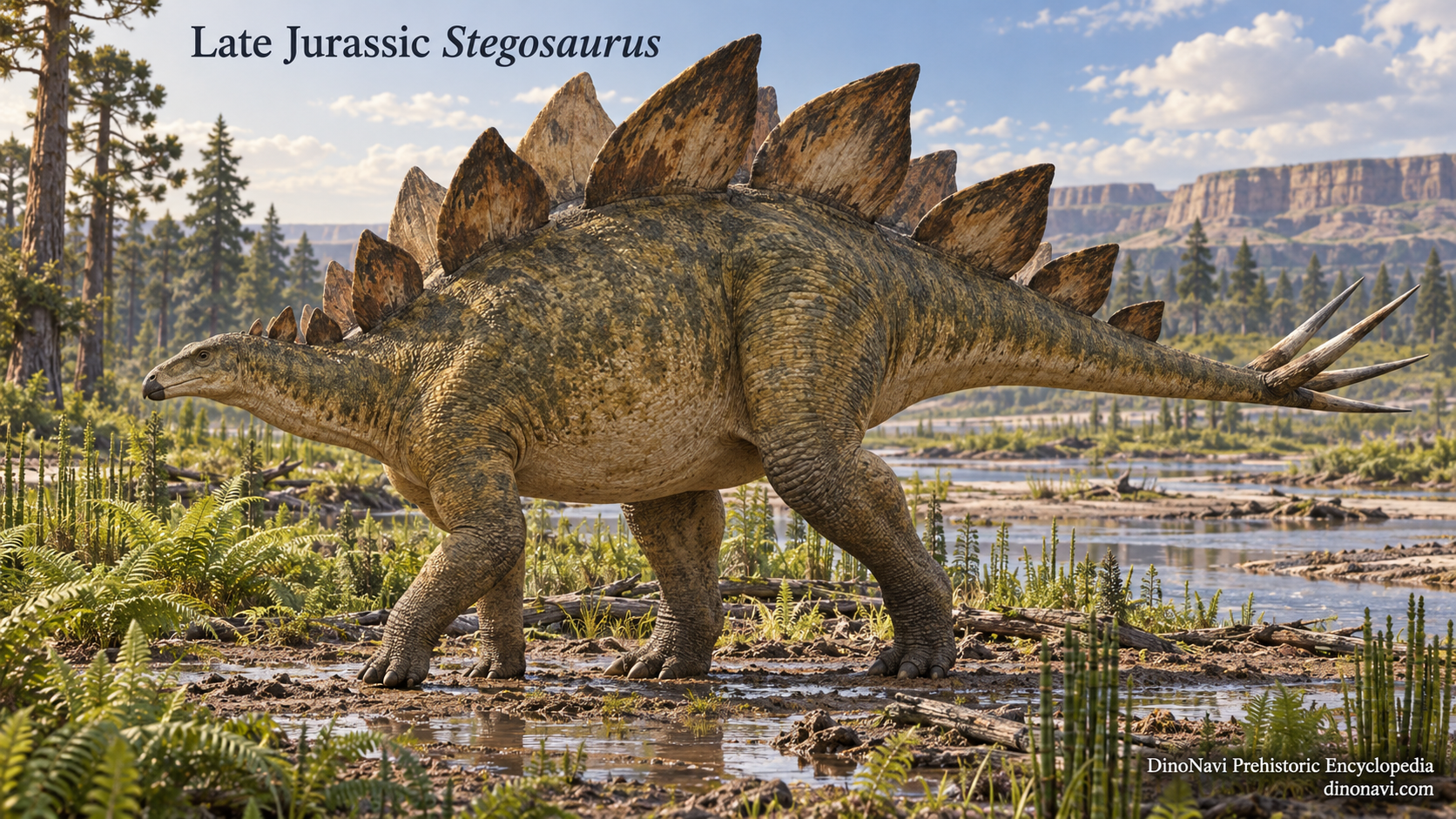
Adult in the Morrison floodplain with time and region identified.
DinoNavi Prehistoric Encyclopedia · dinonavi.com
Reconstruction / infographic · Sekimosoft LLC / DinoNavi · AI-generated / code-authored explanatory images
AI imagined/schematic reconstruction, not a photograph of specimens, actual exhibits or excavation. Color and behavior are uncertain. Enlarge to read diagram text.
2. Were the Plates Attached to Its Backbone?
The plates were made of bone, but they were not simply extensions of the vertebral spines. They formed within the skin as osteoderms and were not directly fused to the vertebrae. This explains why fossil plates are often discovered separated from other skeletal elements. The famous specimen nicknamed Sophie at the Natural History Museum preserves nineteen plates and four tail spikes. Those numbers describe a particular specimen; they are not proof that every Stegosaurus had exactly the same plate count. The plates are normally reconstructed in two alternating upright rows. Early reconstructions imagined them lying flat across the back, illustrating how new fossils can change a familiar dinosaur's appearance.
Zoom then drag. Part names at150%, lines and descriptions at250%.
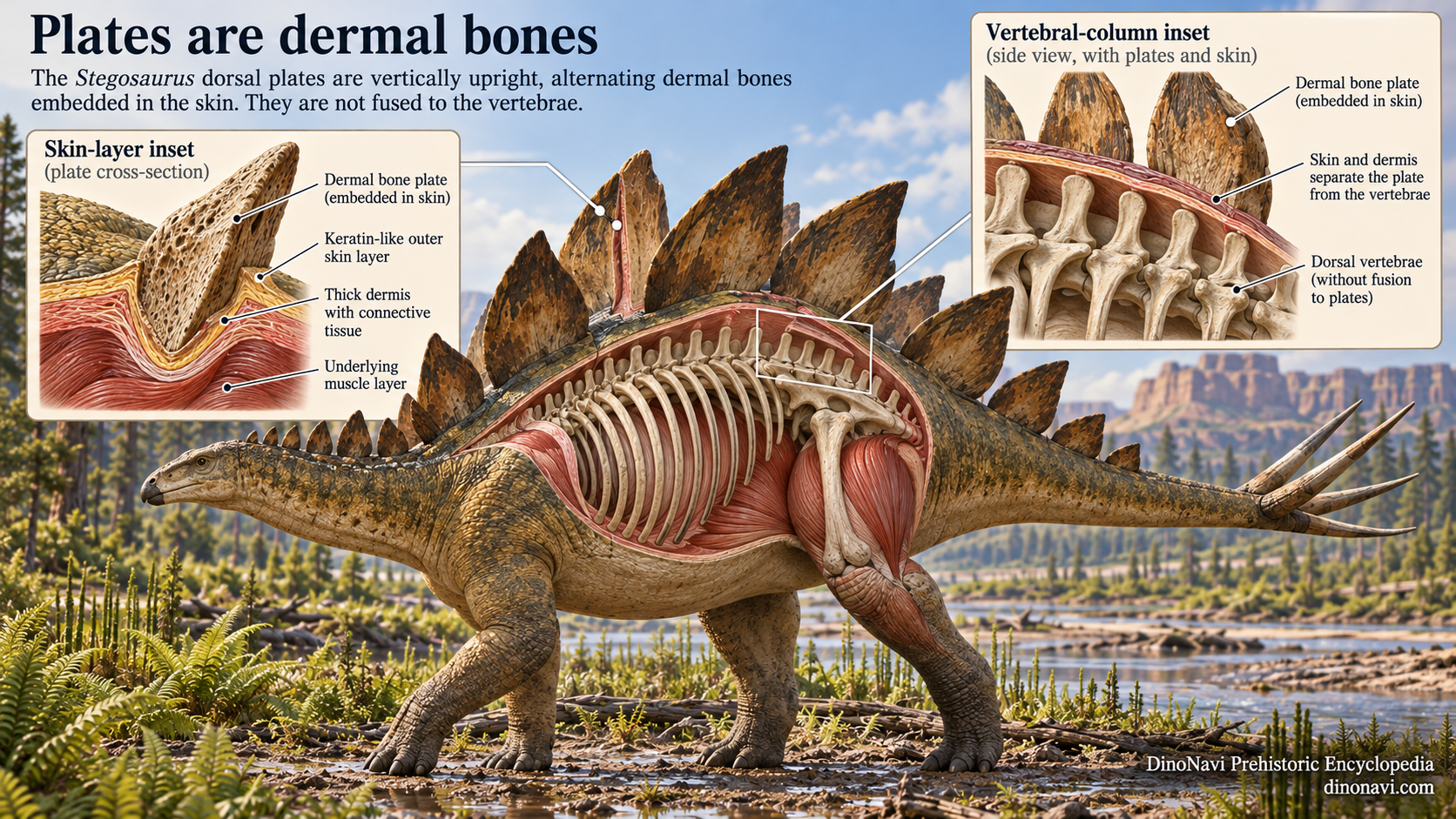
Labeled concept diagram of plate position in the skin and vertebrae below.
DinoNavi Prehistoric Encyclopedia · dinonavi.com
Reconstruction / infographic · Sekimosoft LLC / DinoNavi · AI-generated / code-authored explanatory images
AI imagined/schematic reconstruction, not a photograph of specimens, actual exhibits or excavation. Color and behavior are uncertain. Enlarge to read diagram text. Cross-sections,bones,vessels and arrows are explanatory schematics,not direct records of a particular specimen or measured motion.
3. Were the Plates Armor or Radiators?
Broad and imposing as they appear, the plates were relatively thin. They should not be interpreted simply as thick armor capable of stopping every attack. Their internal architecture included porous bone and spaces associated with vascular structures, and those features changed as the animals developed. One longstanding hypothesis proposes a role in heat transfer. Large surfaces and blood supply could theoretically help release or absorb heat. Experiments and anatomical studies investigated this possibility during the 1970s and later, including studies of plate vascularity. But comparative work on armored dinosaur tissues questioned whether the apparent plumbing was specifically adapted as an efficient radiator. A secondary role in temperature regulation remains possible; it is not a settled explanation for the plates' origin.
Zoom then drag. Part names at150%, lines and descriptions at250%.
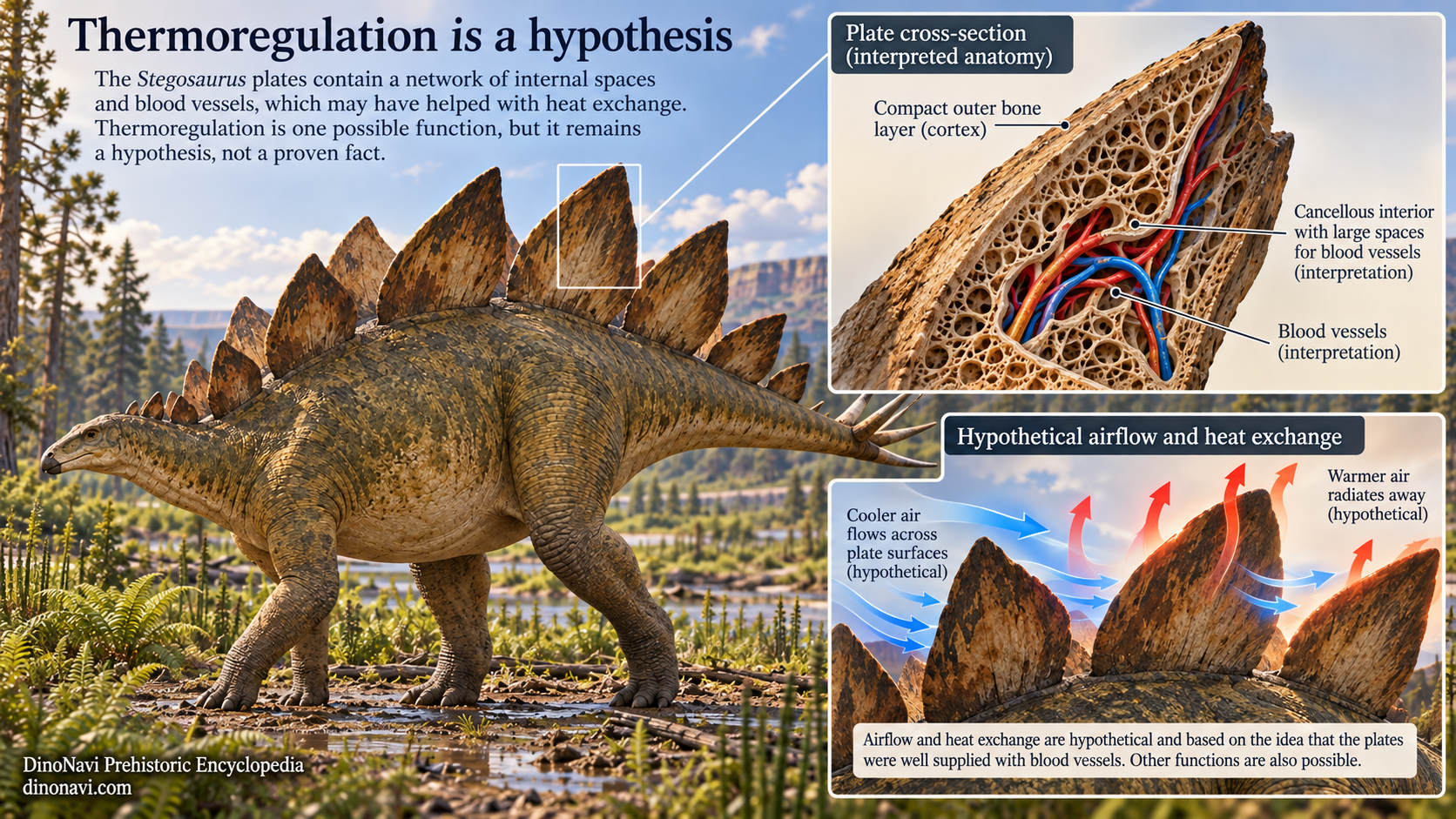
Scientific concept diagram contrasting plate microstructure and the heat-exchange hypothesis; label as hypothesis.
DinoNavi Prehistoric Encyclopedia · dinonavi.com
Reconstruction / infographic · Sekimosoft LLC / DinoNavi · AI-generated / code-authored explanatory images
AI imagined/schematic reconstruction, not a photograph of specimens, actual exhibits or excavation. Color and behavior are uncertain. Enlarge to read diagram text. Cross-sections,bones,vessels and arrows are explanatory schematics,not direct records of a particular specimen or measured motion. Functional,behavioral and growth comparisons are hypotheses or conceptual reconstructions.
4. A Visual Signal to Other Stegosaurs?
Tall plates would have been conspicuous to other members of the species. They could have contributed to recognition, display, or more than one function. Some illustrations give the plates bright colors, yet fossils do not preserve an agreed-upon color scheme for Stegosaurus. A scene showing two adults turning toward one another is an intriguing way to explore this idea. It must be captioned as hypothetical interaction, not an observed courtship ritual or evidence that the plates changed color on command.
Zoom then drag. Part names at150%, lines and descriptions at250%.
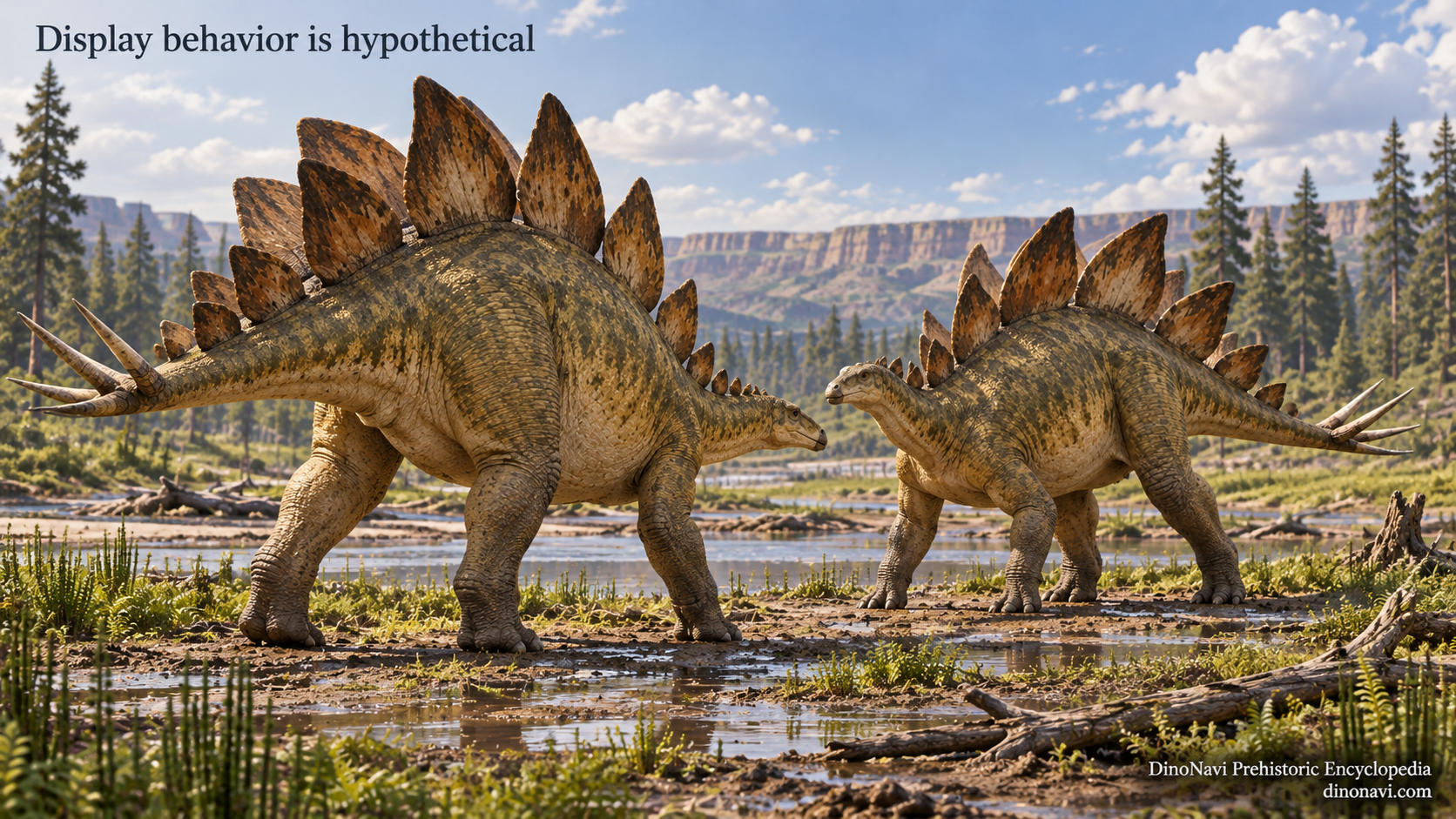
Two adults, speculative display, with uncertainty label.
DinoNavi Prehistoric Encyclopedia · dinonavi.com
Reconstruction / infographic · Sekimosoft LLC / DinoNavi · AI-generated / code-authored explanatory images
AI imagined/schematic reconstruction, not a photograph of specimens, actual exhibits or excavation. Color and behavior are uncertain. Enlarge to read diagram text. Functional,behavioral and growth comparisons are hypotheses or conceptual reconstructions.
5. Four Sharp Spikes at the End of the Tail
Unlike the broad plates, the spikes on the tail have a much more direct potential defensive function. In representative reconstructions of Stegosaurus stenops, two pairs of spikes, four in total, project from the posterior tail. They were not an endless line of sharp spikes running down the entire back. The tail's skeleton and musculature suggest that it could have been moved during threat displays or defensive actions. Nevertheless, fossils cannot reveal an exact strike speed or the outcome of every confrontation. The existence of an anatomical weapon is evidence for a capability, not a record of a particular fight.
Zoom then drag. Part names at150%, lines and descriptions at250%.
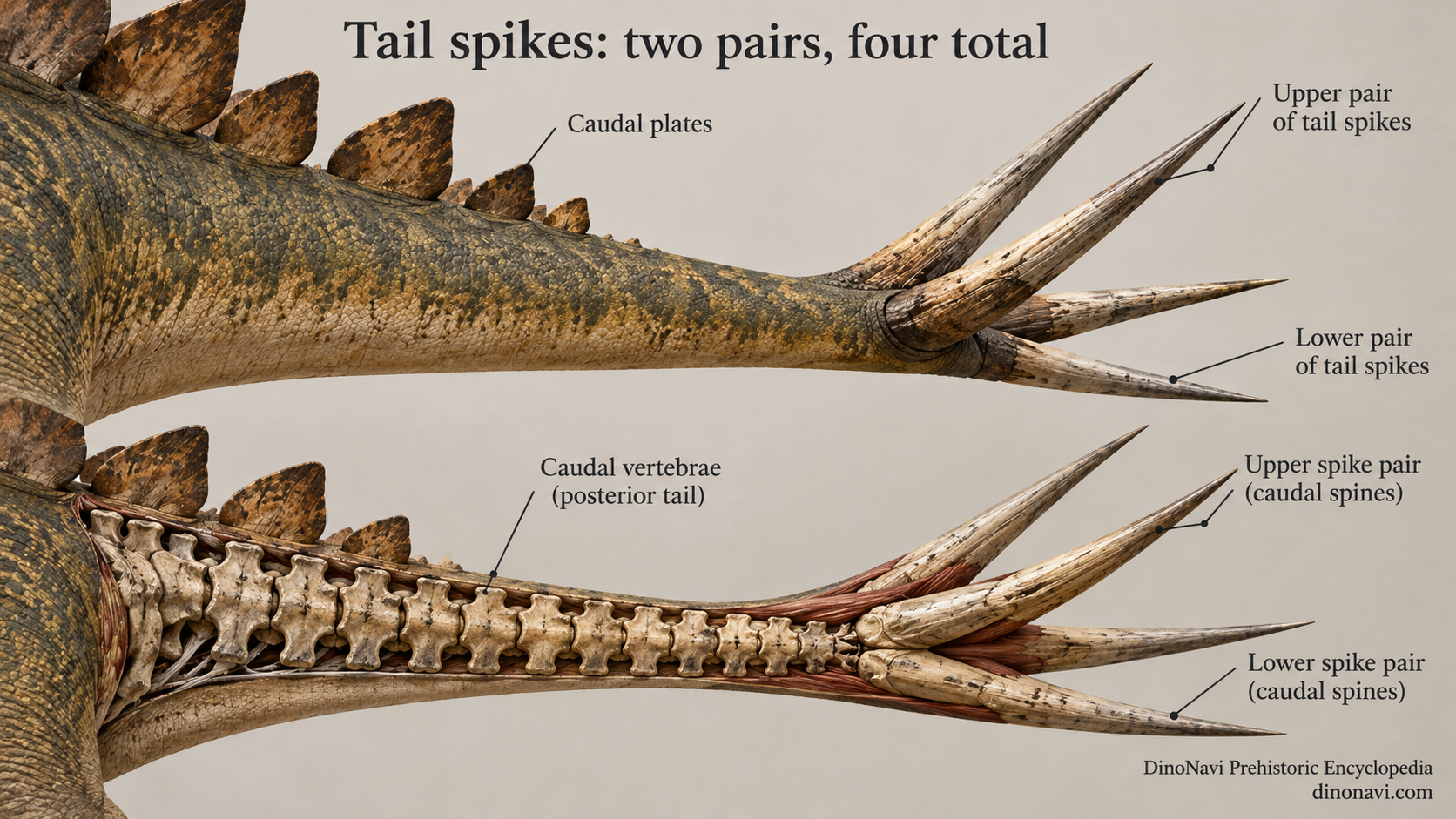
Diagram of tail bones, two pairs of spikes, and possible motion without invented speed numbers.
DinoNavi Prehistoric Encyclopedia · dinonavi.com
Reconstruction / infographic · Sekimosoft LLC / DinoNavi · AI-generated / code-authored explanatory images
AI imagined/schematic reconstruction, not a photograph of specimens, actual exhibits or excavation. Color and behavior are uncertain. Enlarge to read diagram text. Cross-sections,bones,vessels and arrows are explanatory schematics,not direct records of a particular specimen or measured motion.
6. What Happened When Allosaurus Appeared?
The Morrison Formation also contained the large predatory dinosaur Allosaurus. Both animals occupied the same broad ecosystems in the Late Jurassic. That does not establish that dramatic one-on-one battles were constant or inevitable. Researchers have investigated damaged tail spikes and injuries to predatory dinosaur bones as possible signs of such interactions. These interpretations require care: a fossil injury does not automatically identify its cause. A scientifically cautious reconstruction can show an Allosaurus keeping its distance from a Stegosaurus with its tail oriented defensively, without claiming that the illustrated encounter really occurred.
Zoom then drag. Part names at150%, lines and descriptions at250%.
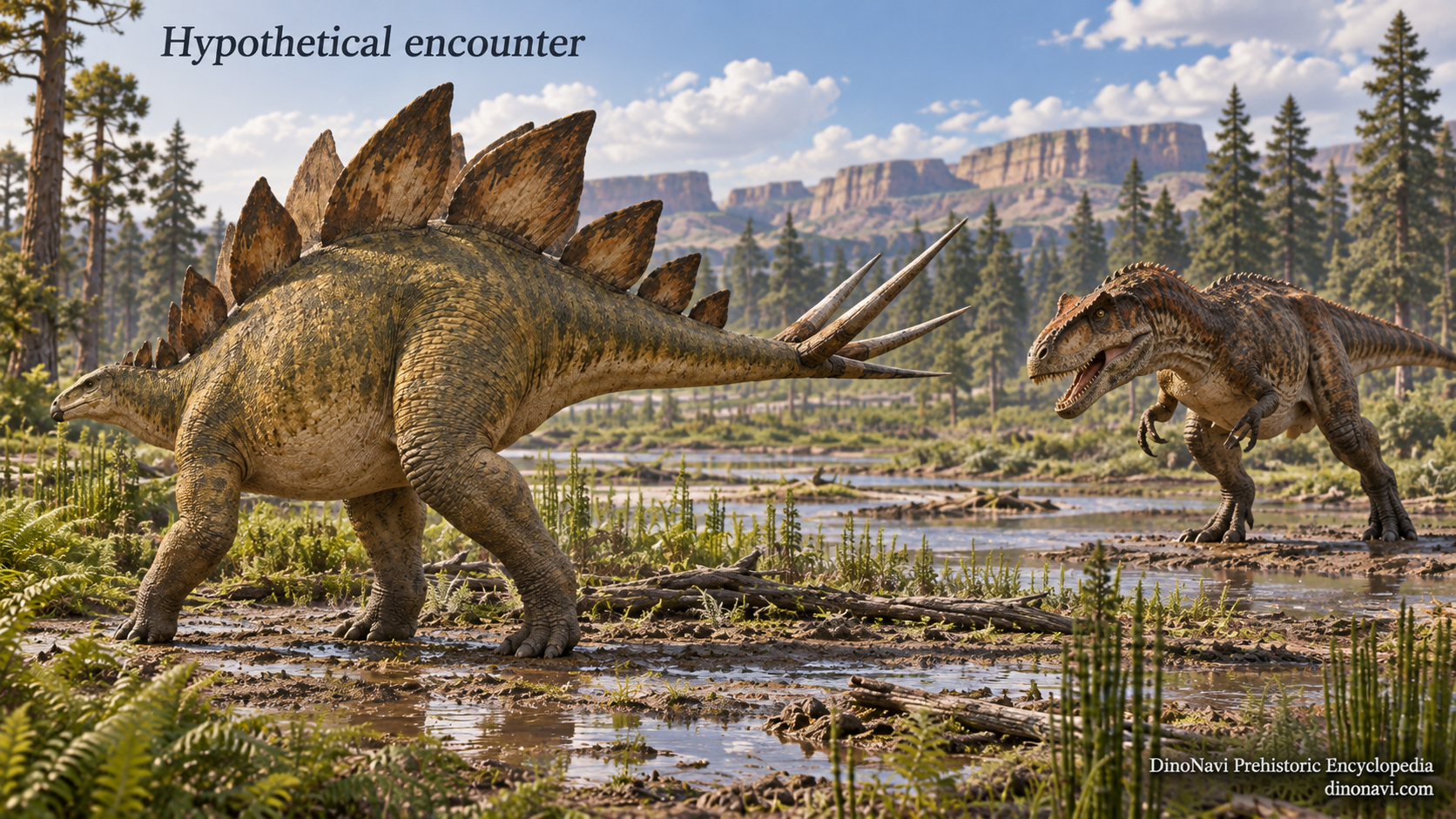
Allosaurus and Stegosaurus facing off, labeled imaginative reconstruction.
DinoNavi Prehistoric Encyclopedia · dinonavi.com
Reconstruction / infographic · Sekimosoft LLC / DinoNavi · AI-generated / code-authored explanatory images
AI imagined/schematic reconstruction, not a photograph of specimens, actual exhibits or excavation. Color and behavior are uncertain. Enlarge to read diagram text. Functional,behavioral and growth comparisons are hypotheses or conceptual reconstructions.
7. The Small Head and the Business of Eating
Stegosaurus had a remarkably small skull relative to its body. Its beak-like front of the jaws and numerous small teeth helped it feed on plants. Its feeding mechanics should not simply be assumed to match those of large chewing mammals. A longstanding popular myth gave Stegosaurus a 'second brain' in its hips. Enlargement of the vertebral canal in that region does not demonstrate a second brain. Nor does a small head allow scientists to declare that a species was stupid. Fossils offer anatomy, not a direct intelligence test.
Zoom then drag. Part names at150%, lines and descriptions at250%.
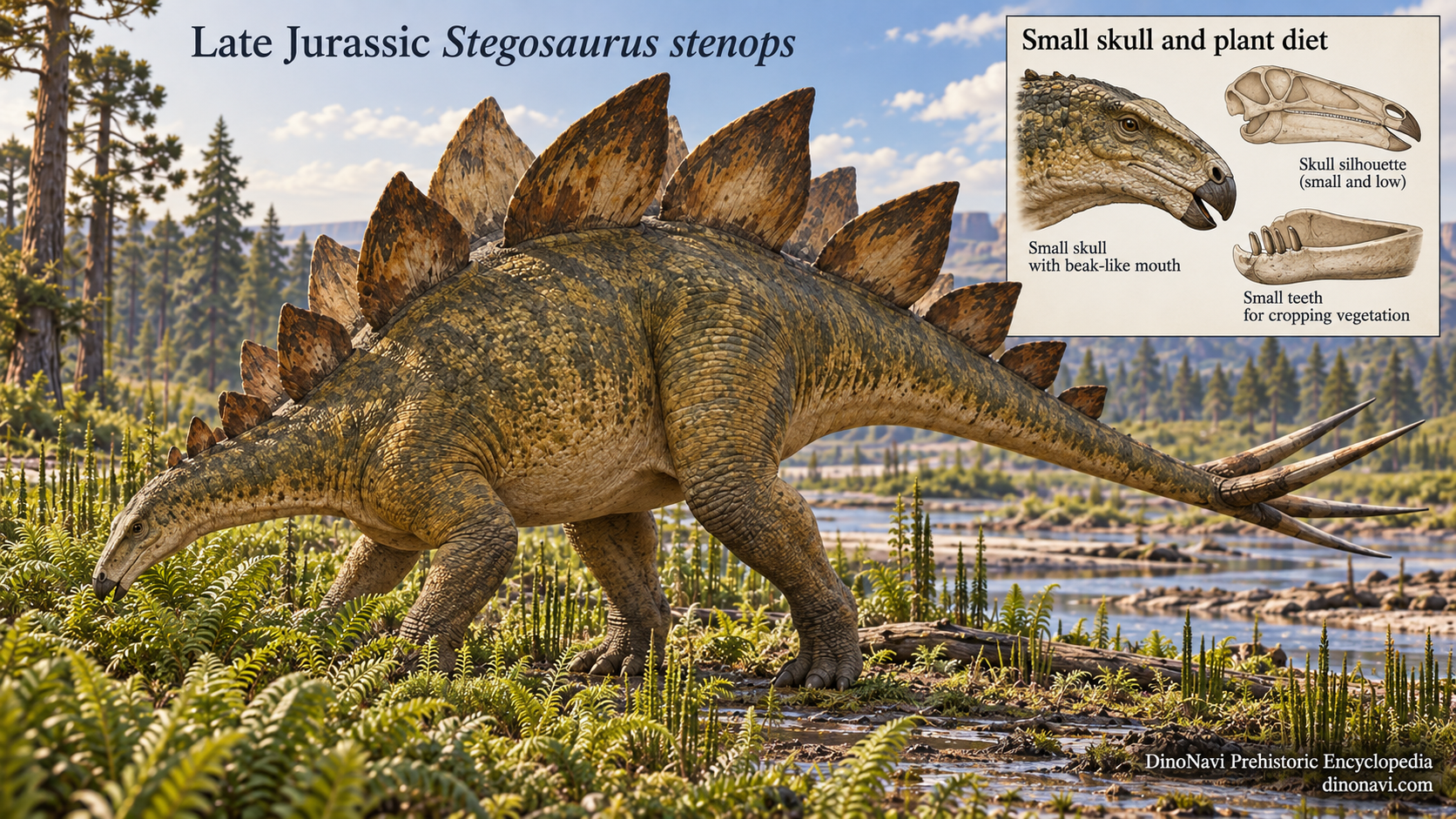
Skull, beak and teeth compared with feeding at low vegetation height.
DinoNavi Prehistoric Encyclopedia · dinonavi.com
Reconstruction / infographic · Sekimosoft LLC / DinoNavi · AI-generated / code-authored explanatory images
AI imagined/schematic reconstruction, not a photograph of specimens, actual exhibits or excavation. Color and behavior are uncertain. Enlarge to read diagram text. Cross-sections,bones,vessels and arrows are explanatory schematics,not direct records of a particular specimen or measured motion.
8. How Did Plates and Spikes Change as It Grew?
Young stegosaurs probably did not have exact miniature replicas of every feature of mature individuals. A 2012 bone-histology study reported changes in the internal structure of plates and spikes through growth. Vascular networks developed in plates, while the cortex of the spikes could become more robust later in life. These features may be consistent with changing roles for display, heat exchange and defense. This does not give a precise age in years at which every plate or spike became functional. Growth diagrams should therefore be labeled conceptual and avoid unsupported numerical age claims.
Zoom then drag. Part names at150%, lines and descriptions at250%.
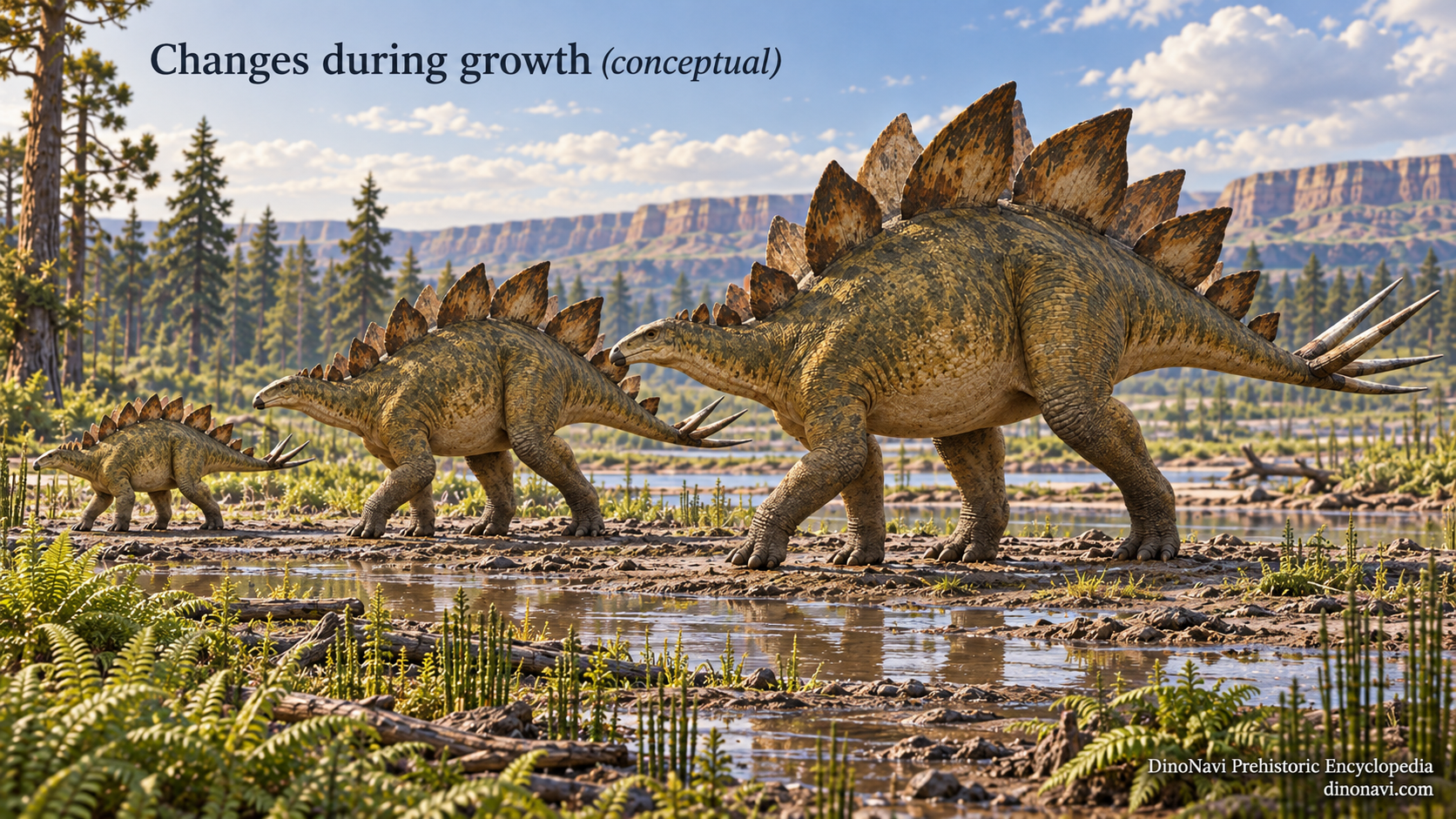
Juvenile, subadult and adult conceptual comparison without invented ages.
DinoNavi Prehistoric Encyclopedia · dinonavi.com
Reconstruction / infographic · Sekimosoft LLC / DinoNavi · AI-generated / code-authored explanatory images
AI imagined/schematic reconstruction, not a photograph of specimens, actual exhibits or excavation. Color and behavior are uncertain. Enlarge to read diagram text. Functional,behavioral and growth comparisons are hypotheses or conceptual reconstructions.
9. Imagine Stegosaurus on a Modern Street
A roughly nine-meter-long Stegosaurus would look astonishing beside a familiar car or bus. Yet a length from snout to tail tip is not the same dimension as shoulder height or the height reached by its dorsal plates. For an imaginative scene set on a modern Tokyo street, a human silhouette of 1.7 meters can serve as a stated reference. Perspective matters: an animal closer to the camera cannot be compared naively with distant architecture. A recognizable modern setting helps visitors grasp scale, but the image must be identified as entertainment and a size comparison, not a photograph of a real prehistoric event.
Zoom then drag. Part names at150%, lines and descriptions at250%.
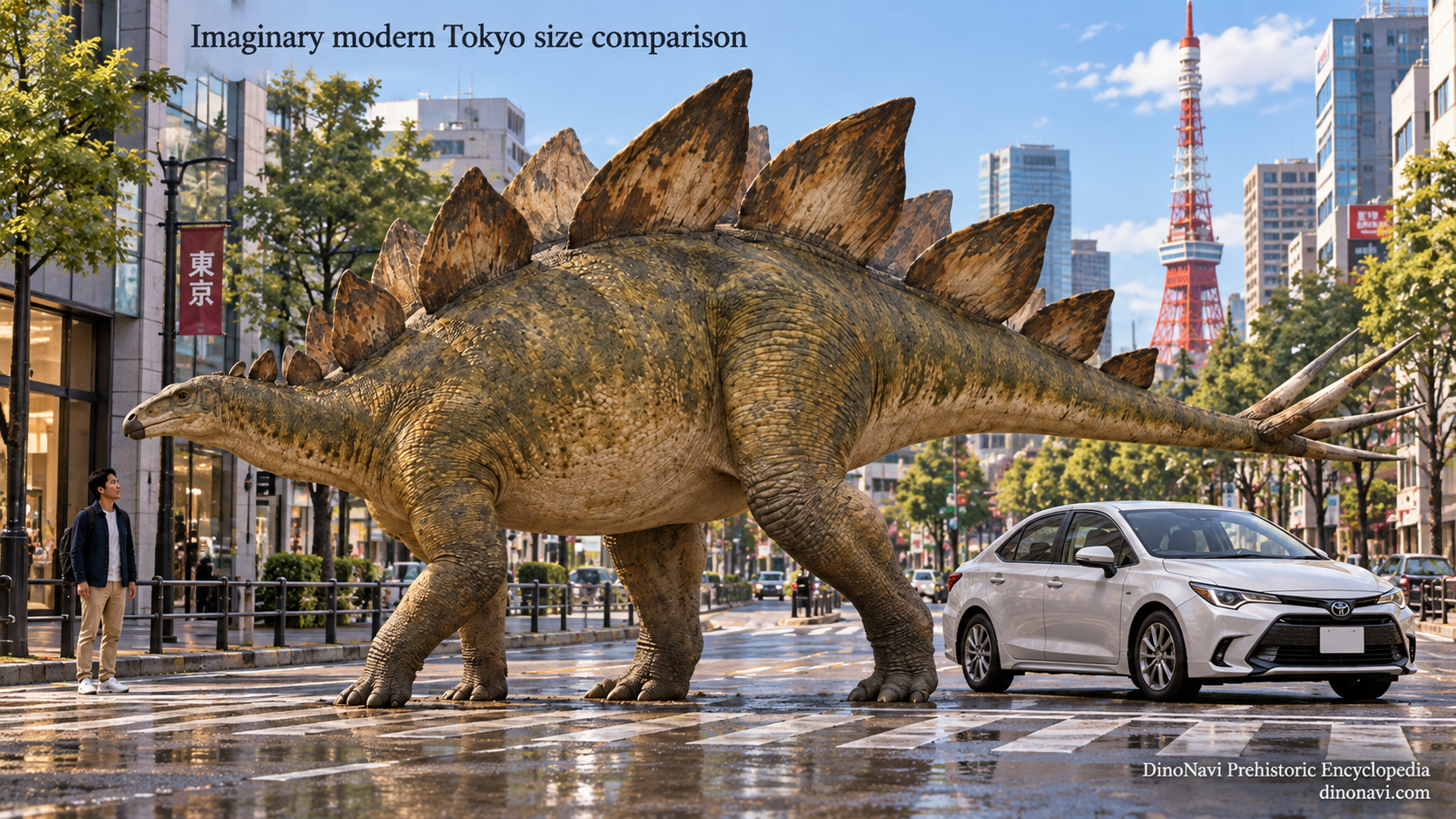
Imagined modern Tokyo comparison with a person and car (perspective illustration)
DinoNavi Prehistoric Encyclopedia · dinonavi.com
Reconstruction / infographic · Sekimosoft LLC / DinoNavi · AI-generated / code-authored explanatory images
AI imagined/schematic reconstruction, not a photograph of specimens, actual exhibits or excavation. Color and behavior are uncertain. Enlarge to read diagram text. Modern Tokyo is fictional. The image is a perspective illustration,not a verified common-plane scale drawing or a measured dinosaur length/height comparison.
10. Fossils, Museums and the Evolution of Reconstruction
Othniel Charles Marsh first named Stegosaurus in 1877. The history of its reconstruction is unusually vivid: what was once imagined as a roof of flat plates became a pair of staggered upright rows as fossil evidence accumulated. The specimen Sophie at London's Natural History Museum is an especially valuable source of skeletal information, including details of the skull and plates. Museum displays may contain original bones alongside casts and reconstructed elements, so observers should not automatically treat every visible component as an original fossil. Images of imagined museum laboratories must be labeled as illustrations rather than documentary photography.
Zoom then drag. Part names at150%, lines and descriptions at250%.
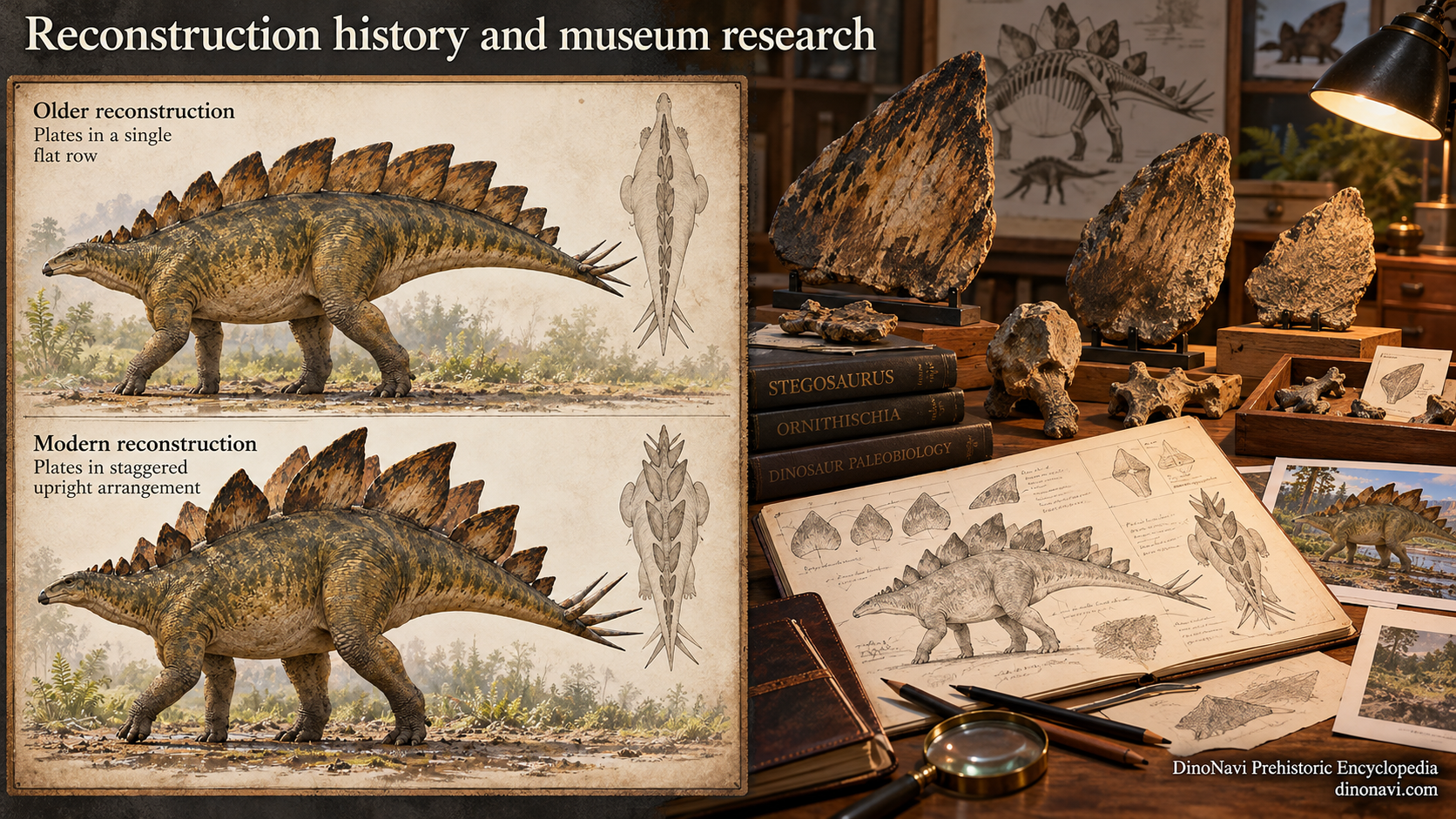
Timeline of Stegosaurus reconstruction and a fictional museum study setting.
DinoNavi Prehistoric Encyclopedia · dinonavi.com
Reconstruction / infographic · Sekimosoft LLC / DinoNavi · AI-generated / code-authored explanatory images
AI imagined/schematic reconstruction, not a photograph of specimens, actual exhibits or excavation. Color and behavior are uncertain. Enlarge to read diagram text. Historical schematic comparison of older and modern plate arrangements. Research room/documents are fictional,not documentary specimen or publication photographs.
Conclusion: Not Every Spike and Plate Was the Same Kind of Tool
The famous plates of Stegosaurus were probably not ordinary armor. Multiple explanations, including display and some contribution to heat exchange, remain subjects of study. The four tail spikes, by contrast, are much more readily interpreted in connection with defense. Treating the two structures separately makes the animal more interesting rather than less. Fossils preserve shapes, microscopic tissues and traces of growth, but not a complete recording of behavior. The next time you see an image of Stegosaurus, look beyond the spectacular silhouette. Its plates and tail tell two different, still-developing scientific stories.
Explore More on DinoNavi
- Stegosaurus species encyclopedia (link to its verified lifeId) - Allosaurus species encyclopedia - How Giant Dinosaurs Evolved (upcoming article) All historical scenes are original scientifically informed or hypothetical illustrations, not photographs of prehistoric events.
References
- Natural History Museum — Stegosaurus dinosaur directory PENDING: supplied bibliography; claim correspondence/content/access not independently verified in179
- Natural History Museum — World’s most complete Stegosaurus goes on show PENDING: supplied bibliography; claim correspondence/content/access not independently verified in179
- Natural History Museum of Utah — Stegosaurus armatus PENDING: supplied bibliography; claim correspondence/content/access not independently verified in179
- Hayashi et al. 2012 — Ontogenetic histology of Stegosaurus plates and spikes PENDING: supplied bibliography; claim correspondence/content/access not independently verified in179
- Farlow et al. 1976 — Plates of dinosaur Stegosaurus: forced convection heat loss fins? PENDING: supplied bibliography; claim correspondence/content/access not independently verified in179
- Main et al. 2005 — Evolution and function of thyreophoran dinosaur scutes PENDING: supplied bibliography; claim correspondence/content/access not independently verified in179
- Farlow et al. 2010 — Internal vascularity of the dermal plates of Stegosaurus PENDING: supplied bibliography; claim correspondence/content/access not independently verified in179
- Natural History Museum — A Stegosaurus brought to life PENDING: supplied bibliography; claim correspondence/content/access not independently verified in179
Text and figures include AI-assisted creation/editing, reconstructions and schematics. Scientific inferences are not established facts. Full-text checks of some references remain incomplete.
Related encyclopedia entries
Related articles
The Life of Tyrannosaurus rex: From Tiny Hatchling to Giant Predator
Triceratops: The Mystery of Its Horns and Frill
Spinosaurus and Life at the Water’s Edge: Did the Sail-Backed Giant Really Swim?