The Evolution of Giant Dinosaurs: How Did Land Animals Become Almost 40 Metres Long?
Around 100 million years ago, a vast animal moved across a landscape of rivers and vegetation in what is now South America. Its neck reached into a wide feeding space, while its huge body travelled on four column-like legs. A giant sauropod would have looked astonishing even beside the largest animals alive today.
DinoNavi editorial · 2026-10-25T09:36:52.907526+00:00
The Evolution of Giant Dinosaurs: How Did Land Animals Become Almost 40 Metres Long?
Around 100 million years ago, a vast animal moved across a landscape of rivers and vegetation in what is now South America. Its neck reached into a wide feeding space, while its huge body travelled on four column-like legs. A giant sauropod would have looked astonishing even beside the largest animals alive today. Yet the question “Which was the biggest dinosaur?” has no simple answer. The longest dinosaur was not necessarily the heaviest. A creature reconstructed from a handful of bones carries more uncertainty than one known from several individuals. This is a story not only of enormous animals but also of how science attempts to measure something that can never be weighed directly. **Editorial note:** All prehistoric sizes here are estimates tied to particular sources. Modern-city scenes are explicitly hypothetical comparisons; they do not imply that non-avian dinosaurs survived into human history.
Chapter 1. Three Different Ways to Be Big
Length, height, and mass
Total length runs from the snout to the tip of the tail. Head height depends on posture, especially the orientation of an exceptionally long neck. Body mass must be estimated using fossil anatomy, relationships between bone dimensions and mass, or a reconstruction of body volume. These are different quantities, and they do not produce a single universal ranking. London's Natural History Museum lists *Patagotitan mayorum* at approximately 37.5 metres long and 57 metric tonnes, while *Argentinosaurus huinculensis* is described at roughly 35 metres and 70 metric tonnes. The latter is known from fragmentary remains, so its reconstructed mass is particularly uncertain. [R01]
Why the labels on an illustration matter
A “length” line must actually connect snout and tail tip, not run vertically to the animal's head. A head-height label should not be called shoulder height. Even a credible number becomes misleading when it is attached to the wrong measurement. For DinoNavi's comparisons, we will use one explicit reference dataset per panel and keep all silhouettes on a common ground plane.
Zoom then drag. Part names at150%, lines and descriptions at250%.
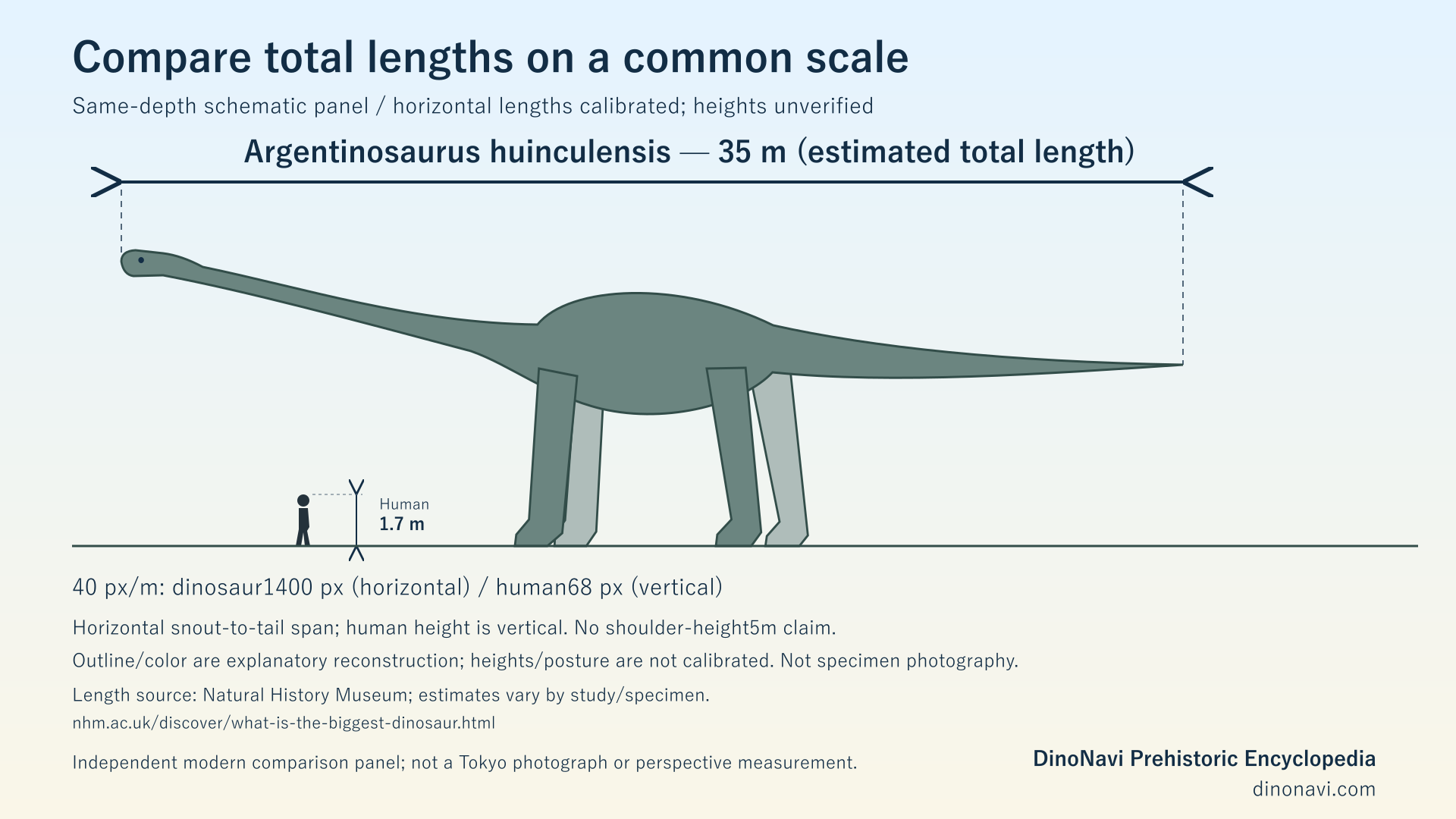
Argentinosaurus estimated total length35m with a1.7m human reference
DinoNavi Prehistoric Encyclopedia · dinonavi.com
Reconstruction / infographic · Sekimosoft LLC / DinoNavi · AI-generated / code-authored explanatory images
Coordinate panel at40px/m:horizontal length1400px;vertical human height68px. No shoulder-height5m measurement. Animal outline/posture/height illustrative.
Chapter 2. The Sauropod Body Plan
Sauropods were primarily herbivorous dinosaurs characterized by long necks, relatively small heads, large bodies, four supporting limbs, and long tails. Not every sauropod was gigantic. However, multiple branches of their evolutionary history produced exceptionally large forms in the Jurassic and Cretaceous. [R02]
A remarkable feeding apparatus
A long neck enabled an animal to reach vegetation across a broad feeding volume without moving its heavy trunk each time. Researchers have proposed that this could have made feeding more economical. It does not follow that every species held its neck vertically throughout the day: posture varied, and exact neck mobility remains a scientific question. [R02] Unlike many large modern herbivorous mammals, sauropods generally did not process all their food through extensive chewing. Their teeth and jaw movements were suited to acquiring vegetation. The idea that every sauropod depended on a permanent stone-filled gastric mill is not supported as a universal explanation. Their internal digestive physiology remains partly reconstructed from comparative biology. [R02]
Zoom then drag. Part names at150%, lines and descriptions at250%.
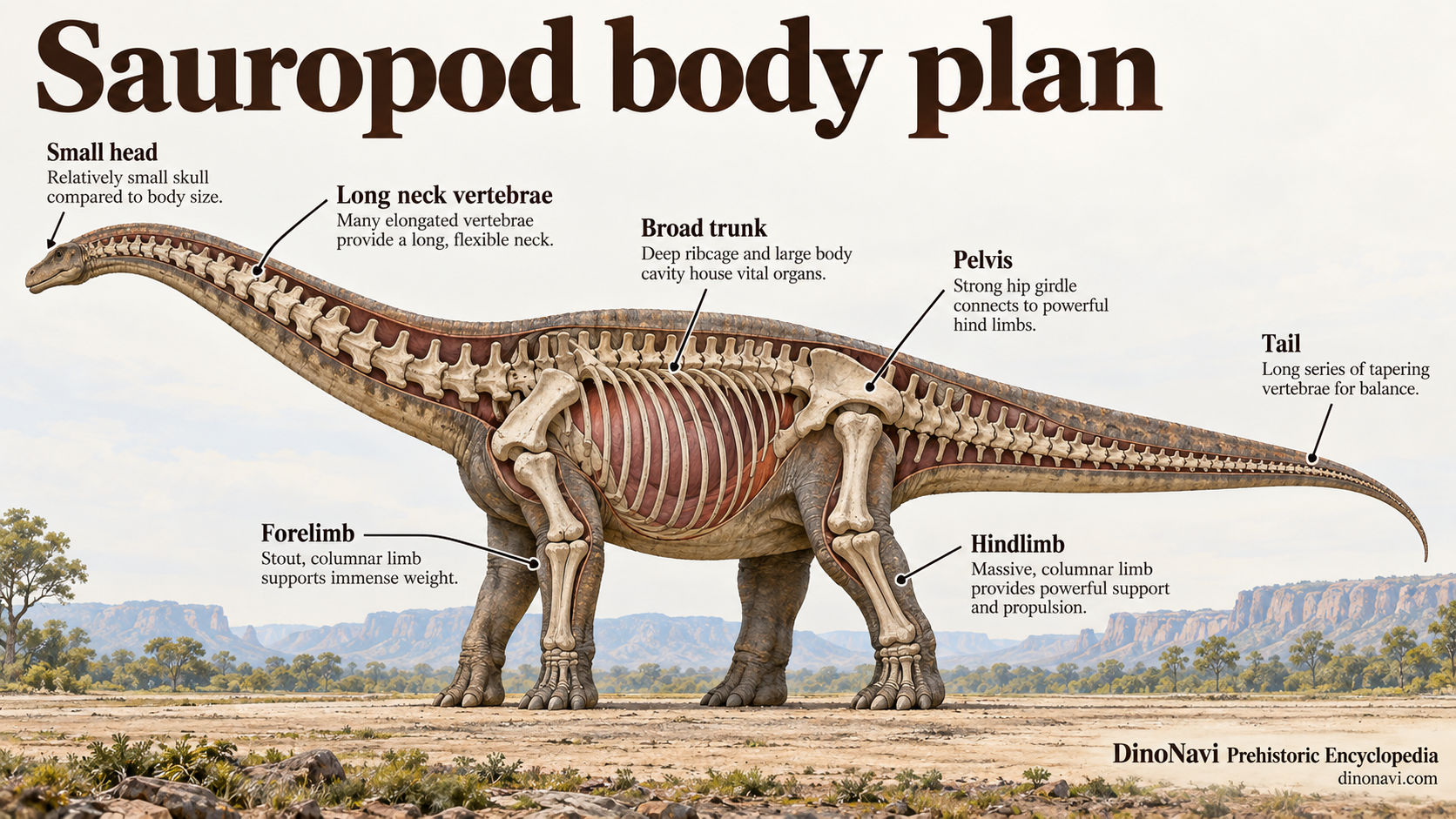
Anatomical overview of a long neck, compact head, immense torso, and four load-bearing legs.
DinoNavi Prehistoric Encyclopedia · dinonavi.com
Reconstruction / infographic · Sekimosoft LLC / DinoNavi · AI-generated / code-authored explanatory images
AI imagined/schematic reconstruction,not documentary photographs of specimens,excavations or actual exhibits. Color,soft tissue and posture are uncertain. Enlarge to read labels. Bones,organs,air spaces,force arrows and estimation models are explanatory schematics,not mapped preserved bones or measurements of a particular specimen.
Chapter 3. Patagotitan: A Giant with Valuable Fossil Evidence
*Patagotitan mayorum* lived in Early Cretaceous Patagonia. It is especially important because several individuals contributed fossil material, making parts of its anatomy more secure than those of giants represented by only a few bones. [R01][R03] The Natural History Museum presents a length of 37.5 metres and an estimated mass of 57 metric tonnes. Meanwhile, the Field Museum's mounted cast, Máximo, stretches 122 feet (around 37.2 metres) and reaches 28 feet (around 8.5 metres) at the head; the museum uses an estimate of approximately 70 US tons. Those figures describe reconstructions based on fossils, not a directly measured live animal. [R01][R03] Standing beside a cast shows scale vividly, but reconstructed displays may include replicas, composite elements, and missing portions restored from related material. Fossil completeness and artistic completeness are not the same thing.
Zoom then drag. Part names at150%, lines and descriptions at250%.
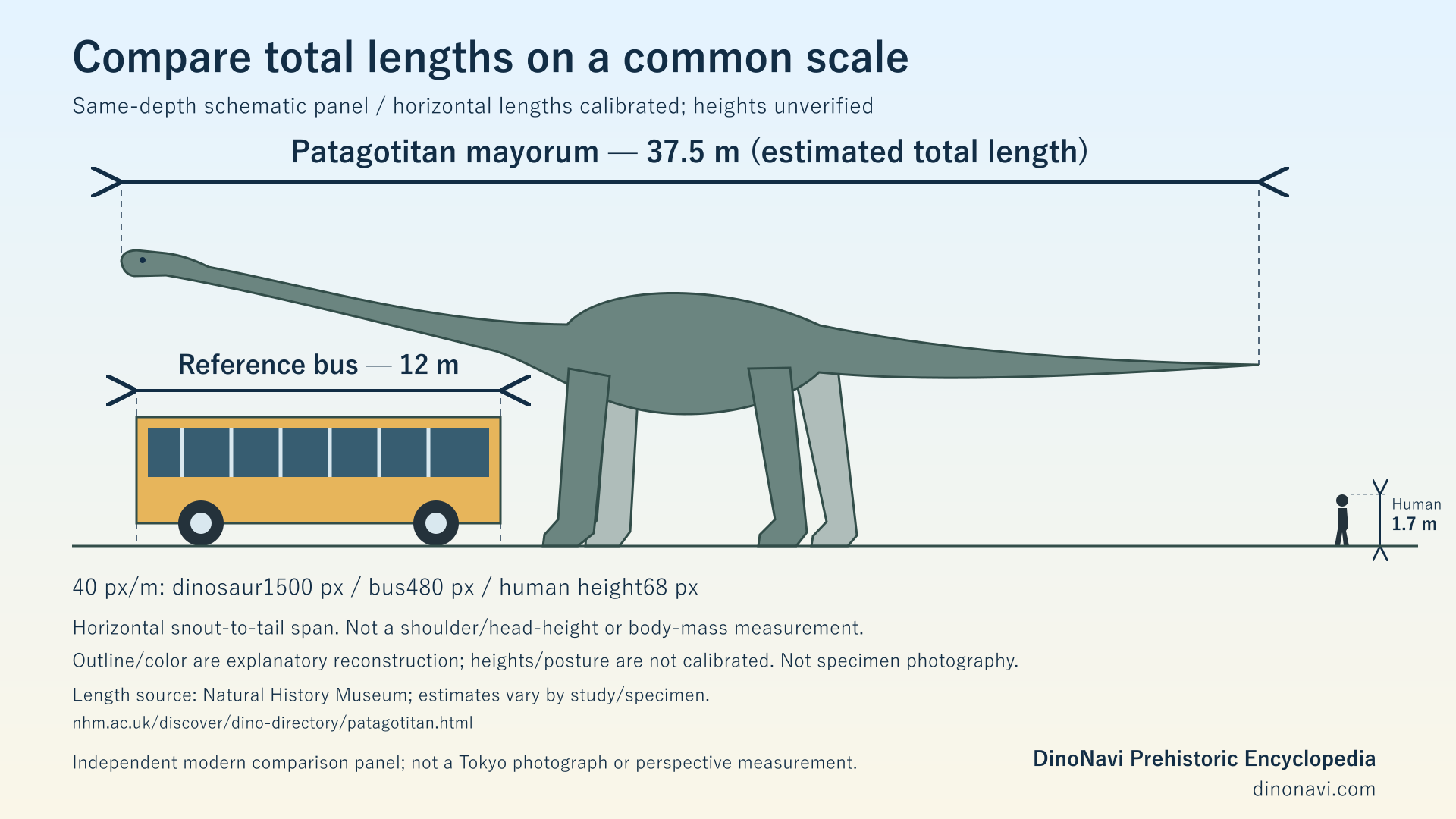
Patagotitan37.5m,reference bus12m and human height1.7m comparison
DinoNavi Prehistoric Encyclopedia · dinonavi.com
Reconstruction / infographic · Sekimosoft LLC / DinoNavi · AI-generated / code-authored explanatory images
Length horizontal,height vertical.40px/m:dinosaur1500px,bus480px,human68px. Dinosaur height/posture illustrative,not calibrated.
Image source
Chapter 4. Argentinosaurus: Huge, but Incompletely Known
*Argentinosaurus huinculensis* is another immense South American titanosaur. The Natural History Museum gives it an illustrative length of about 35 metres and an estimated mass of about 70 metric tonnes. However, its fossil record is incomplete: researchers must infer the missing skeleton around large vertebrae and limb elements. [R01] It is therefore unwise to declare Argentinosaurus indisputably the largest animal that ever walked on land. Discovering more of its skeleton could substantially change interpretations of body shape and volume. A limited record is not an embarrassment; it is part of the scientific problem.
Zoom then drag. Part names at150%, lines and descriptions at250%.
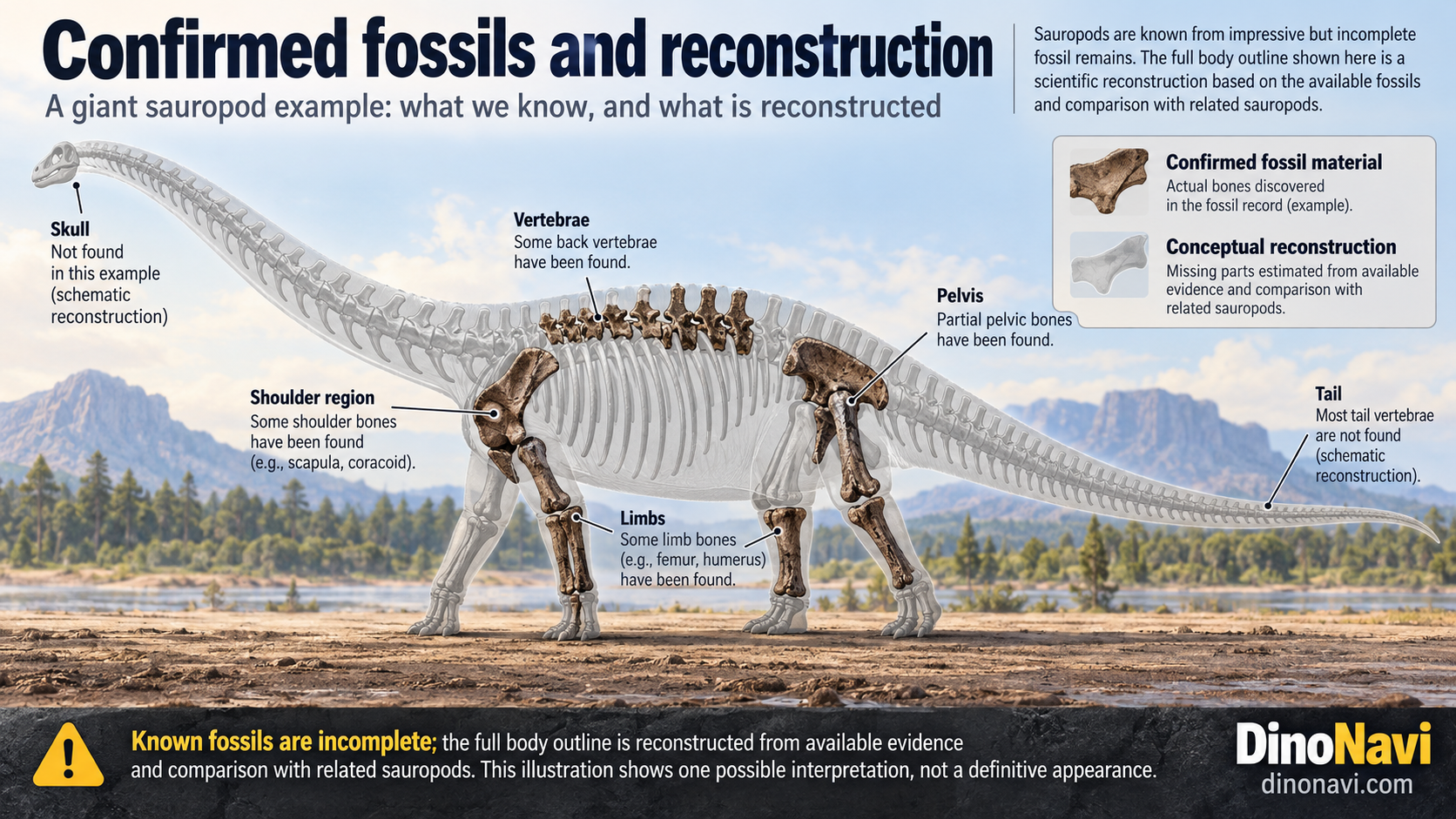
Confirmed fossil material versus inferred reconstruction (generic sauropod schematic)
DinoNavi · dinonavi.com
Reconstruction / infographic · Sekimosoft LLC / DinoNavi · AI-generated / code-authored explanatory images
AI generic explanatory schematic. Brown/gray illustrates observed versus inferred material;it is not a preserved-bone map of an actual Argentinosaurus or other named specimen. Not a documentary photograph.
Chapter 5. Dreadnoughtus and the Uncertainty of Mass
*Dreadnoughtus schrani* offers an especially useful lesson in how mass estimation works. Some early estimates placed this sauropod at roughly 59 tonnes, while different models based on reconstructed body volume produced figures closer to 22 tonnes. The Natural History Museum notes this striking range. [R01] The animal did not physically change size between papers. Different scientists were estimating missing muscles, air spaces, body contours, and total volume using different assumptions. Techniques based on the load-bearing dimensions of limb bones do not necessarily agree with those based on volumetric reconstructions. Rather than accepting a mass figure without qualification, ask: which skeletal elements were measured, which model was used, and how much of the living animal was reconstructed?
Zoom then drag. Part names at150%, lines and descriptions at250%.
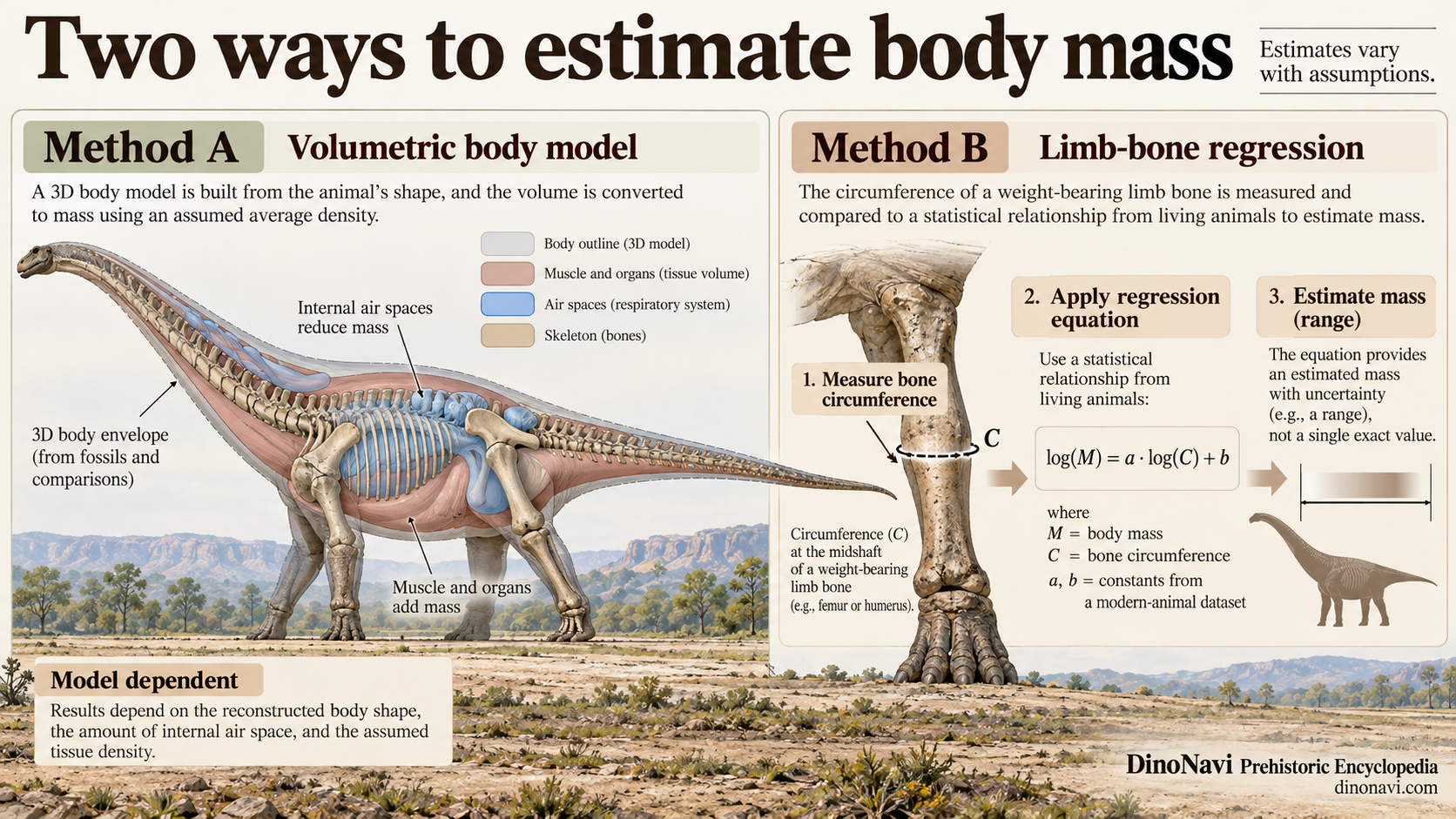
A conceptual comparison between volume-based mass estimation and estimates made from limb-bone dimensions.
DinoNavi Prehistoric Encyclopedia · dinonavi.com
Reconstruction / infographic · Sekimosoft LLC / DinoNavi · AI-generated / code-authored explanatory images
AI imagined/schematic reconstruction,not documentary photographs of specimens,excavations or actual exhibits. Color,soft tissue and posture are uncertain. Enlarge to read labels. Bones,organs,air spaces,force arrows and estimation models are explanatory schematics,not mapped preserved bones or measurements of a particular specimen. Volume/density and limb-bone regression depend on assumptions/datasets;coefficients are conceptual.59t and22t are different published estimates,not one settled body mass.
Chapter 6. Supporting the Weight and Moving Air
The limbs of the largest sauropods became imposing load-bearing structures. Their posture may remind us of elephants, but their toes, claws, proportions, and evolutionary origins differed substantially from those of mammals. Every illustrated foot needs the correct anatomy for its own dinosaur group. Features in sauropod vertebrae have also been interpreted as evidence of an air-sac system comparable in broad organization to that of living birds. Air spaces within the skeleton and the respiratory apparatus may have mattered for long necks and efficient gas exchange. The exact layout of soft tissues cannot simply be read from a fossilized backbone. [R02] A sensible anatomical diagram should therefore differentiate the preserved bone from the hypothetical shape of internal organs.
Zoom then drag. Part names at150%, lines and descriptions at250%.
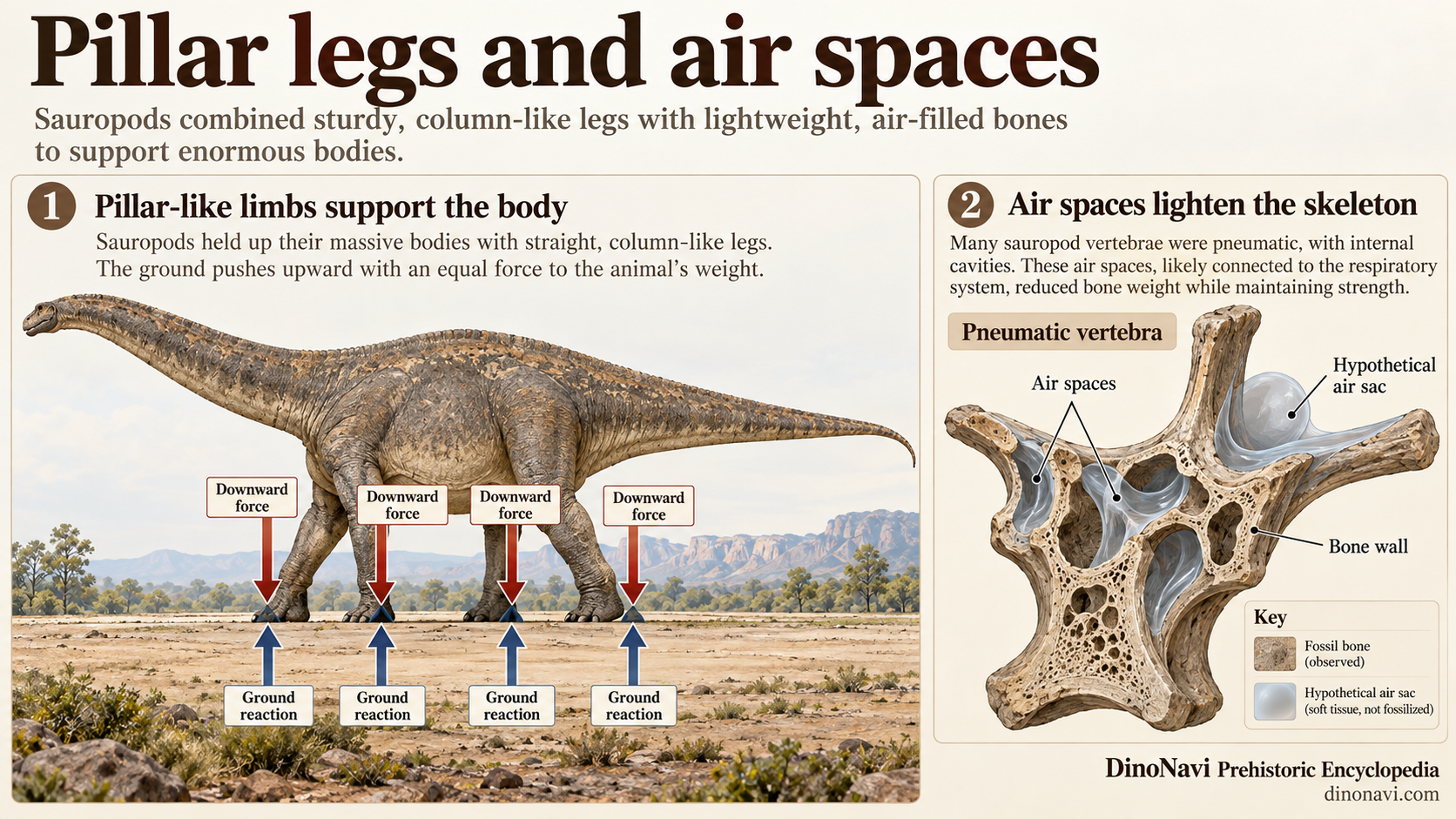
Cross-section of a pneumatic vertebra and conceptual load paths through sauropod limbs.
DinoNavi Prehistoric Encyclopedia · dinonavi.com
Reconstruction / infographic · Sekimosoft LLC / DinoNavi · AI-generated / code-authored explanatory images
AI imagined/schematic reconstruction,not documentary photographs of specimens,excavations or actual exhibits. Color,soft tissue and posture are uncertain. Enlarge to read labels. Bones,organs,air spaces,force arrows and estimation models are explanatory schematics,not mapped preserved bones or measurements of a particular specimen.
Chapter 7. From Egg to Giant
Even the largest sauropod began life at a vastly smaller scale. Sauropods laid eggs, and their young experienced enormous changes in size before becoming adults. Egg dimensions are constrained biologically; giant adult body mass does not imply equally giant eggs in direct proportion. [R02] Evidence of nesting colonies and fossil trackways in different sauropod groups provides glimpses into their lives. But we should not transfer the specific parental behaviour of one species to every other sauropod. Whether individuals received prolonged care remains uncertain in many cases. Small juveniles probably encountered ecological dangers very different from those faced by massive adults. The familiar image of a towering grown dinosaur represents only one stage in a much longer life story.
Zoom then drag. Part names at150%, lines and descriptions at250%.
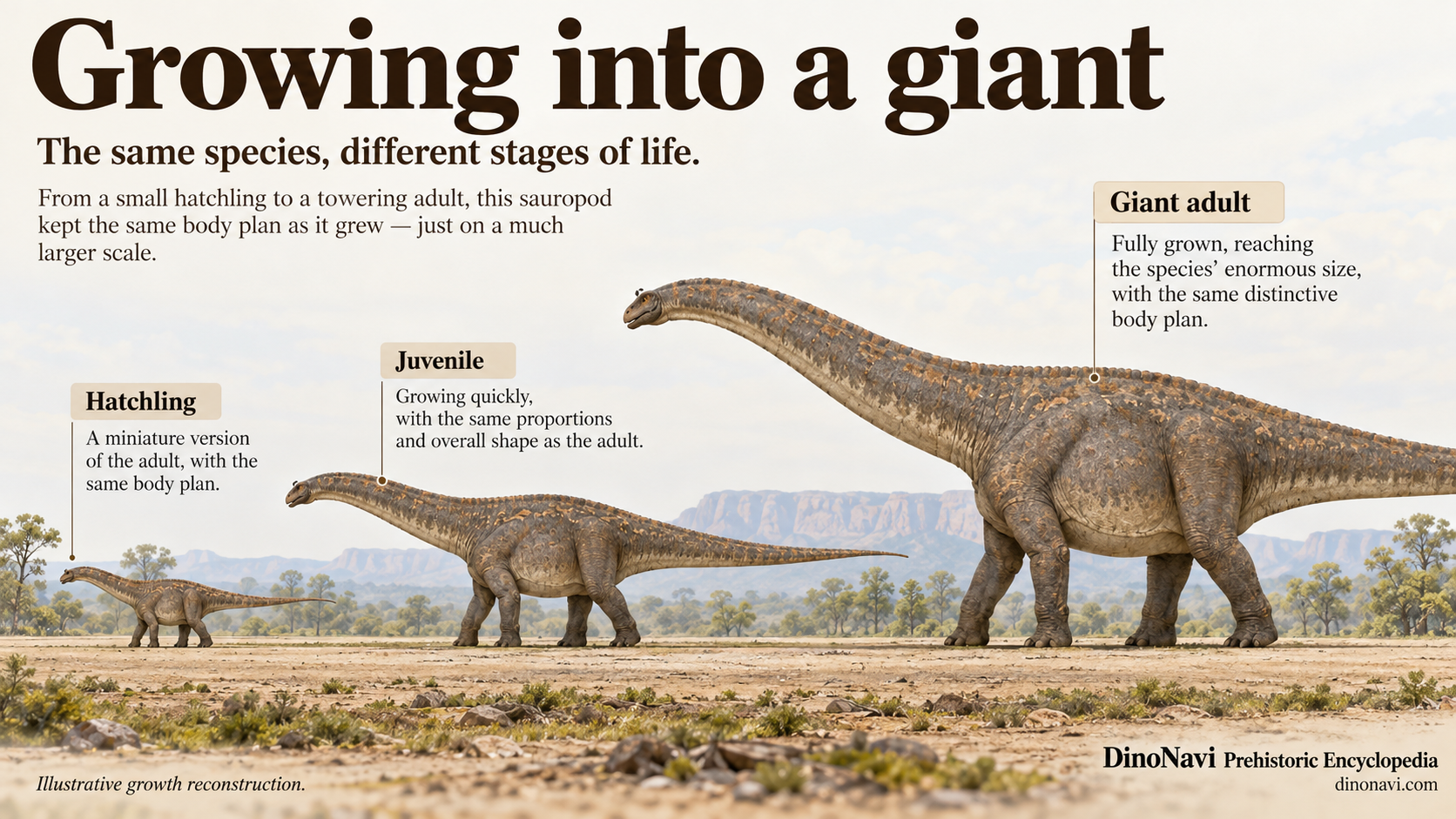
Hatchling, juvenile, and adult shown in a conceptual growth sequence without inventing precise ages.
DinoNavi Prehistoric Encyclopedia · dinonavi.com
Reconstruction / infographic · Sekimosoft LLC / DinoNavi · AI-generated / code-authored explanatory images
AI imagined/schematic reconstruction,not documentary photographs of specimens,excavations or actual exhibits. Color,soft tissue and posture are uncertain. Enlarge to read labels. Conceptual growth stages,not proof of precise ages or identical body proportions at every age. Adult tail extends outside the frame.
Chapter 8. Why Evolve to Be So Large?
Immense size could have offered important advantages, including reduced vulnerability to some predators and access to large amounts of vegetation. It also came with costs: huge energy requirements, the need to grow quickly enough to survive, reproductive constraints, mechanical stress, and challenges associated with moving such large bodies. Evolutionary research emphasizes combinations rather than a single magical cause. Long necks, feeding efficiency, respiratory anatomy, life history, and inherited features may have worked together to enable extraordinary gigantism. Multiple sauropod lineages evolved extremely large bodies independently. [R02] Thus the story is not one of a single evolutionary ladder steadily climbing toward a champion. It is a branching history of dinosaurs finding different ways to inhabit enormous body sizes.
Zoom then drag. Part names at150%, lines and descriptions at250%.
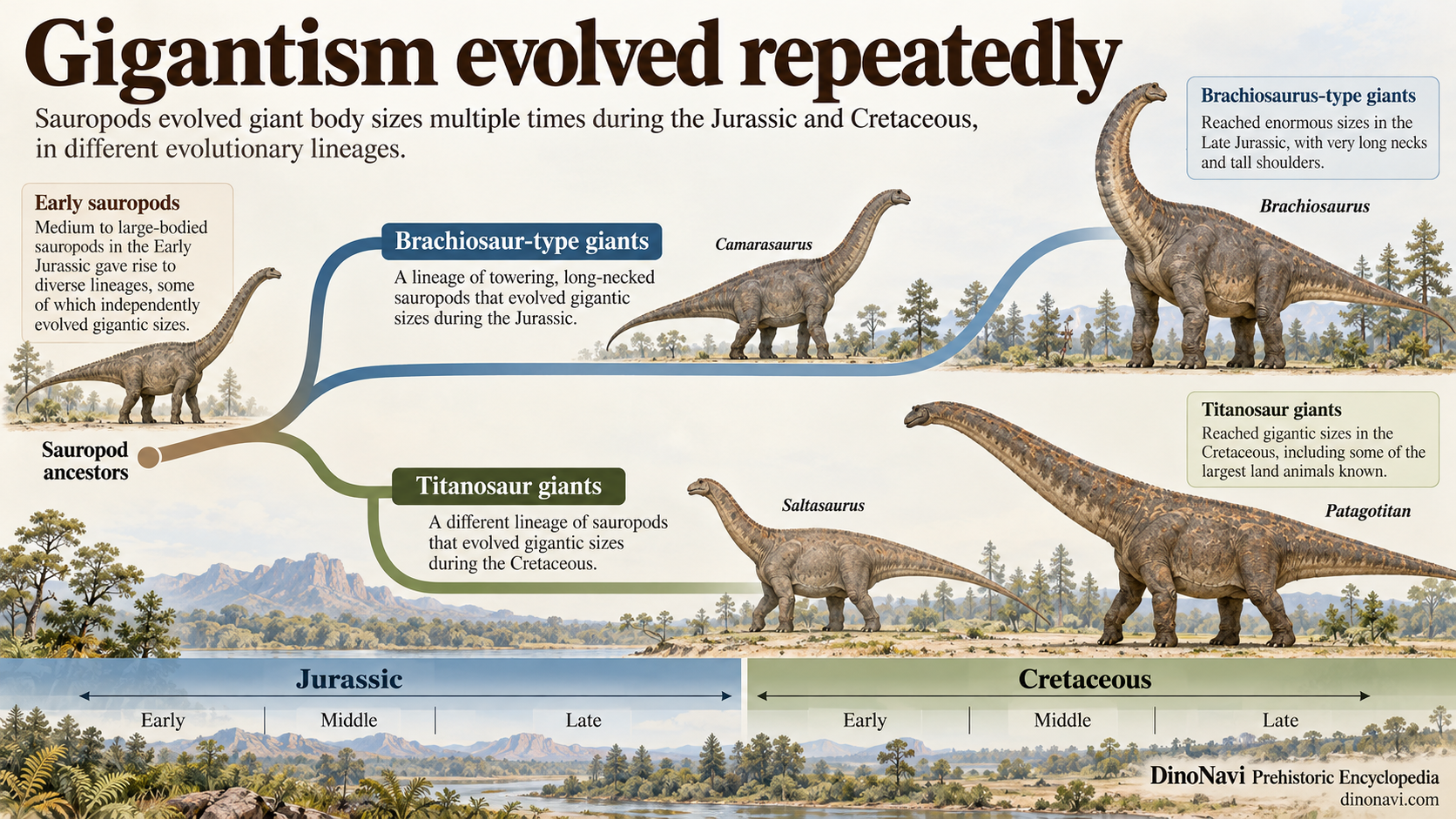
Timeline and branches showing gigantism appearing in more than one sauropod lineage; proximity on the graphic does not imply direct ancestry.
DinoNavi Prehistoric Encyclopedia · dinonavi.com
Reconstruction / infographic · Sekimosoft LLC / DinoNavi · AI-generated / code-authored explanatory images
AI imagined/schematic reconstruction,not documentary photographs of specimens,excavations or actual exhibits. Color,soft tissue and posture are uncertain. Enlarge to read labels. Conceptual comparison across eras/lineages,not contemporaneous coexistence or direct ancestry between the illustrated species.
Chapter 9. What If a Giant Dinosaur Walked Through Tokyo?
Imagine a 37.5-metre Patagotitan standing in a modern Tokyo street. A typical city bus is roughly 11–12 metres long, so the animal's nose-to-tail length would exceed three such buses. That does not mean it would tower above the Tokyo Tower, which rises to 333 metres. Height and horizontal length must not be confused. The most effective scene is not a fantasy creature that dwarfs a skyscraper. It is an accurately scaled giant occupying a familiar road beside signals, pedestrians, parked vehicles, and buildings. A recognisable environment makes its sheer size more surprising. Similar educational entertainment scenes could be set in Paris, New York, or beside the Egyptian pyramids. All must be labelled as imagined comparisons, not actual photographs or historical evidence.
Zoom then drag. Part names at150%, lines and descriptions at250%.
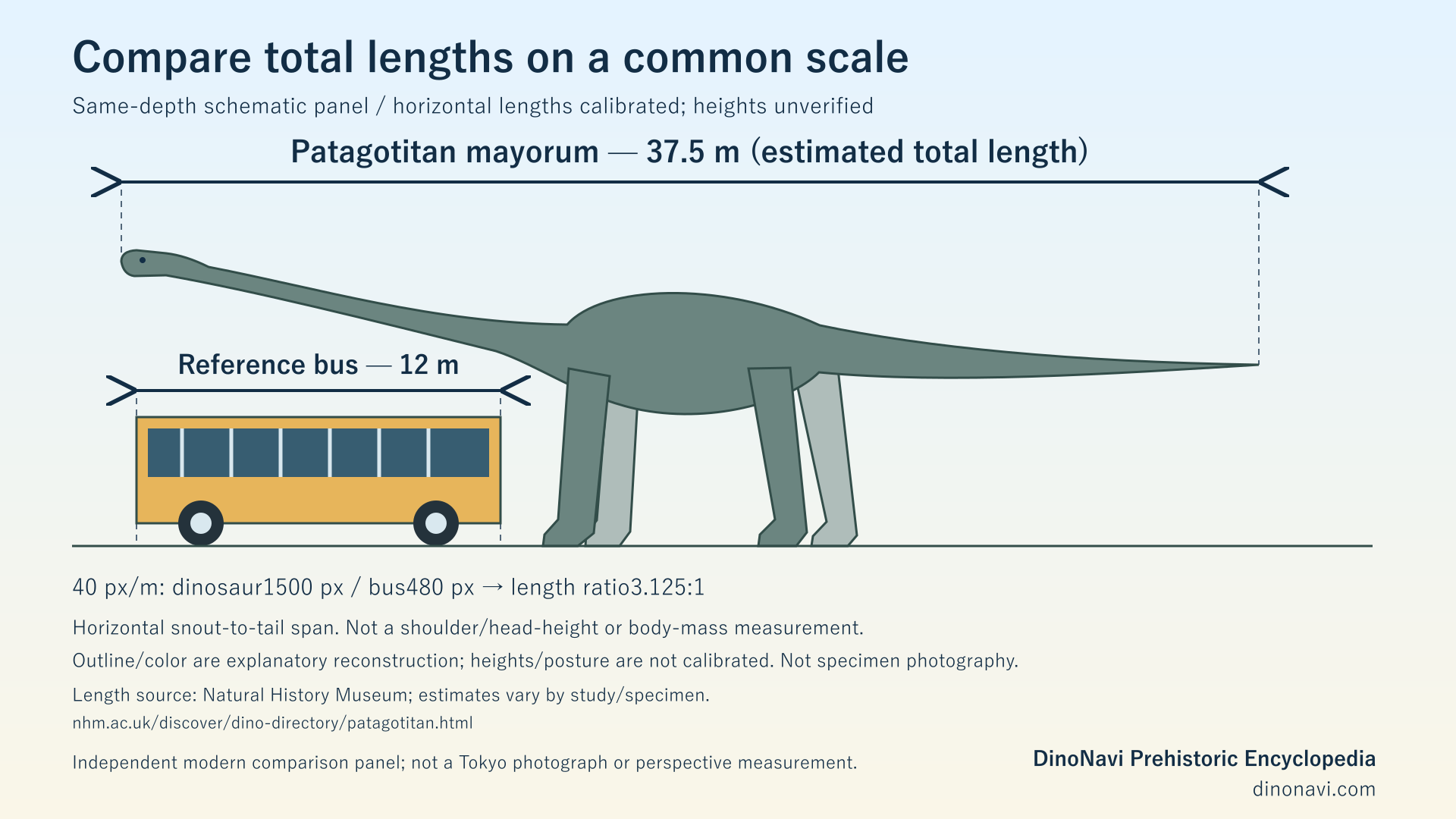
Independent length panel: estimated37.5m Patagotitan and a12m reference bus
DinoNavi Prehistoric Encyclopedia · dinonavi.com
Reconstruction / infographic · Sekimosoft LLC / DinoNavi · AI-generated / code-authored explanatory images
Only horizontal length is calibrated at40px/m:dinosaur1500px,bus480px. Outline,height,posture and color are illustrative,not measured shoulder height or Tokyo photography.
Image source
Chapter 10. Building Giants from Fossil Fragments
Paleontologists do not uncover completed dinosaur models. They find bones damaged by time, geology, weathering, and sometimes long journeys through sediment. Some exceptionally large dinosaurs are known from only a few vertebrae; others include parts of several individuals. Researchers record the fossil material, compare the bones with better-known relatives, infer missing pieces, and develop digital or physical reconstructions. Then they test how body proportions affect length, posture, and volume. Every step introduces questions that can be revised when new fossils are discovered. The most revealing museum exhibition is therefore not merely an impressive skeleton. It is one that shows what is original evidence, what has been reconstructed, and why different estimates persist.
Zoom then drag. Part names at150%, lines and descriptions at250%.
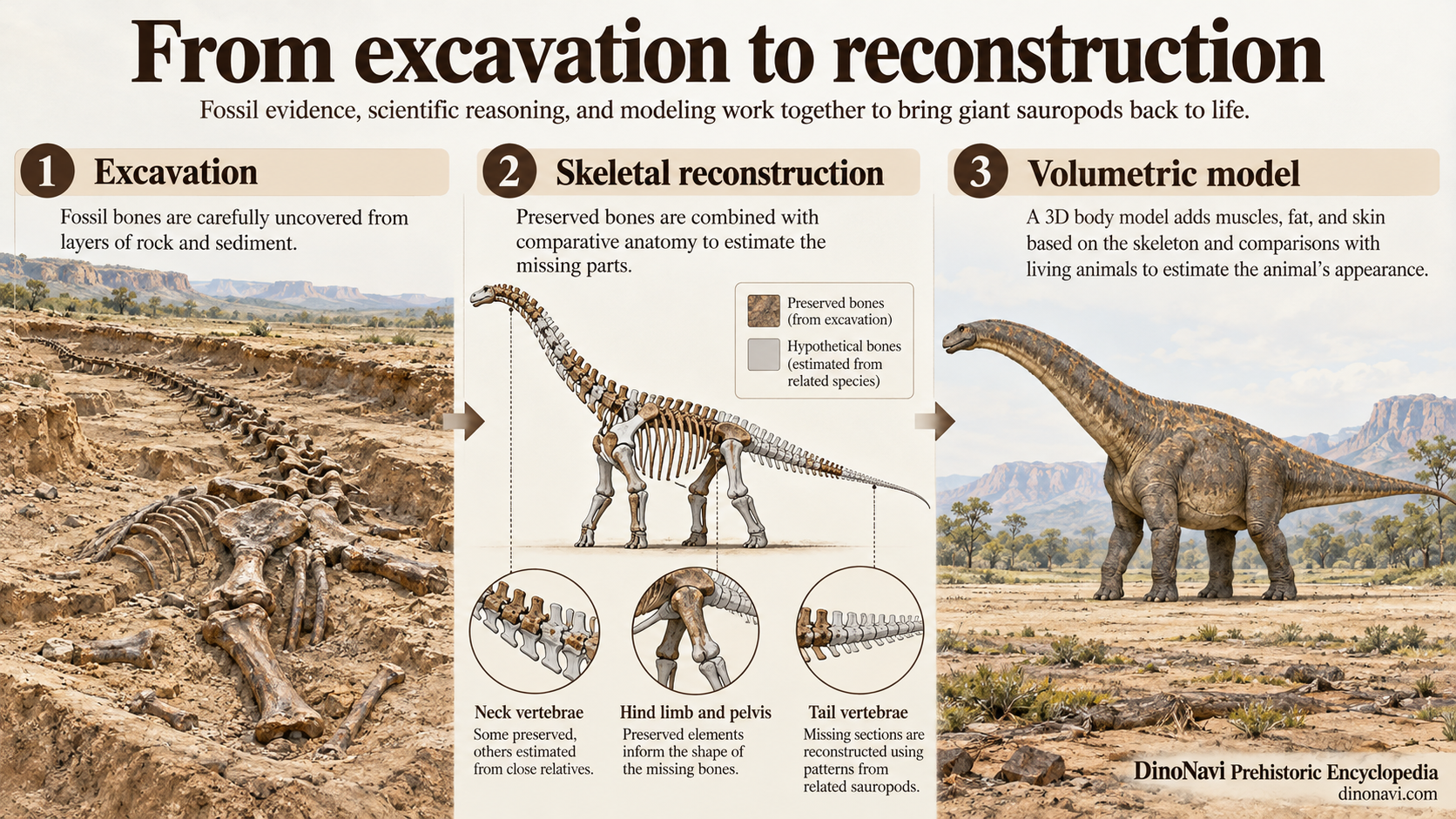
The scientific chain from excavation to skeletal restoration to an estimated body-volume model; conceptual, not a reproduction of a specific museum exhibit.
DinoNavi Prehistoric Encyclopedia · dinonavi.com
Reconstruction / infographic · Sekimosoft LLC / DinoNavi · AI-generated / code-authored explanatory images
AI imagined/schematic reconstruction,not documentary photographs of specimens,excavations or actual exhibits. Color,soft tissue and posture are uncertain. Enlarge to read labels. Bones,organs,air spaces,force arrows and estimation models are explanatory schematics,not mapped preserved bones or measurements of a particular specimen.
Conclusion: Bigger Than a Number
Patagotitan, Argentinosaurus, Dreadnoughtus and their relatives challenge our understanding of what terrestrial animals can be. But none should be reduced to a single number on a leaderboard. Length and mass answer different questions, and the quality of the fossil record shapes how confidently we can answer either one. With their long necks, immense bodies, specialized limbs, remarkable biology, and complex evolutionary history, sauropods represent an extraordinary experiment in the possibilities of life on land. When you next see a dinosaur-size infographic, pay attention to the word “estimated”. It is the beginning of a scientific story, not a disappointment. **Explore more:** The Life of Tyrannosaurus rex; Triceratops: Horns and Frill; Spinosaurus at the Water's Edge; Stegosaurus: Plates and Tail. **Illustration and science notice:** Prehistoric sizes are estimates that differ across sources. Modern-city images are imagined educational comparisons. © Sekimosoft LLC / DinoNavi.
References
- Natural History Museum (London), What was the biggest dinosaur? PENDING: supplied bibliography,claim correspondence not independently verified
- Sander et al. (2011), Biology of the sauropod dinosaurs: the evolution of gigantism, Biological Reviews 86:117–155. PENDING: supplied bibliography,claim correspondence not independently verified
- Field Museum, Máximo the Titanosaur. PENDING: supplied bibliography,claim correspondence not independently verified
- Natural History Museum (London), Patagotitan dinosaur directory. PENDING: supplied bibliography,claim correspondence not independently verified
Text and figures include AI-assisted creation/editing, reconstructions and schematics. Scientific inferences are not established facts. Full-text checks of some references remain incomplete.
Related encyclopedia entries
Related articles
The Life of Tyrannosaurus rex: From Tiny Hatchling to Giant Predator
Triceratops: The Mystery of Its Horns and Frill
Spinosaurus and Life at the Water’s Edge: Did the Sail-Backed Giant Really Swim?